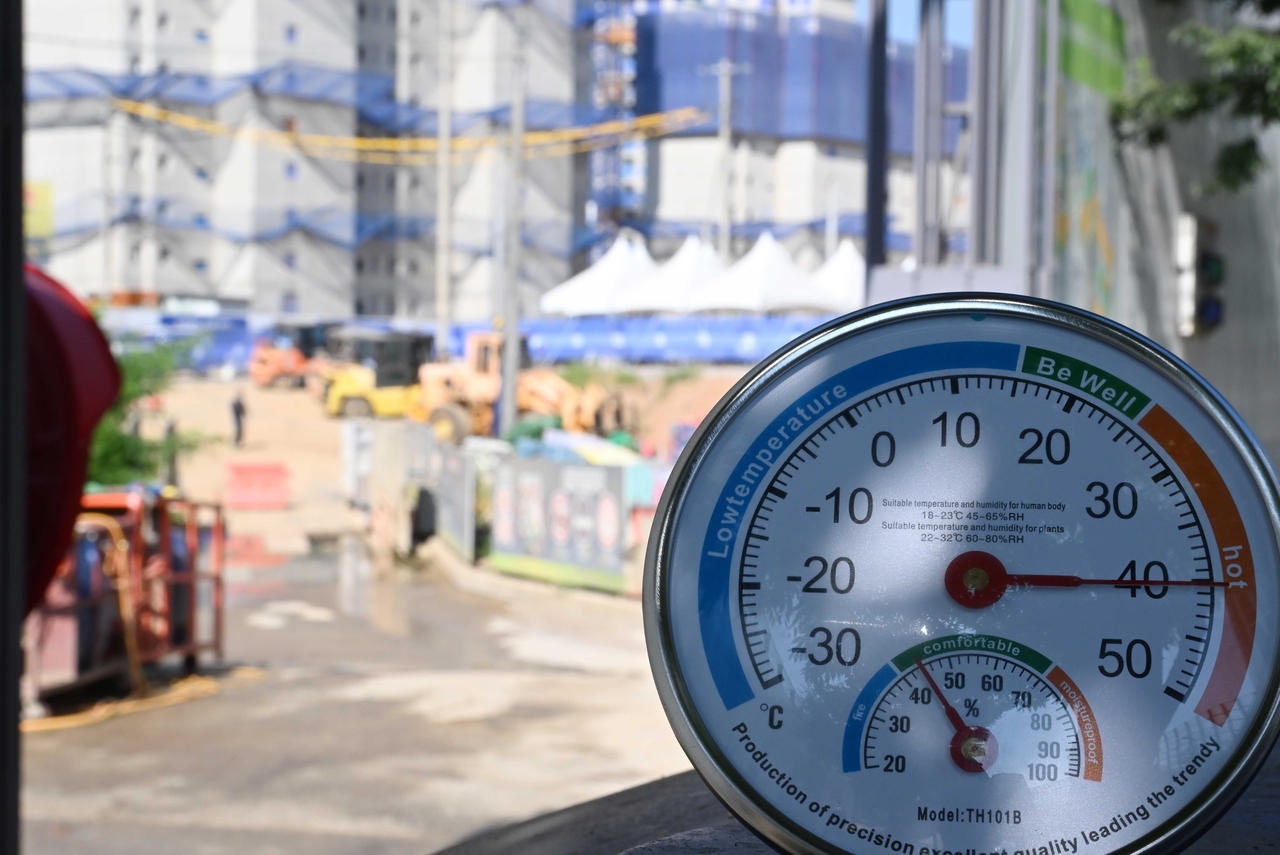
The Seoul Metropolitan Government is overhauling its "construction site safety allowance," a program that compensates daily-wage construction workers for lost income when extreme weather — including heat waves and heavy rain — forces work stoppages at public construction sites. The revamp scraps income eligibility requirements and standardizes the allowance rate so that more workers can receive support quickly and fairly.
The city announced Monday that it will substantially revise the criteria for paying the safety allowance starting this month, bringing the program in line with the realities of construction sites.
First, in keeping with the policy goal of stabilizing employment in the construction sector, the city is eliminating all income thresholds and extending eligibility to all daily-wage construction workers whose primary occupation is in the industry. The change removes a bottleneck under which strict criteria — including a living-wage ceiling — had limited the share of potentially eligible workers to just 7.1 percent, expanding the potential beneficiary pool to 46.4 percent, roughly 6.5 times the previous level. Removing the income verification and assessment process will also make the program easier to apply in the field.
The city is also standardizing the safety allowance rate — previously calculated on the basis of each worker's contractual wage — at 22,500 won ($16) per hour, ensuring consistency and fairness across worksites and job types while improving operational efficiency. The rate is derived from the prevailing wage for general laborers published in the Korea Federation of Construction Contractors' "Construction Industry Wage Survey," conducted under the Statistics Act. On days when extreme weather halts work, workers can receive support for up to four hours, with a daily maximum of 90,000 won.
The city also plans to run targeted outreach campaigns tailored to construction workers to help the revamped program take root smoothly. Information will be provided through the Construction Notification Service and the websites of contracting agencies, while posters and QR codes will be placed in areas frequently used by workers at construction sites so they can immediately check eligibility requirements and payment procedures.
Last year, Seoul became the first local government in the country to introduce the safety allowance, which guarantees a minimum level of wage compensation for daily-wage construction workers when extreme weather such as cold snaps or heat waves forces public construction sites to suspend operations.
"In an era of extreme climate, safely stopping work is not a choice but an obligation," said Kim Yong-hak, Seoul's director of construction technology policy. "By scrapping the income threshold and unifying the rate, we will lower the barriers at the worksite, and through intensive outreach we will increase the number of workers who actually benefit — firmly establishing both livelihood stability and a culture of safety for daily-wage construction workers."
ikson@heraldcorp.com