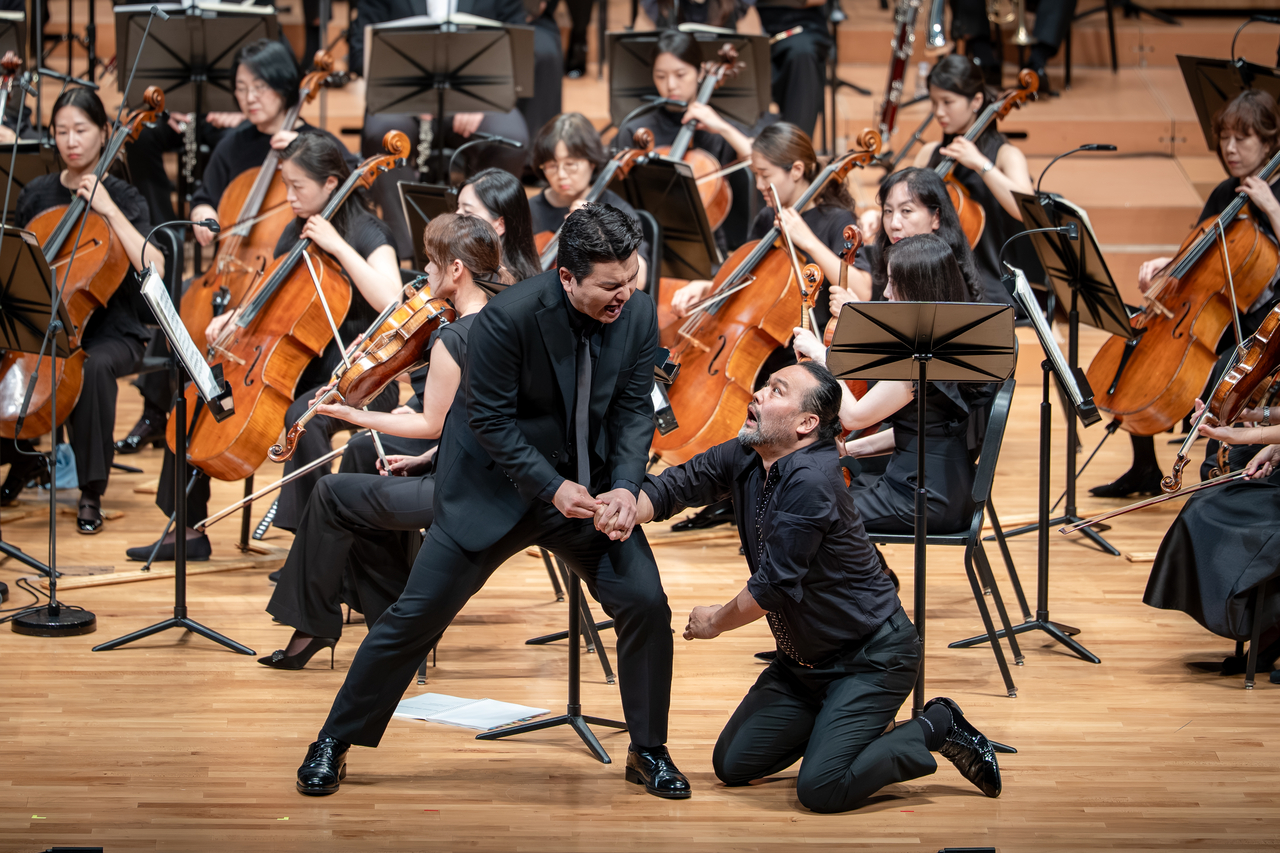
An insufferably arrogant ruler strolls onstage, hands thrust into his pockets. His path is nothing less than an emperor's walk. Bass-baritone Samuel Youn, playing Alberich — the dwarf king whose eyes radiate contempt for the world and whose voice brims with sinister desire — transforms Seoul Arts Center into Nibelheim in an instant. The authority of a Kammersänger seizes the stage without a moment's hesitation.
Act I of "Das Rheingold," scene three. In Nibelheim, Alberich tests the Tarnhelm, a magic helm of transformation and concealment. Loge, the cunning god of fire, gently pricks the vanity of Alberich, who has seized the all-powerful ring and stands at the pinnacle of power. "Can you not shrink even smaller — small enough to hide in the tiniest crack?" Alberich intones the incantation with swaggering confidence.
"Become a crouching, crawling gray toad!"
At that moment, Youn pulled a gray costume over himself and flattened to the stage floor. Wotan, king of the gods, seized the opening and wrested both Alberich and the ring away. The boastful dwarf, drunk on his own power, had walked straight into a trap and lost everything. Warm laughter rippled through the audience — though there was little time to savor it. Stripped of the ring, Alberich shed all his desire and cried out, "Am I now free?" The line carries the truth that whoever holds the ring becomes a slave to power, yet what rang out was not liberation but a tangle of rage and desolation.
Richard Wagner's (1813–1883) monumental four-part cycle "Der Ring des Nibelungen" — some 15 hours in full, excluding intermissions — came to the stage in a 205-minute highlight version, also excluding intermissions. It marks the 150th anniversary of the cycle's complete world premiere.
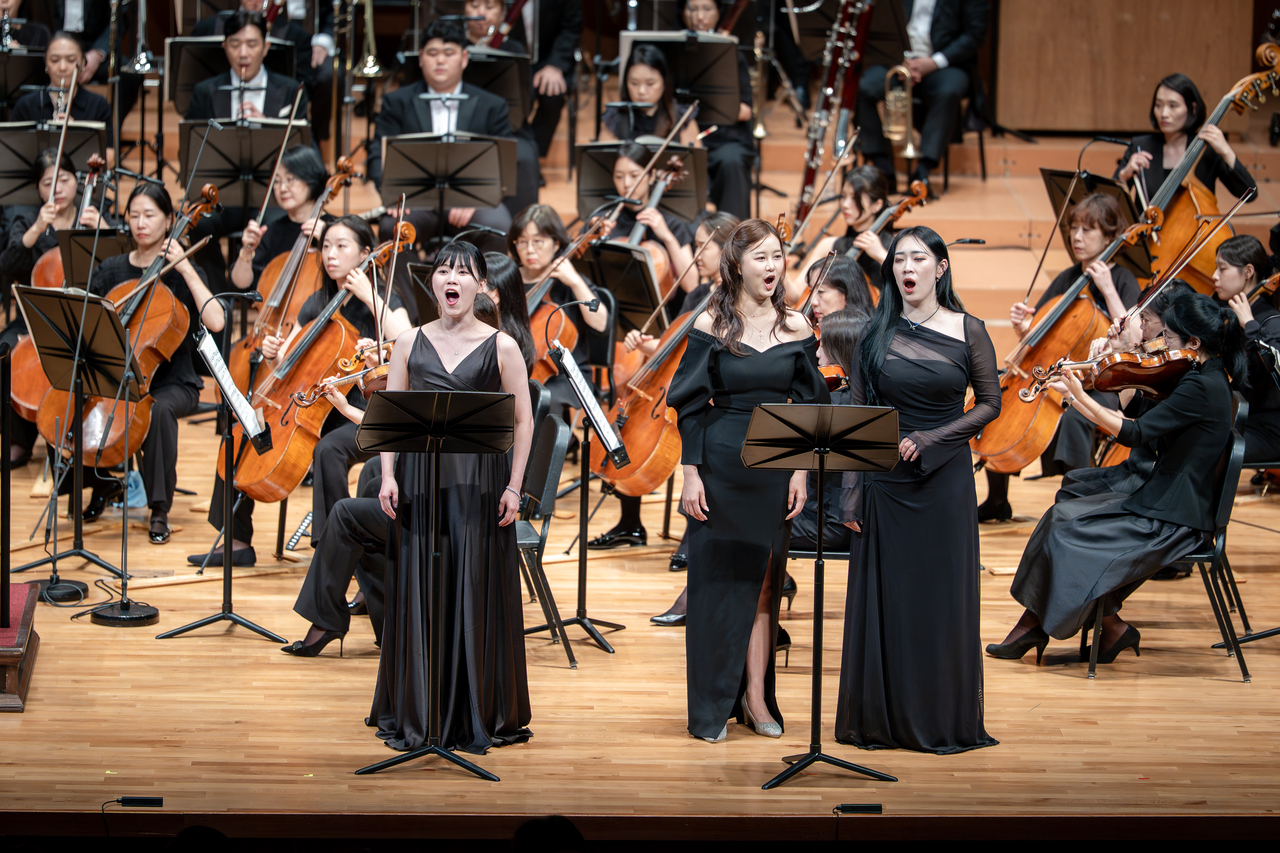
"Der Ring des Nibelungen" is a blockbuster opera. Staging this work — which shares its mythological roots with the "Lord of the Rings" films and draws on Nordic and Germanic legend — is no small undertaking. The Korean production took the form of a concert opera highlight, yet its scale was immediately overwhelming. Four harps, eight double basses and the full 115-member Bucheon Philharmonic Orchestra, led by principal conductor Adrien Perruchon, joined 16 of Korea's most celebrated vocal soloists — among them Samuel Youn, Kim Ki-hun, Kim Jae-hyeong, Kim Seung-jik, Lee Myeong-ju, Park Seung-ju and Jeon Tae-hyeon — to throw open the gates of a mythic world.
A libretto written in reverse: Wagner's universe compressed into 205 minutes
The stage was crowded with performers on a near-epic scale, yet it held almost no physical scenery. Unlike the current trend of packing even concert-opera formats with elaborate costumes and lighting, the production filled the stage with nothing but the 115-piece orchestra, the conductor and music stands before "Das Rheingold" began.
Wagner spent 26 years composing the cycle, from 1848 to 1874, and his working method was remarkable. He did not conceive the four parts in order from the outset; instead he started with "Siegfried's Death," the precursor to the final installment, "Götterdämmerung." As he wrote the libretto, he realized that earlier events were needed to make the story intelligible, and so he worked backward — to "Young Siegfried," then "Die Walküre," then "Das Rheingold." The text moved ever further into the past, writing prequel upon prequel to uncover the story's origins, while the music was arranged to follow the narrative in forward sequence.
The highlight version trimmed each of the four parts to roughly 50 to 60 minutes: "Das Rheingold" and "Die Walküre" at 50 minutes each, "Siegfried" at 45 and "Götterdämmerung" at 60. The opera's central premise is straightforward: whoever renounces love, wins the gold, forges it into a ring and gains the power to rule the world.
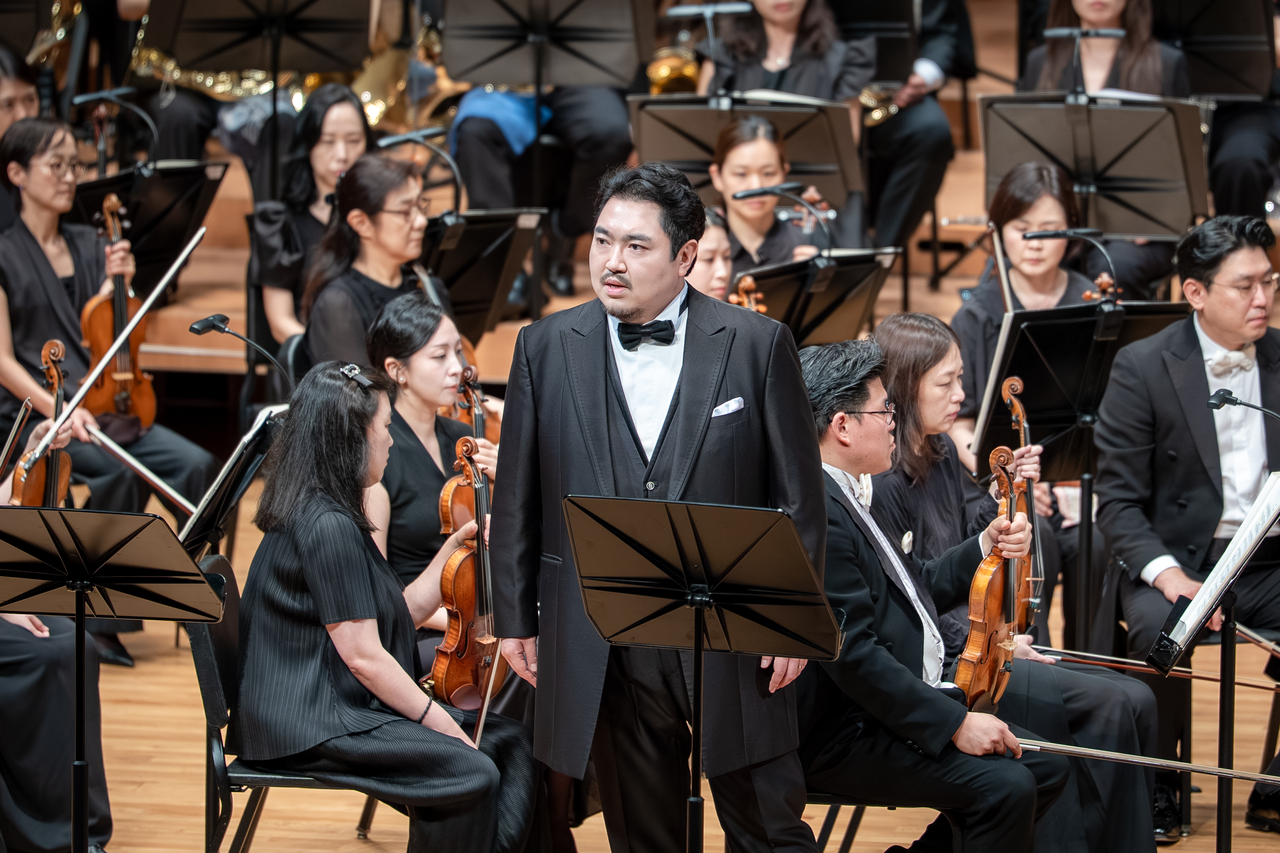
The roughly 200-minute compressed narrative was shrewdly constructed. This was no "Best of Wagner" — a string of popular arias plucked from across the four parts. Part one traced the birth of power and the first signs of its coming ruin; part two turned to human love and sacrifice; part three followed the birth of a hero with free will; and part four brought the hero's death and the fall of the gods. The result was a distillation that cut to the heart of Wagner's philosophical vision: the greed for power destroying the world, and pure love and self-sacrifice redeeming it. Narrative supertitles projected from the concert hall's choral gallery filled in the gaps between scenes.
The greatest challenge in condensing 15 hours of opera was preserving the chronological order of events and the pivotal scenes. Conductor Perruchon said he aimed to ensure that "scene transitions would not feel unnatural, so that the whole could be understood as one vast narrative." Above all, the production preserved the leitmotifs — the recurring melodic themes that identify specific characters, objects and ideas throughout the opera and music drama.
The orchestra slowly layered arpeggios over a long E-flat major chord to paint the primordial river of the Rhine, a world not yet touched by desire or contract, the moment of creation itself. Then, the instant Alberich loses the ring, the so-called "devil's interval" — the augmented fourth, or tritone — and harsh dissonance erupt, casting their shadow over the entire cycle. "Das Rheingold" functions as the musical birth certificate of the whole "Ring": the world is born, and the music immediately tells us how unstable that world is.
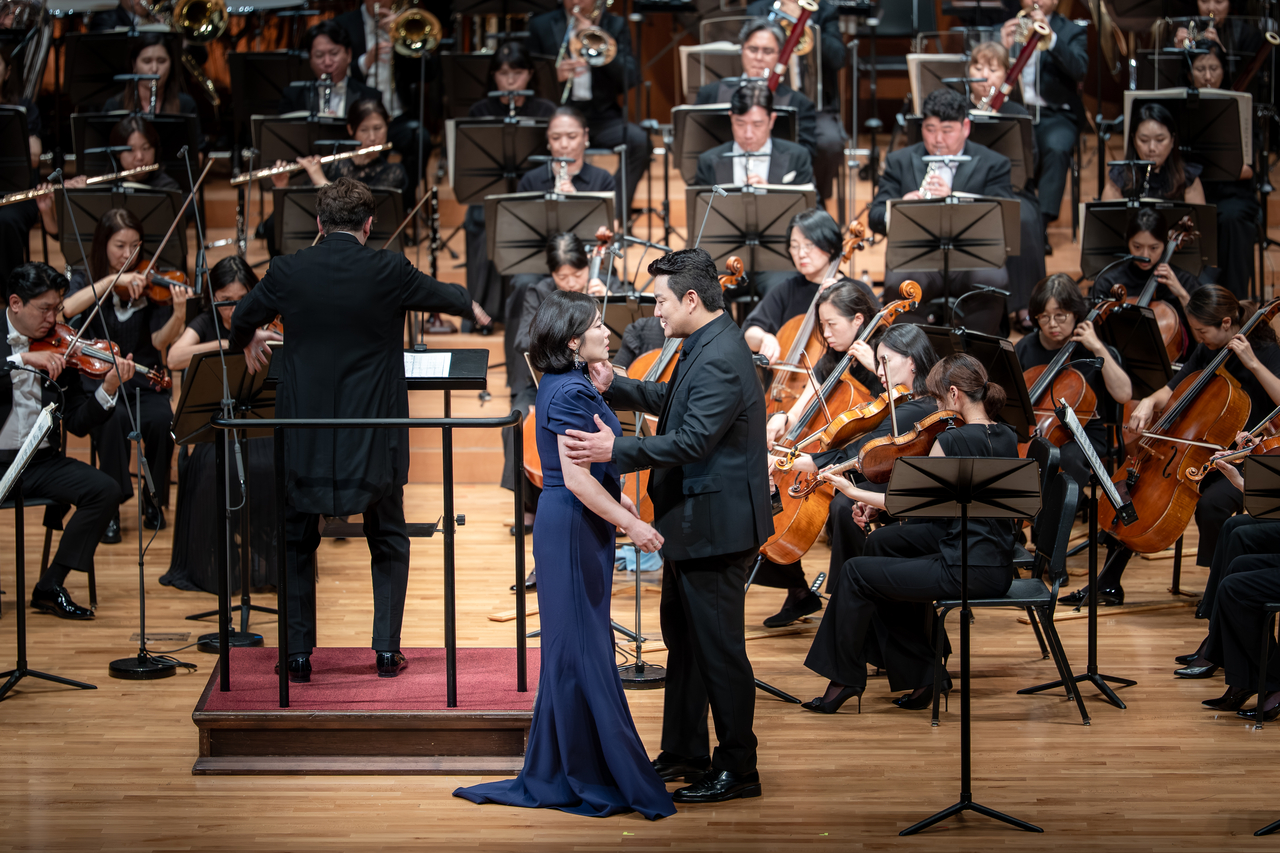
As part two, "Die Walküre," unfolds, the mythic realm descends into the human world. The love between Siegmund and Sieglinde is rendered in lyrical, warm melodies shared by orchestra and voice. The brass and strings then explode into the "Ride of the Valkyries," a stark contrast that unleashes a world of war and death. In part three, "Siegfried," the hammering of the forge and the rhythm of the percussion elevate human labor into music. Siegfried's act of reforging the shattered sword Nothung with his own hands expresses the will to shape one's own destiny, and the percussion and blazing brass announce the birth of a hero.
In part four, "Götterdämmerung," low woodwinds and dark strings build Hagen's monodrama — Hagen being the son of Alberich — while Siegfried's funeral march weaves the cycle's major leitmotifs into a vast orchestral tapestry. At the end, Brünnhilde's self-sacrifice brings down a world steeped in curse and desire, and the dissonance that has run through the entire work is purified in the light of D-flat major — a suggestion that redemption awaits at the far end of destruction, and that a new world is about to begin.
The lineage of desire led by Samuel Youn: Korean vocal artists' commanding energy
Staging "Der Ring des Nibelungen" in Korea is difficult precisely because assembling a dream team capable of doing full justice to the opera is so hard. The greatest significance of this highlight version lay in the fact that it was, conductor aside, an almost entirely Korean production — both orchestra and soloists.
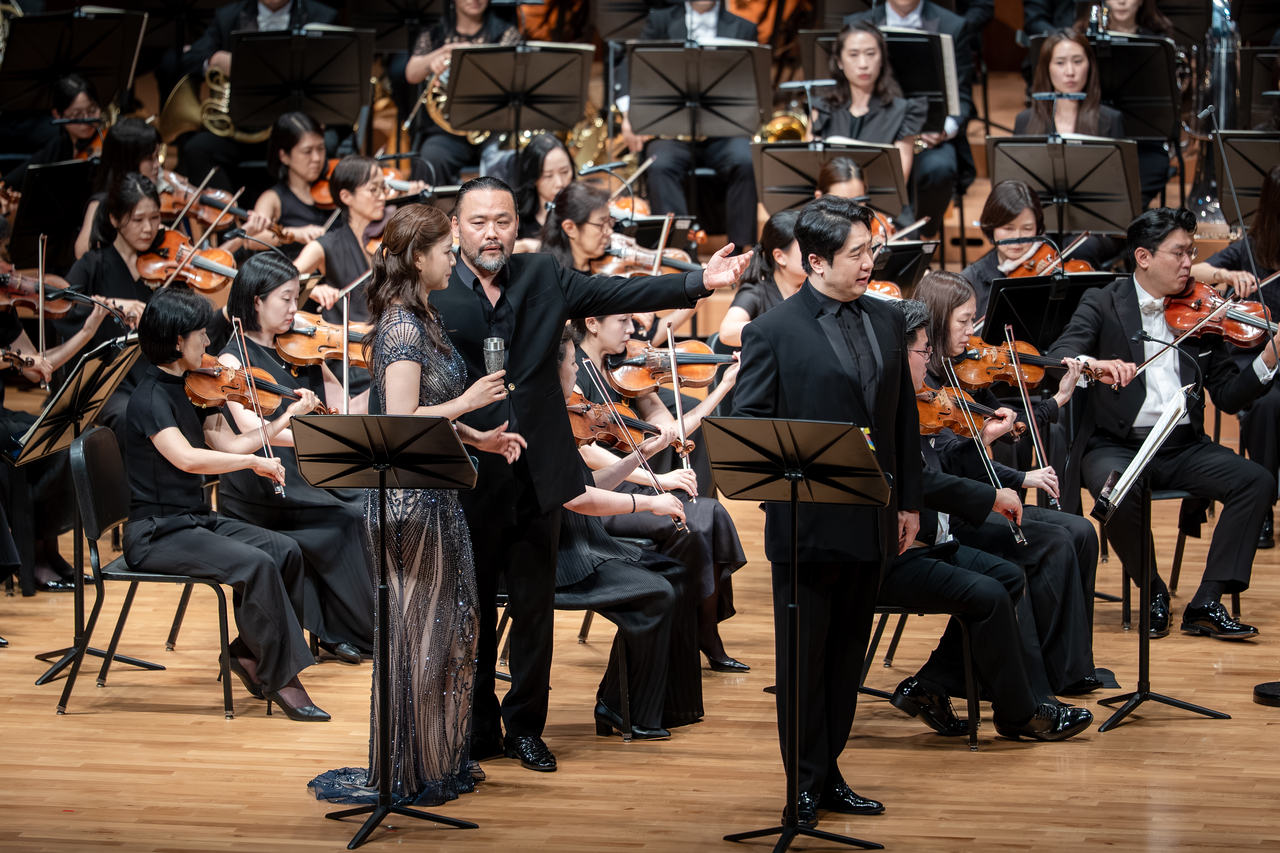
For this Korean "Ring," a roster of vocalists whose names alone inspire confidence assembled in force. Bass-baritone Samuel Youn led the charge, joined by a wave of principal singers who have commanded stages at opera houses across Europe. With such a distinguished cast in place, each role took on intriguing connections to the others.
Through Youn, a continuous lineage of desire ran through the entire "Ring" world. He took on both Alberich, the first holder of the ring, and Alberich's son Hagen, giving full bloom to the production's villainous core. Baritone Kim Ki-hun, who has appeared at Salzburg and Berlin as Donner, made a bold double-casting gamble by also playing Gunther. Tenor Kim Jae-hyeong took the role of Siegfried, Choi In-sik played Wotan and the Wanderer, and Lee Myeong-ju portrayed Brünnhilde.
The lower male voices were simply commanding. Youn was, in effect, a second director guiding the entire cast onstage. He was already in character before he made his entrance — hands shoved into his trouser pockets, a physical thread linking father Alberich to son Hagen. He sang with eyes burning with desire and a crooked set to his mouth, method acting woven into every note. As the villain who sets events in motion, he became the powerful energy that wound the spring of the 205-minute production, serving as its musical anchor by sheer force of presence. The performance confirmed, once again, the stature of a singer who has been a leading figure at the Bayreuth Festival — Wagner's sacred ground — and who holds the Kammersänger title, awarded in the German-speaking world only to singers of exceptional distinction.
Equally memorable was the moment Kim Ki-hun, as Donner, the god of thunder, strode onstage with his hammer and bellowed "Heda Heda Hedo!" — a scene he had performed with the Berlin Philharmonic at the Salzburg Easter Festival and in Berlin earlier this spring, now recreated here. Playing Donner, Kim produced a sound cleaner and more resonant than the brass themselves, conjuring the voice of thunder.
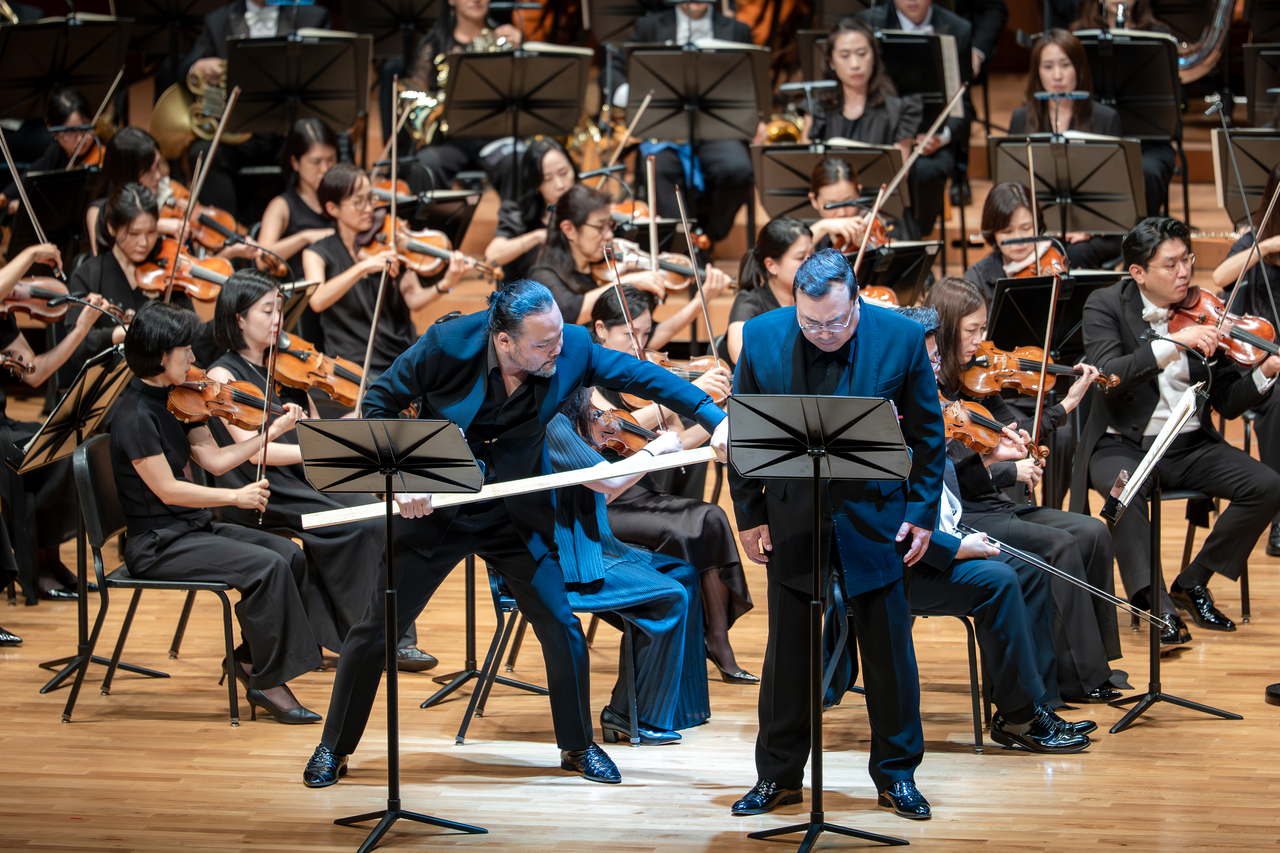
In part four, "Götterdämmerung," as Gunther (Kim Ki-hun), Gutrune (Kim Ji-won) and Hagen (Samuel Youn) turned their heads to gaze into the distance, the image of Siegfried approaching along the Rhine, sounding his horn, seemed almost visible to the eye. At that moment, the horn player walked in from backstage having finished playing offstage, and a ripple of gentle laughter passed through the absorbed audience.
Baritone Choi In-sik, a resident soloist at the Cologne Opera, held the audience with a Wotan that moved between divine authority and a father's tender anguish for his daughter Brünnhilde. Tenor Kim Seung-jik, as Siegmund, drew out the role's lyrical quality with a clear, pure tone. Kim Jae-hyeong's Siegfried was delivered with a straight, unwavering sound that left no gaps. Mezzo-soprano Jeong Ju-yeon, moving between the Rhinemaidens and Erda, and soprano Kim Eun-hui, as a Sieglinde certain in her love, both steered the drama with assurance. Lee Myeong-ju created a Brünnhilde who was firm, powerful and deeply compelling.
What erased the limitations of a concert opera stripped of all stage machinery was the work of Youn, Kim Ki-hun and Lee Myeong-ju, each of whom built their character from Wagner's vast world using only body and voice. While these three committed fully on a stage where every gesture counted, some of the other singers kept their eyes fixed on their scores even when a partner turned to look at them — a stark contrast to those who pushed their music stands aside to carve out space for acting. The Bucheon Philharmonic's determined effort was evident throughout, though errors in the brass and certain other sections were audible.
Even so, the "Ring" highlight was a production whose strengths outweighed its weaknesses. The enormous scale and labyrinthine web of characters that normally require several evenings to unfold were compressed with remarkable density into 205 minutes. Generous narration made it easy for even first-time listeners to become quickly absorbed, and the performances of Youn and Choi In-sik — as Wotan and the Wanderer, the narrative connective tissue of the cycle — made the drama readily intelligible.
It was not a "perfect" Ring, but the production threw the door to the "Ring" wide open. Before experiencing all 15 hours of the great cycle, this stands as an ideal introduction — a signpost pointing toward a magnificent world. The production continues Saturday at Bucheon Arts Center.
shee@heraldcorp.com