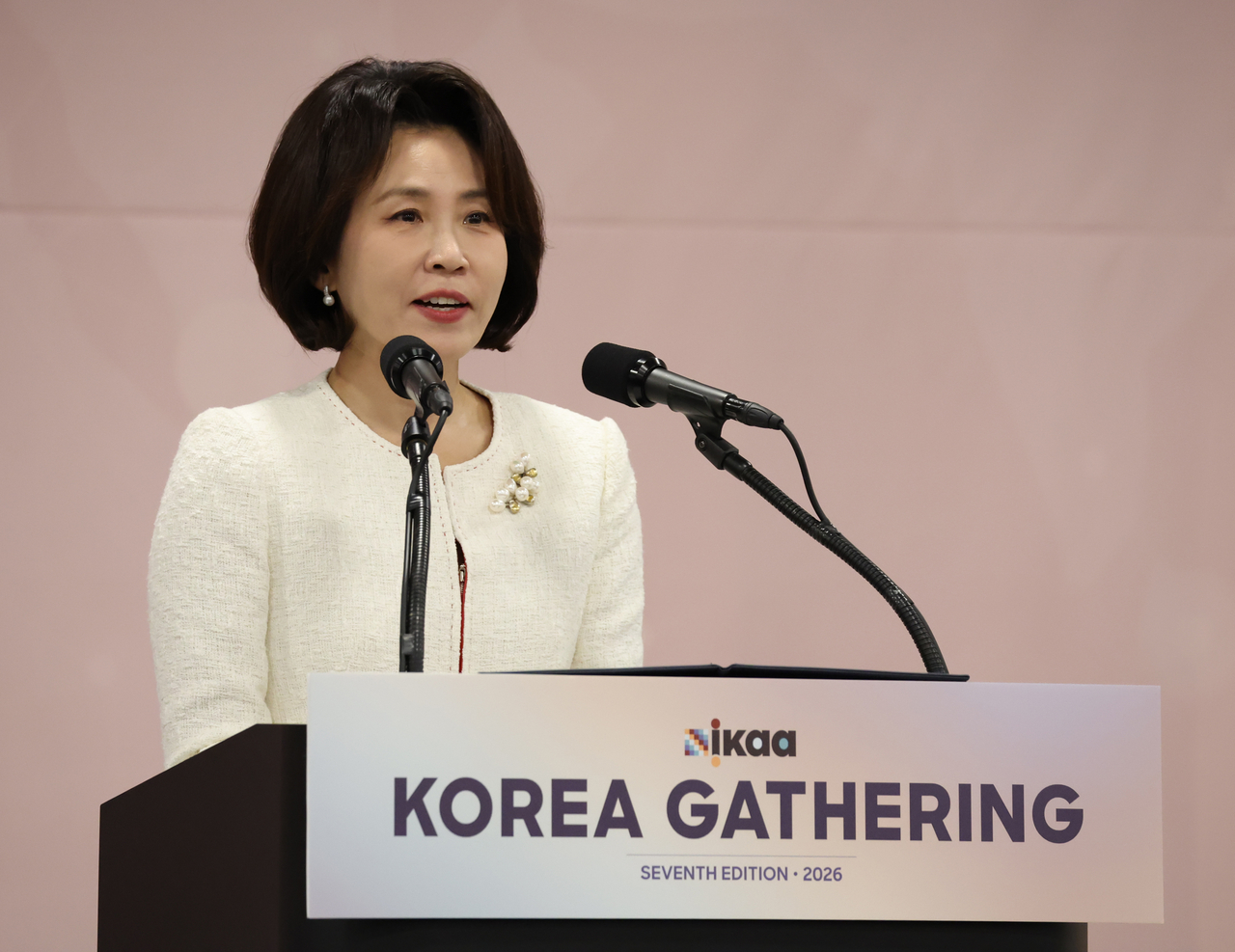
![People Power Party leader Jang Dong-hyeok speaks at the first meeting of the Elected Official Evaluation and Innovation Task Force at the National Assembly on July 28. [Yonhap]](https://wimg.heraldcorp.com/news/cms/2026/08/11/rcv.YNA.20260728.PYH2026072809320001300_P1.jpg)
The People Power Party is failing to gain meaningful ground even as approval ratings for President Lee Jae Myung and the Democratic Party of Korea slide. Despite mounting public backlash over the government's real estate and stock market policies and controversy surrounding the Democratic Party's push to abolish prosecutors' supplementary investigative powers, the PPP's own support has remained flat. Party leader Jang Dong-hyeok is banking on a reform package built around the concept of a "member-driven party" to turn the tide.
The PPP held the second meeting of its Elected Official Evaluation and Innovation Task Force at the National Assembly on Tuesday, beginning work on establishing evaluation criteria. The TF is developing an assessment framework for sitting Assembly members and PPP-affiliated provincial governors that will factor in party duties, legislative activity, contributions to the party and past achievements. Criteria for evaluating the party leader and floor leader are also under discussion, according to people familiar with the matter.
Jang has said he intends to give party members a meaningful voice in the evaluation process. At the TF's inaugural meeting on July 28, he said members' opinions "must be given significant weight in evaluating elected officials in some form," adding that "this is the path to becoming a member-driven party, and a member-driven party is the first step toward becoming a party of the people."
The "member-driven party" principle is also expected to serve as the centerpiece of a broader reform plan Jang plans to unveil soon. The announcement had originally been expected around Liberation Day, but the schedule has shifted to Aug. 26 — the first anniversary of Jang's election as party leader. Political observers see the adjustment as a practical accommodation of the Liberation Day holiday, the Democratic Party's national convention and the PPP's own retreat scheduled for Aug. 27-28. Park Chung-kwon, the party's chief spokesperson, said Jang "intends to meet with various lawmakers to gather their views."
The leadership is expected to accelerate the party's organizational overhaul once the reform plan is released. The PPP's supreme council approved appointments to its Special Committee on Organizational Strengthening on Monday. In keeping with convention, Secretary-General Jeong Hee-yong will chair the committee, with two-term lawmaker Gu Ja-geun serving as vice chair. Kang Myeong-gu, deputy chief for organization, and Seo Cheon-ho, deputy chief for strategic planning, will serve as ex-officio members.
The committee plans to begin selecting district chapter chairs, focusing first on chapters that have fallen vacant. The effort carries the clear hallmarks of a regional organizational overhaul aimed at the next general election. The dual push — reforming the elected-official evaluation system while restructuring local chapters — appears designed to tighten internal discipline and strengthen the party's organizational capacity.
Broadening the party's appeal, however, remains an unresolved challenge. Public anger over the government's real estate and stock market policies has grown, and the Democratic Party has also seen its ratings dip amid the controversy over abolishing prosecutors' supplementary investigative powers — yet the PPP has been unable to translate either development into a clear uptick in support.
A Realmeter survey conducted Aug. 3-7 among 2,514 adults aged 18 and older nationwide, commissioned by Energy Economy News, found that President Lee's job approval rating fell 2.6 percentage points from the previous week to 43.3 percent — a fourth consecutive weekly decline and the lowest since he took office.
A separate party approval survey conducted Aug. 6-7 among 1,007 adults aged 18 and older nationwide showed the Democratic Party at 44.6 percent and the PPP at 37.6 percent. The Democratic Party slipped 0.5 percentage point from the previous poll, while the PPP fell 0.1 percentage point. Even as the ruling camp's ratings wobbled, the PPP's support essentially held flat.
Realmeter said of the PPP that "conservative voters in Seoul, Daegu and North Gyeongsang Province rallied behind the party's offensive over the government's tax reform proposal and the revision to the Criminal Procedure Act, but internal disciplinary disputes and damaging gaffes by the leadership offset those gains, leaving support stagnant."
Both surveys were conducted via automated response on mobile phones. The presidential job approval poll carries a margin of error of plus or minus 2.0 percentage points at the 95 percent confidence level, with a response rate of 4 percent. The party approval poll carries a margin of error of plus or minus 3.1 percentage points at the 95 percent confidence level, with a response rate of 3.4 percent. Further details are available on the National Election Survey Deliberation Commission website.
mp1256@heraldcorp.com