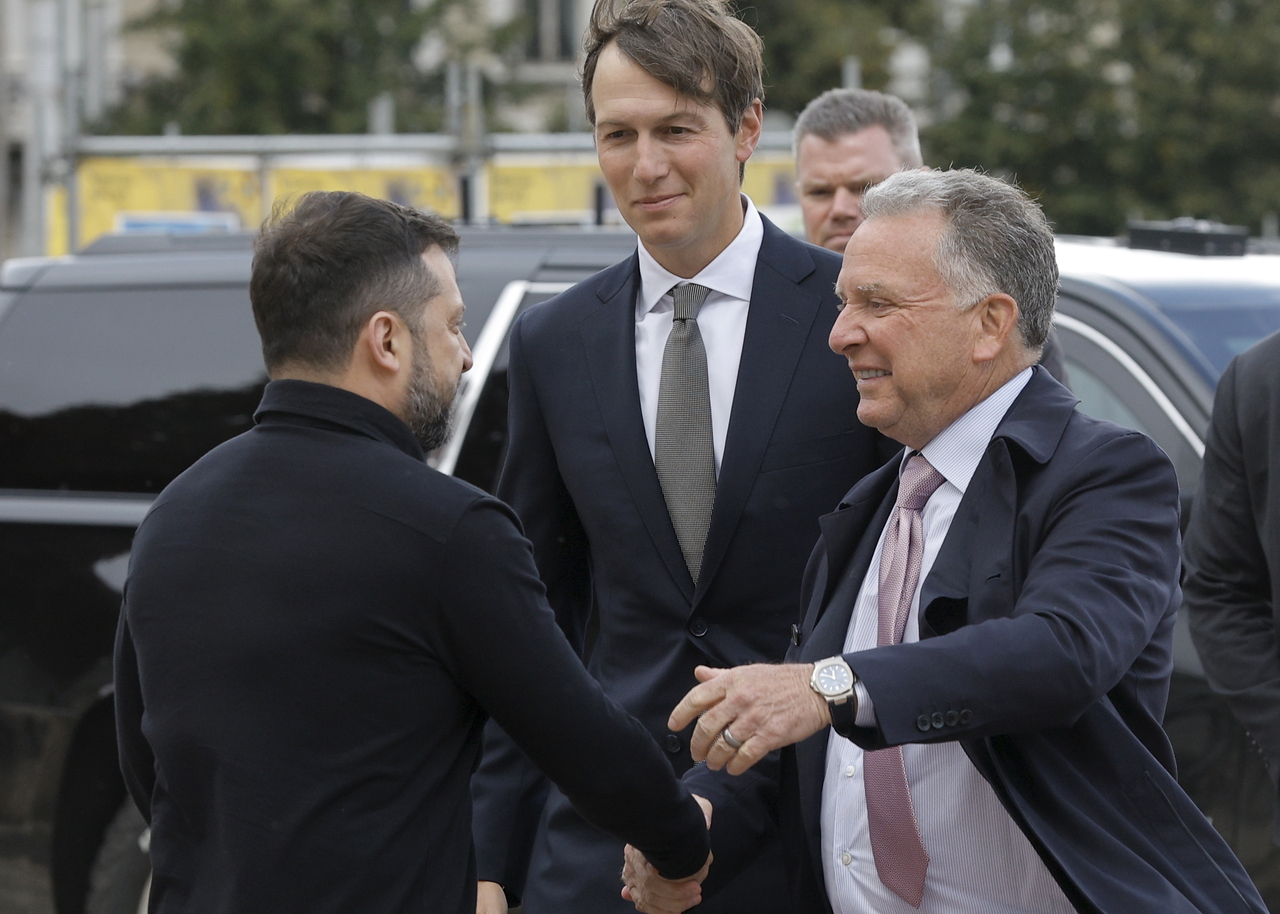
![Joint Chiefs of Staff Chairman Jin Yeong-seung (left) and Air Force Chief of Staff Son Seok-rak speak at Cheong Wa Dae on Monday during the second joint public-private inspection meeting on mega-projects, chaired by President Lee Jae Myung. [Cheong Wa Dae press pool]](https://wimg.heraldcorp.com/news/cms/2026/08/11/news-p.v1.20260811.3c5daaf0acca472ba925c69975c71454_P1.jpg)
The Ministry of National Defense has decided to relocate the Air Force functions of Gwangju Air Base — designated as the site for the Honam semiconductor cluster — to other bases by mid-2028. Observers say the timeline for returning land currently provided to USFK will be a critical variable.
"We will work closely with the Ministry of Foreign Affairs and the National Security Office to consult with the US side on securing the prompt return of the USFK-provided land," the Defense Ministry said Tuesday.
Within Gwangju Air Base, the area exclusively used by US forces covers 739,200 square meters, while jointly used facilities including runways account for 957,000 square meters. Together, the combined 1.7 million square meters represent more than 20 percent of the total developable area of 8.18 million square meters.
Gwangju is one of five South Korea-US combined air base operations (COB) in the country and serves as a key hub for US air power deployment in contingencies. Under the Status of Forces Agreement (SOFA), the land has been provided to the US side, meaning the South Korean government cannot unilaterally use it.
Existing consultations between the two militaries have proceeded on the assumption that replacement facilities would be built in Muan and functions transferred by September 2033. Since the government aims to begin using the site for a semiconductor industrial complex by 2028, the schedule would need to be moved up by more than five years.
The US 7th Air Force recently stated that it "has significant military interests at Gwangju Air Base and will continue close cooperation."
The Defense Ministry's explicit use of the phrase "return of provided land" signals that the process will go beyond simply adjusting Gwangju's COB status — procedures to physically reclaim the land and facilities currently used by US forces will proceed in parallel.
![A fighter jet from the 1st Fighter Wing prepares for takeoff at Gwangju Air Base. [Yonhap]](https://wimg.heraldcorp.com/news/cms/2026/08/11/news-p.v1.20260811.7263c04b72ae45a7ad377d175d24fdb9_P1.jpg)
The Defense Ministry's plan follows a directive issued by President Lee Jae Myung at the second joint public-private inspection meeting on mega-projects, which he chaired at Cheong Wa Dae on Monday.
"I would like the Defense Ministry to temporarily relocate Gwangju Air Base functions to another military air base by mid-2028, so that the air base site can be put to use as a semiconductor industrial complex at the earliest possible time," Lee said at the meeting.
On the Honam semiconductor cluster, Lee said he wanted it "executed swiftly, at a pace no slower than Kumamoto in Japan," adding that the situation called for "not just a speed campaign but a blitzkrieg." TSMC's Kumamoto factory took 22 months from the announcement of construction plans in October 2021 to its completion in January 2024.
![A trainer jet from the 1st Fighter Wing prepares for takeoff at Gwangju Air Base. [Yonhap]](https://wimg.heraldcorp.com/news/cms/2026/08/11/news-p.v1.20260811.2dc5779fae344ec19df31bd3c444d618_P1.jpg)
Alongside this, the Defense Ministry said it would "push ahead promptly with the Muan military airport relocation project in consultation with the South Jeolla Province-Gwangju Special City and other relevant parties." The ministry made clear that the temporary dispersal is a bridging measure until the final relocation to Muan is complete, not a replacement for it.
Gwangju Air Base is home to the Air Force's 1st Fighter Wing, which carries out advanced flight training to develop combat pilots and conducts air defense missions over the southwestern airspace. The base is equipped with T-50 advanced trainer jets and the domestically developed TA-50 light attack aircraft.
Internal military reviews had previously concluded that dispersing the 1st Fighter Wing's functions would require at least three years, but the timeline is now expected to be shortened by more than a year.
The military is reportedly considering distributing the wing's three subordinate flight squadrons across three separate wings: the 16th Fighter Wing in Yecheon, the 20th Fighter Wing in Seosan and the 19th Fighter Wing in Chungju.
![Trainer jets from the 1st Fighter Wing fly over the Gwangju Air Base area. [Yonhap]](https://wimg.heraldcorp.com/news/cms/2026/08/11/news-p.v1.20260811.c8aaf7dc0fe54c2e9c7fcd613c690103_P1.jpg)
On the budget front, how quickly the costs of unit relocation and facility expansion can be reflected in next year's budget process will be a key factor, given that the Defense Ministry has moved up the temporary dispersal deadline.
Analysts have noted that relocating pilot-training infrastructure on the scale of the 1st Fighter Wing would require at least a year and a half and hundreds of billions of won. Given the government's push for speed, related funding is expected to be treated as a priority.
The relocation of the Air Force ammunition depot in Mareuk-dong has already drawn 268.1 billion won ($189 million), with land compensation and foundational construction largely complete, meaning much of the groundwork needed for the semiconductor complex is well advanced. The government is reviewing ways to efficiently reorganize these assets in line with its plans for the semiconductor industrial complex.
Because the T-50 advanced trainer education system requires the simultaneous transfer of instructors, maintenance personnel, simulators, air traffic control and communications facilities, and housing, finalizing the Air Force's detailed plan on which base takes on which function will be central to the temporary dispersal effort.
Defense Ministry spokesperson Jeong Bit-na, asked at a regular briefing Tuesday whether the 2028 target was realistic, said the ministry would "find feasible options to actively cooperate with government policy and will be able to explain them to the public before long."
rimsclub@heraldcorp.com