
As the climate crisis makes extreme rainfall and heat waves increasingly routine and urban infrastructure ages faster, Seoul is shifting its safety management paradigm from reactive recovery to proactive prevention.
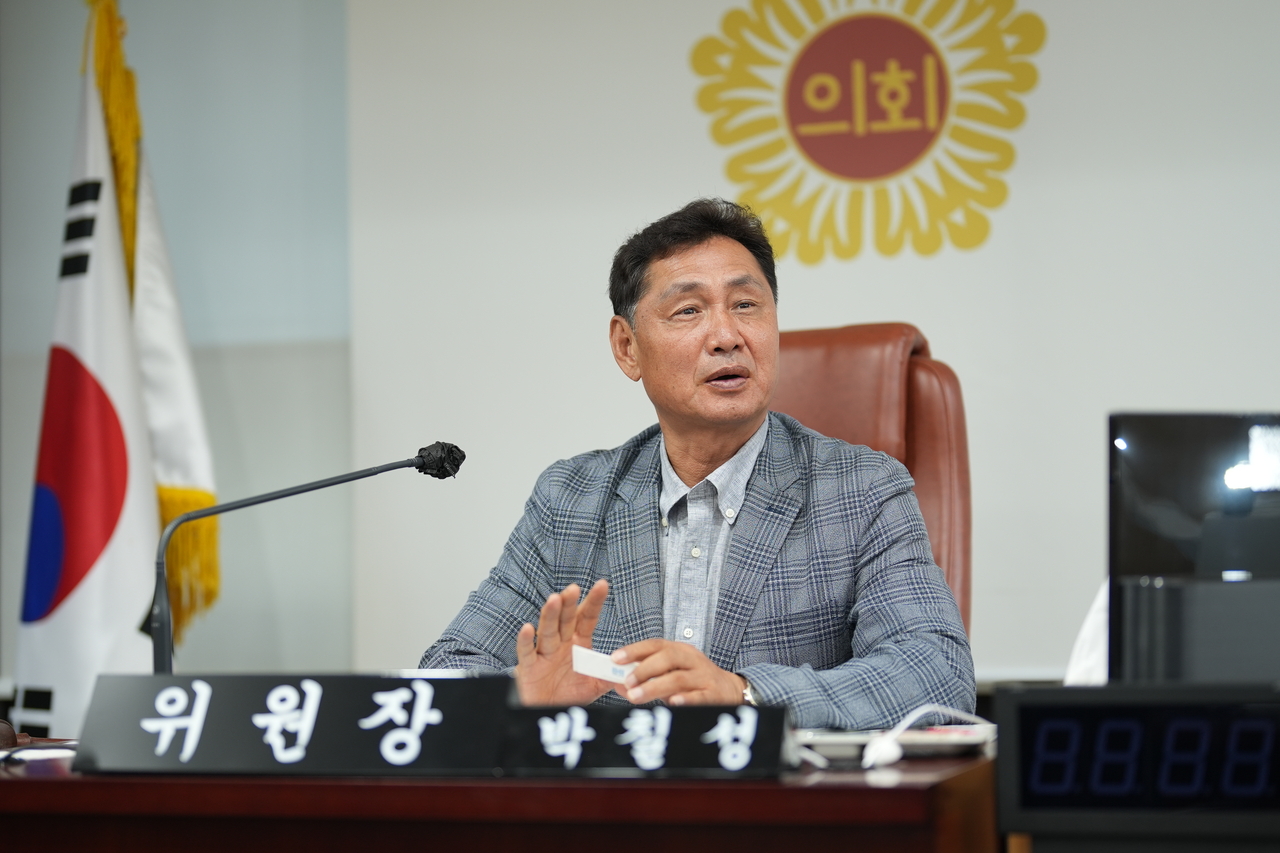
Park Chil-sung, chair of the Seoul Metropolitan Council's Urban Safety and Construction Committee and a Democratic Party of Korea member representing Guro District 4, has placed prevention-centered safety management at the heart of the committee's work during the first half of the 12th council term. His vision is to use AI, the Internet of Things and various monitoring instruments to detect disaster risks early, and to manage key facilities — roads, bridges, tunnels and underground roadways — systematically through accumulated data.
"I feel a profound sense of responsibility as the chair of the committee entrusted with the safety of 10 million Seoul residents," Park said in an interview with The Herald Business on Wednesday. "Over the next two years, my focus will be on building a Seoul that does not simply clean up after accidents, but one that identifies dangers in advance and prepares for them — an eco-friendly city where citizens are safe."
Extreme rainfall becomes the norm: building an AI-based disaster response system
Park said responding to the climate crisis requires first overhauling Seoul's disaster-prevention standards to reflect current meteorological conditions. Existing standards, drawn up on the basis of historical rainfall and weather statistics, are no longer adequate for dealing with increasingly intense downpours, heat waves and heavy snowfall.
He plans to closely monitor the progress of large-capacity rainwater storage and drainage facilities and sewer line renovation projects under way in high flood-risk areas such as Gangnam Station, Gwanghwamun and Sillim-dong, while also strengthening disaster-prediction capabilities through advanced technology.
The committee's particular focus will be on expanding early warning systems that use AI and sensor networks to continuously monitor water levels and on-site conditions at semi-basement homes, underground roadways and urban streams, alerting residents and relevant agencies quickly when dangerous readings are detected. The approach involves analyzing accumulated weather and infrastructure data to identify high-risk areas in advance, securing response time before incidents occur.
Protections for residents who are relatively more vulnerable in disasters will also be reinforced. Park said the committee will strengthen flood and heat-wave measures for semi-basement residents, elderly people living alone and the homeless, and will check whether adequate on-site responses are being made based on weather conditions — including guaranteed rest breaks for outdoor construction workers and the operation of cooling centers.
"The success or failure of disaster response depends less on how quickly we recover after an accident than on how early we detect danger and prevent harm," Park said. "We will use AI and IoT to elevate Seoul's safety management system so that threats to citizens' daily lives — flooding, ground subsidence and the like — can be caught at the earliest possible stage."
Moving beyond 'fix it when it breaks': investment prioritized by risk level
Park believes that as Seoul's major infrastructure enters a full-scale aging phase, maintenance practices must change accordingly. He argues the city needs a management framework that goes beyond legally mandated inspections on fixed schedules, and instead continuously analyzes the condition, usage levels and risk of each facility to catch anomalies early.
Regarding the recent discovery of level differences at approach ramps on Seongsu Bridge and Dongjak Bridge, Park said even minor changes at facilities used by citizens every day must be included in inspection targets. The Urban Safety and Construction Committee is calling on the Seoul Metropolitan Government to conduct a comprehensive survey of all bridge facilities and to make the results publicly available.
The committee has also moved to address regulatory gaps in the demolition of aging civil engineering structures. The collapse during the demolition of the Seosomun overpass highlighted the growing need for dismantling design standards and supervision frameworks suited to civil infrastructure such as bridges and overpasses, which have structural characteristics distinct from buildings.
At the launch of the 12th council, the Urban Safety and Construction Committee adopted a resolution urging the government to revise laws and systems to ensure safety in the demolition of aging civil engineering structures. The resolution calls on the government to establish detailed dismantling design standards and standard unit costs applicable to civil structures, and to create qualification requirements for dedicated supervisors with relevant expertise.
The committee's approach to construction site management also goes beyond assigning responsibility after accidents, aiming instead to strengthen institutional safeguards that screen out risk factors at every stage — from design and construction through to demolition.
Urban ground subsidence is another key area of scrutiny. Drawing on firsthand visits to incident sites in Yeonhui-dong and Myeongil-dong, Park said he will continue to examine cavity surveys of roads near underground development projects, the replacement of aging sewer pipes, and whether soil and geology specialists are involved in excavation work.
The committee also plans to expand the use of ground-penetrating radar for underground cavity detection, underground monitoring networks and advanced measurement equipment. Park said he will verify that field data and expert input are adequately reflected in the ground-characteristics analysis map the Seoul Metropolitan Government is building, and check whether the relevant information is being made sufficiently available to the public.
With the fiscal burden of aging infrastructure growing, Park proposed "asset management-based preventive maintenance" as an alternative approach. Rather than setting repair priorities simply on the basis of a facility's age, the method weighs structural risk, usage volume and the projected human and economic toll of a potential accident to determine the order in which budgets are allocated.
He added that accumulating safety diagnostic data gathered through AI and sensors over the long term, and applying new high-durability technologies and construction methods, can reduce the overall life-cycle cost of facilities.

Renovating aging residential areas in Guro: improving transport, safety and daily living environment
In his home district of Guro-gu, Park is concentrating his legislative efforts on renovating aging residential areas and improving the infrastructure most closely tied to residents' daily lives.
To improve conditions for redevelopment projects in the Garibong-dong and Guro 3 and 4 dong areas, he plans to examine regulations that undermine project viability and recommend necessary system improvements to the Seoul Metropolitan Government. Rather than focusing solely on the development projects themselves, he is placing greater weight on simultaneously improving the surrounding living environment — parking, pedestrian access, transport and safety.
He also plans to keep pushing forward projects that residents can feel in their daily lives: accessibility improvements at Daerim Station and Nam Guro Station, repairs to aging roads and sidewalks, the expansion of smart streetlights and CCTV coverage, and the reinforcement of flood-prevention facilities to reduce flood damage.
The mixed-use redevelopment of the old Garibong market site is seen as a project that can address both the area's parking shortage and the revitalization of the traditional market at the same time. Given the difficulties the project faces over funding and other issues, Park plans to seek a path forward through consultations among the Seoul Metropolitan Government, the autonomous district and other relevant agencies.
"Seoul's safety is not completed simply by building one large new facility," Park said. "What matters is proactively identifying and fixing even small hazards — on the roads and bridges citizens use every day, and in the alleys and residential areas throughout the city." He added: "I will fulfill the council's role in building a safer Seoul by listening directly to citizens in the field and translating their voices into policy and budgets."
7toy7@heraldcorp.com





