![Major corporate buildings in Jung-gu, Seoul. The business community has raised concerns about growing management uncertainty after the National Assembly rejected a bill to lower the top inheritance tax rate. [Herald DB]](https://wimg.heraldcorp.com/news/cms/2026/08/13/news-p.v1.20241211.10fe329f3ed540df90975d6286efabb9_P1.jpg)
After the government moved to require companies to cancel their treasury shares, the number of cases in which firms instead disposed of those shares to fund restricted stock unit grants has roughly tripled, a review of regulatory filings shows. The trend was particularly pronounced among small and medium-sized enterprises, which face a heavier burden from mandatory cancellation than large conglomerates. Some observers say the shareholder-return effect the government had sought to achieve through mandatory cancellation is failing to materialize.
RSU disposals triple after mandatory cancellation announced

A review of all 1,371 treasury share disposal plans disclosed on the Financial Supervisory Service's DART system over the past three years found that 54 of the 345 plans filed between January and July this year explicitly cited RSUs as the purpose of disposal.
The upward trend becomes clear when measured against 2025, the year the government announced it would enshrine mandatory treasury share cancellation in law. RSU-linked treasury share disposals stood at 16 in the same January-to-July period of 2024, doubled to 33 in 2025, and reached 54 this year. RSU payouts as a share of all treasury share disposal plans more than doubled over the same period, rising from 7.3 percent to 14.9 percent.
Analysts interpret the surge as companies exploiting an exemption in the revised Commercial Act that allows firms to forgo cancellation when treasury shares are used for employee compensation. RSUs are shares granted to employees only after they meet specific conditions such as performance targets, and actual delivery can take years after the initial disclosure. Companies are choosing RSUs as a workaround precisely because the grants carry no immediate risk of diluting the controlling shareholder's stake.
SMEs rush to adopt RSUs — Kosdaq disposals up fivefold
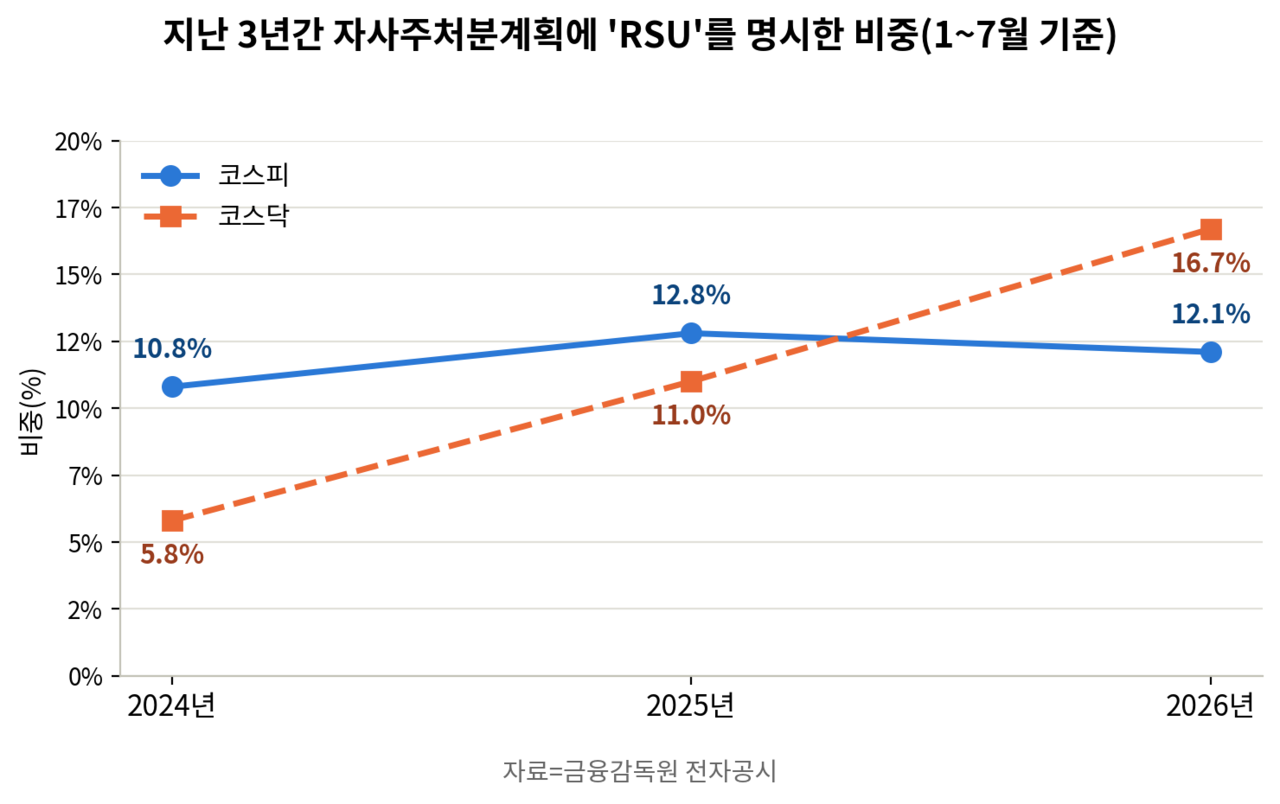
The shift toward RSU-linked treasury share disposals was especially sharp among smaller companies. An analysis of treasury share disposal disclosures by market segment shows that in the January-to-July period of 2024, RSUs accounted for 10.8 percent of Kospi filings (8 cases) and 5.8 percent of Kosdaq filings (8 cases). This year those figures reached 12.1 percent on the Kospi (17 cases) and 16.7 percent on the Kosdaq (37 cases) — a roughly fivefold increase on the Kosdaq alone. No RSU-linked disposals were recorded on the Konex market.
Industry insiders say smaller companies, which stand to be hit harder by mandatory cancellation than large conglomerates, have little choice but to seek workarounds more aggressively. "Founders at small and medium-sized enterprises tend to hold far smaller stakes than those at large companies, because SMEs grow through outside investment," said the chief executive of one IT venture firm. "RSUs, unlike stock options, hand over shares outright at no cost to the employee, which is a burden for the company — but we have no choice when it comes to dealing with the treasury share cancellation requirement."
The mandatory cancellation requirement applies to all listed companies regardless of size. During the Commercial Act revision process, the business community asked that some SMEs be exempted, but the request was rejected.
'Cancellation avoidance dims shareholder-return effect'
Experts say the shift toward RSU-linked disposals risks undermining the shareholder-return effect the government originally intended. Lee Chang-min, a professor at Hanyang University's business school, said disposing of treasury shares through RSUs rather than canceling them is "the most a company can do within the bounds of the law to game the system."
Lee added that unlike stock options — which are legally prohibited from being granted to controlling shareholders — RSUs carry no such restriction, leaving significant room for self-dealing. Companies have long faced criticism for using treasury shares to entrench controlling shareholders' grip, and the amendment's original intent of curbing that practice has been blurred.
The Korea Capital Market Institute raised similar concerns in a 2023 study, finding that more than half of companies that acquired treasury shares — 65.5 percent — used them for employee performance compensation, yielding no shareholder-return benefit. Kang So-hyeon, a research fellow at the institute, said treasury shares acquired by companies "are disposed of at management's discretion, undermining equity among shareholders or being used to benefit controlling shareholders."
Financial regulators appear to be conducting no dedicated monitoring of market behavior since the Commercial Act revision. An FSS official said the Ministry of Justice is seeking input from the Financial Services Commission on how the revised act is being implemented. An FSC official separately confirmed that the agency is not conducting any dedicated monitoring of treasury share cancellation trends.
Industry officials say the lack of follow-through is a problem given that shareholder-return expansion was the stated goal of the revision. "The Commercial Act has an enormous impact on the business community and capital markets alike, yet there is no clear lead ministry," one industry official said. "Even after three major overhauls, there is no monitoring of side effects or unintended consequences after each revision — and that is simply not acceptable."
klee@heraldcorp.com