No new permits for second straight year
Low profitability, lack of exit strategy deter private developers
'Skeptical' about effect of land ministry's rent improvement plan
![Seoul Mayor Oh Se-hoon meets with young residents at the Gaebyeong Sagium youth safe housing complex in Guro-gu, Seoul, on Wednesday. [Joint press corps] [Yonhap]](https://wimg.heraldcorp.com/news/cms/2026/08/14/rcv.YNA.20260812.PYH2026081215270001300_P1.jpg)
Seoul's youth safe housing program — which accounts for 25 percent of the city's housing supply — has not received a single new permit since last year. With the government's Aug. 13 housing supply package pledging stronger financial support for privately built public-support rental housing operators, including those behind the youth safe housing program, attention is turning to whether the stalled supply pipeline can be restarted.
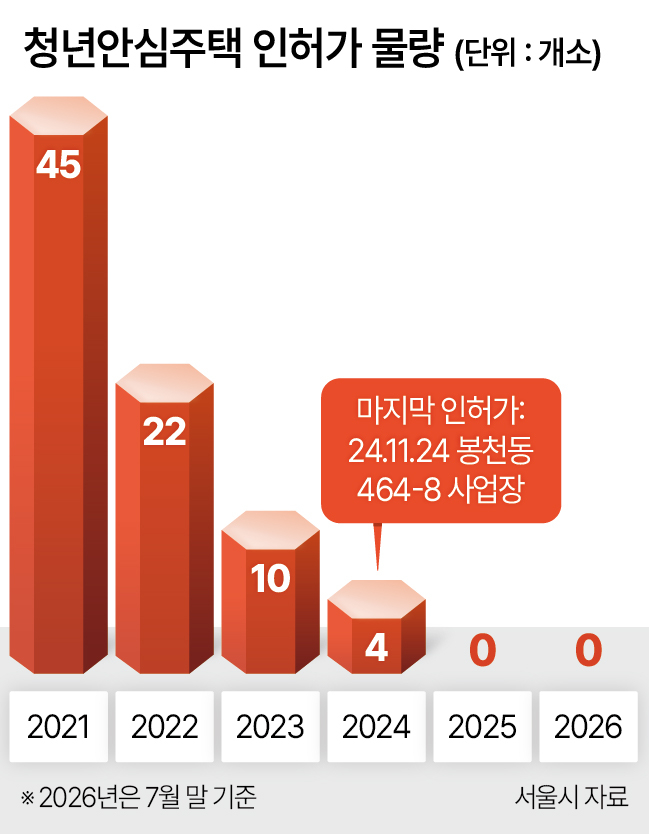
As of late July, not a single new youth safe housing project had received a permit from the Seoul Metropolitan Government. The number of permitted projects fell steadily — from 45 in 2021 to 22 in 2022, 10 in 2023 and four in 2024 — before dropping to zero last year and remaining there. The last permit was issued Nov. 24, 2024, for a 100-unit project at 464-8 Bongcheon-dong.
Cancellations have compounded the problem. Of the 150 cumulative youth safe housing sites, 101 have been completed and 27 are under construction. The number of canceled projects rose by two over the past year, from 13 to 15, while seven sites have yet to break ground.
The Seoul Metropolitan Government acknowledges the severity of the slowdown. "More than 90 percent of the units we committed to supply have already received permits, and some sites are already under construction," a city official said. "Adding 17,500 units by 2030 is an achievable target, but we cannot guarantee supply beyond that."
The drought in new permits stems from weak profitability and the absence of a clear exit strategy for private developers. The youth safe housing program provides transit-oriented rental housing for young people without homes and newlywed couples, combining public rental units with privately built public-support rental units — the latter accounting for 50 to 90 percent of supply. The Gaebyeong Sagium complex in Guro-gu that Mayor Oh visited Wednesday is a case in point: 332 of its 605 units are privately built rentals.
The city has been working to ease the burden on private developers. In April it raised the interest subsidy ceiling on construction financing for private operators from 2 percent to 4 percent for three years, and earlier this month it temporarily relaxed the public-contribution rate by 5 percentage points for three years.
"Private developers have a more positive outlook than last year, when there were no policy improvements at all," said Lee Ju-hwa, chief executive of real estate development advisory firm Realty Mate. "The easing of the public-contribution rate has improved project viability, and there is a sense that developers are reconsidering youth safe housing."
Against this backdrop, the Ministry of Land, Infrastructure and Transport unveiled its Aug. 13 housing supply expansion package, which includes stronger financial support for the privately built public-support rental model. The plan introduces a Korea Housing and Urban Guarantee Corporation long-term mortgage product backed by rental housing as collateral and offers enhanced fund support for 20-year rental commitments compared with 10-year ones. Under the scheme, 10-year rentals receive equity investment of up to 11 percent of total project costs, a loan ceiling of 120 million won ($84,800) and a lending rate of 2.6 to 3.4 percent, while 20-year rentals receive equity of up to 14 percent, a loan ceiling of 200 million won and a rate of 2.0 to 2.8 percent.
The long-standing industry complaint about rent levels also received a modest fix. Rents for privately built units in the youth safe housing program are set at 75 to 85 percent of the surrounding market rate. The Special Act on Private Rental Housing sets the mandatory rental period at 10 years and caps annual rent increases at 5 percent, but in practice few operators raise rents by that much — the typical increase is about 2.5 percent every two years, in line with inflation, meaning the gap with market rents tends to widen over time.
Under the new package, 20-year rental projects may set initial rents at 95 percent of the market rate and adjust back to 95 percent of the market rate when a tenant changes.
Whether the measures will have a real effect remains uncertain. "Developers in the youth safe housing program generally accept losses during the mandatory 10-year rental period and aim to recoup them by selling the building afterward at a market gain," a city official said. "It is doubtful whether any operator would hold on for 20 years." On the rent improvement plan, the official added that current youth safe housing policy already caps initial rents at up to 85 percent of the market rate under city guidelines, and that the impact of the land ministry's measures would depend on how they are written into the Special Act on Private Rental Housing. "Either way, the 20-year condition means the effect is likely to be limited," the official said.
shy@heraldcorp.com
hope@heraldcorp.com