
"How much do you spend each month on AI subscriptions?" "How long have you been feeling lonely?" The Seoul Metropolitan Government is surveying residents on these and other fine-grained aspects of daily life.
The city said the survey aims to capture how residents are living amid the AI transition, the demographic cliff and the climate crisis, and to use the findings as baseline data for designing city policy.
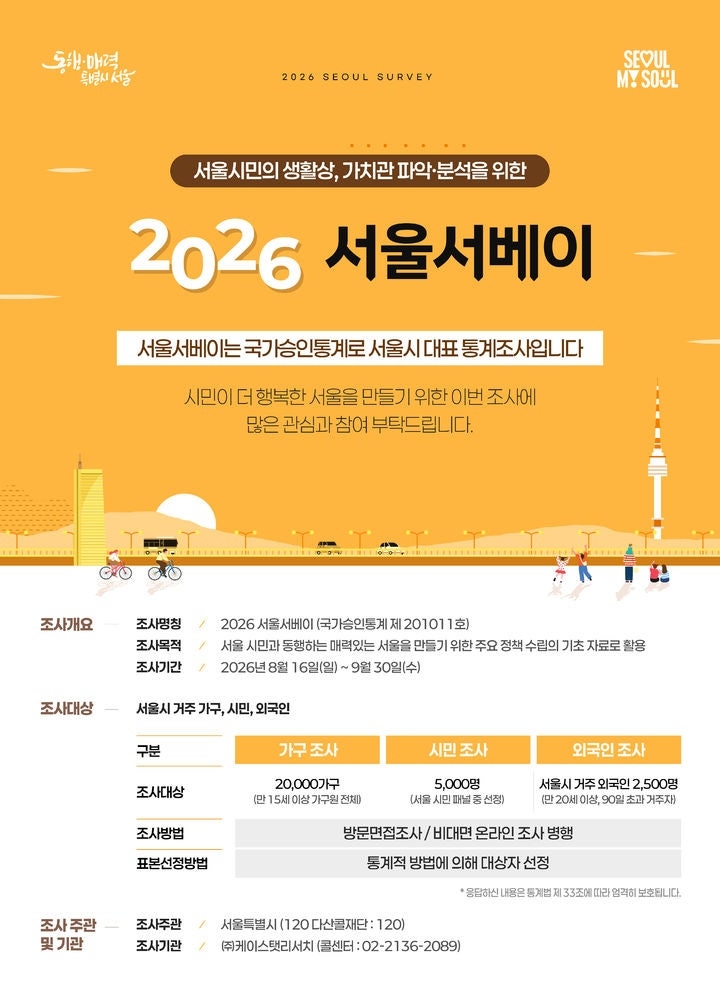
Seoul will launch the 2026 Seoul Survey on Sunday, running through Sept. 30. Now in its 24th edition since launching in 2003, the Seoul Survey is a nationally approved statistical survey. It targets 20,000 Seoul households, 5,000 citizens and 2,500 foreign residents.
This year's survey includes questions on everyday topics such as generative AI use and subscription spending, family caregiving, retirement preparation and loneliness. Respondents will be asked how often they use generative AI, how much they spend on subscriptions, how well they understand and apply AI tools, and what AI-related support they need — all aimed at capturing how daily life has changed as AI becomes mainstream.
Parents of minor children will be asked about their concerns over their children's digital use, with the results intended to inform the city's digital safety policies for youth.
In line with the city's low birth rate and aging challenges, the survey also asks how family-friendly Seoul is for child-rearing and how livable it is for older residents. The city will also attempt, for the first time, to measure the scale of "young family caregivers" — youth who provide care for family members — and gauge the severity of loneliness among residents, two issues that have been difficult to track through administrative records alone.
The survey will measure in detail how long residents have been experiencing loneliness and probe demand for related policy support from multiple angles. Questions on residents' perception of Seoul's urban competitiveness will also be included, along with factors the city needs to strengthen its global standing.
The survey will also assess public trust in city government, how well residents feel the effects of city policies, and what kind of city residents want Seoul to become — findings the city plans to use as a compass for future governance. Results from the 2026 Seoul Survey will be published on the Seoul Open Data Plaza in the first half of next year, with both the full report and raw statistical data made available.
"Through the Seoul Survey, we will document Seoul's present in statistics and realize data-driven administration that proactively responds to various changes," said Jeong Yeong-jun, director of the Seoul Metropolitan Government's Digital City Bureau.
ken@heraldcorp.com





