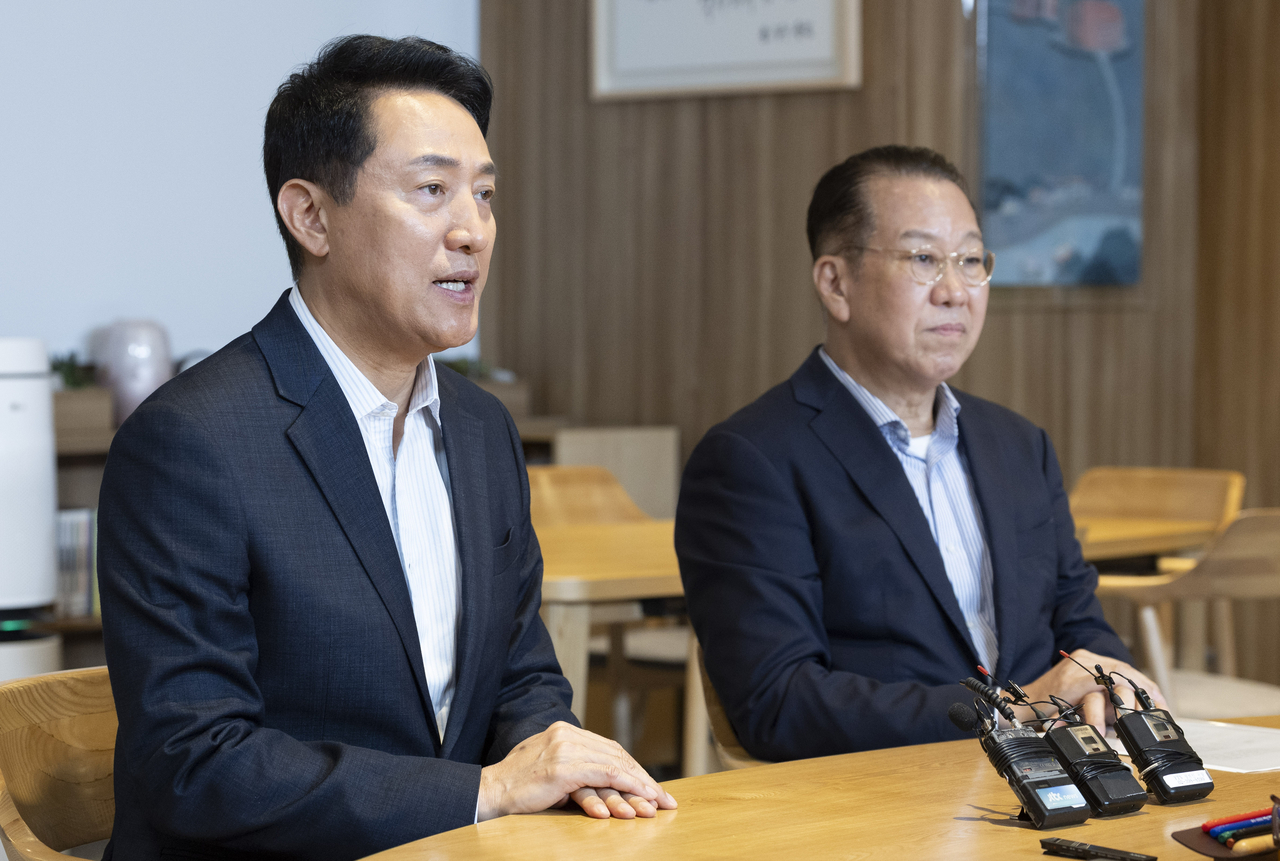
Seoul Mayor Oh Se-hoon again made clear his opposition to the government's consideration of Yongsan Park as a potential housing supply site, warning that building apartments there would generate traffic volumes beyond what surrounding roads could handle — turning them into parking lots. People Power Party lawmaker Kwon Young-se, who met with Oh on Tuesday, echoed that position, saying the idea of "throwing up apartments" in Yongsan Park "must be withdrawn without fail." Kwon represents the Yongsan constituency in Seoul.
Oh made the remarks during an afternoon meeting with Kwon at the mayor's office in Jung-gu, where the two discussed the government's housing supply plan for Yongsan Park.
Oh said he had attended a Cabinet meeting Tuesday morning and had the opportunity to speak directly to the president about real estate supply measures. "It is fortunate that some lending regulations have been eased, but several of my proposals were not accepted," he said. He added that he had urged the government to accelerate redevelopment projects by easing floor-area-ratio regulations, lifting restrictions on the transfer of union membership status, and reducing the mandatory ratio of rental housing units.
Oh said he had also delivered a firm message that he could not agree to any further greenbelt releases.
Oh again said he could not accept building apartments on any part of Yongsan Park, including Yongsan Children's Garden. "Yongsan Park is a place of historic significance — a space given concrete form through special legislation with the consensus of successive administrations and the public," he said. "If more than 10,000 apartment units were built there, the resulting traffic would be impossible to manage."
He added that the problem would be compounded once the nearby Yongsan International Business District is completed. "The roads around that area would become a parking lot," he said.
Oh also raised the issue of soil contamination. "Decontamination work has been ongoing in parts of Yongsan Park for five years," he said. "With the land not yet transferred from the US military, I can say with certainty that breaking ground on apartments there is impossible."
He said he had conveyed three clear positions: support for deregulation, opposition to converting Yongsan Park into an apartment site, and opposition to additional greenbelt releases.
Kwon was equally direct in opposing housing development at Yongsan Park. "The idea of rushing to throw up apartments in Yongsan Park just because the government is in a hurry on real estate policy must be withdrawn," he said. He suggested that if the government intended to build youth housing, areas near Gyeongnidan-gil and Noksa-pyeong would be better alternative sites than Yongsan Park.
Kwon also warned of soil contamination risks. "Even if management authority over Yongsan Children's Garden is transferred from the US military, excavating the site will likely uncover contamination problems," he said. "Yongsan Park is a place that was occupied by foreign forces for 100 years. It should be a place for our descendants to enjoy for the next 100 years."
Yongsan Park is a large urban green space covering approximately 2.99 million square meters, managed as a national park under special legislation. The government has been primarily considering Yongsan Children's Garden — roughly one-tenth of the park's total area — as a priority housing supply site, while also examining whether other parts of the broader Yongsan Park could be made available.
ikson@heraldcorp.com