![A Gangnam apartment complex [The Herald Business DB]](https://wimg.heraldcorp.com/news/cms/2026/08/24/rcv.YNA.20260812.PYH2026081214410001300_P1.jpg)
High-income wage earners face an effective income tax rate more than 10 percentage points higher than that on capital gains from real estate and other assets — even when both are subject to the same top statutory rate, new data show.
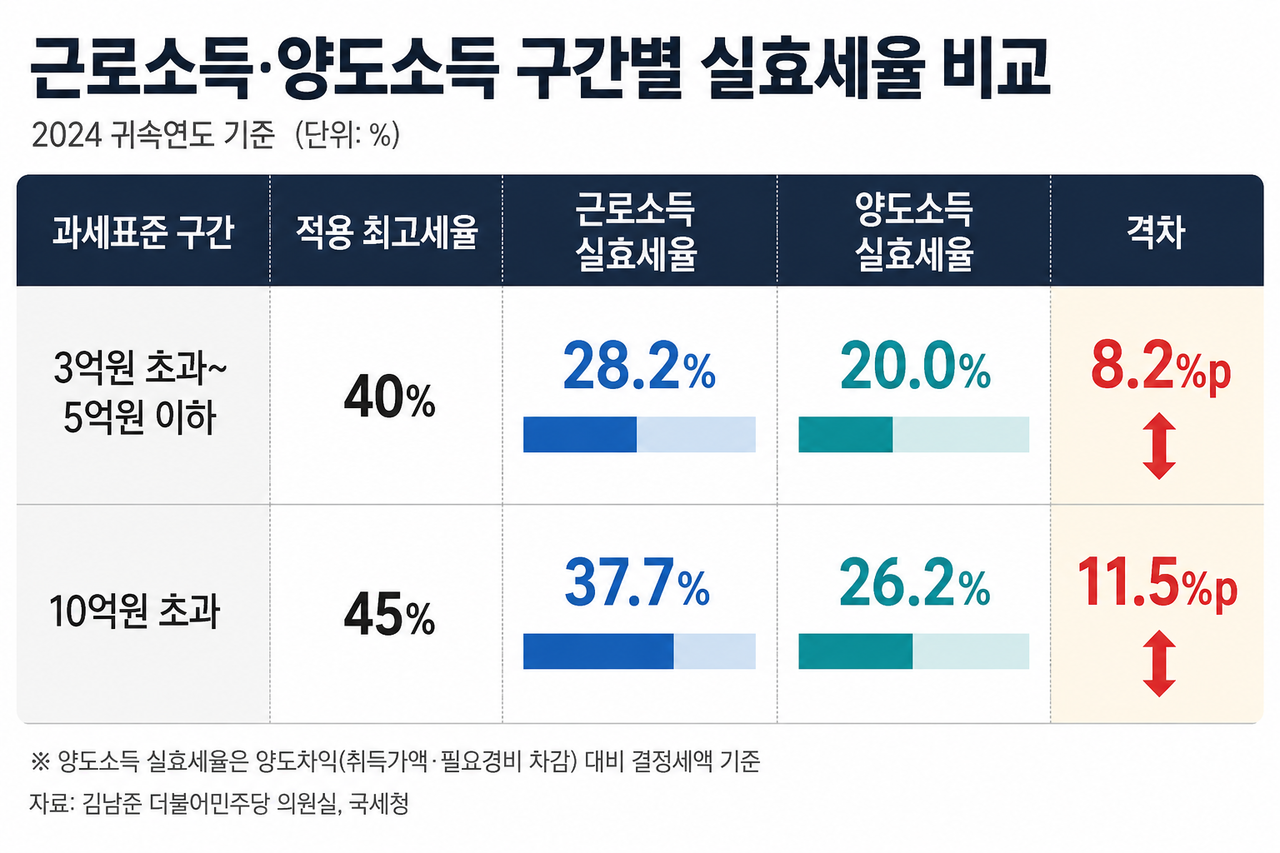
In the bracket above 1 billion won ($718,000), where the top rate of 45 percent applies, the effective tax rate on earned income ran about 12 percentage points higher than on capital gains. The figures have renewed calls to narrow the tax burden gap between income from labor and income from asset sales.
According to data the National Tax Service submitted to Kim Nam-jun, a Democratic Party of Korea lawmaker on the National Assembly's Budget and Accounts Special Committee, the effective tax rate on earned income in the over-1-billion-won bracket stood at 37.7 percent for fiscal year 2024. The bracket is subject to the top income tax rate of 45 percent.
Of about 21.08 million total wage earners, 4,557 fell into the top bracket above 1 billion won. Their combined gross wages totaled 9.64 trillion won, with a final tax liability of 3.63 trillion won.
By contrast, the effective tax rate on capital gains in the same over-1-billion-won bracket — also subject to the 45 percent top rate — was estimated at 26.2 percent, some 11.5 percentage points below the earned-income rate.
Of 974,337 capital gains tax filings in the same year, 7,581 fell into the top bracket. Their total transfer value came to 172.21 trillion won, with capital gains of 31.74 trillion won. The effective rate was calculated by dividing the final tax liability of 8.32 trillion won by the capital gain — the transfer value minus acquisition costs and necessary expenses.
The gap was not confined to the top bracket. In the 300-million-to-500-million-won range, where a 40 percent rate applies, the effective rate on earned income was 28.2 percent while the effective rate on capital gains was only 20.0 percent — a gap of 8.2 percentage points.
The disparity has also been widening over time. The difference in effective rates between the top earned-income and capital-gains brackets grew from 11.5 percentage points in 2021 to 12.4 percentage points in 2023.
The gap stems from fundamental differences in how the two income types are taxed. Earned income tax is levied on wages paid in return for labor, while capital gains tax targets profits realized from selling real estate and other assets. Differences in available deductions, the scope of recognized necessary expenses, and the mechanics of assessment mean that even identical statutory rates can produce significantly different effective burdens.
Earned income tax also dominates overall income tax revenue. Of total income tax receipts of 117.4 trillion won in 2024, earned income tax accounted for 61 trillion won, or 52 percent. Capital gains tax on asset transfers in the same year came to 16.7 trillion won, representing 14.2 percent of total income tax revenue.
The equity debate is set to intensify after the government confirmed it will end the suspended surcharge on capital gains tax for multi-home owners as scheduled. Starting May 10, 2026, the heavier rate will apply to transfers of homes in designated adjustment zones by owners of multiple properties. Those who sign a sales contract by May 9, 2026, however, will receive a grace period before the surcharge takes effect, with the length varying by region.
"If an excessive tax burden gap exists between income earned through labor and gains from rising asset prices, correcting it is the National Assembly's duty under the principle of statutory taxation," Kim said. "The core of any capital gains tax reform should not be simply collecting more tax or controlling the real estate market, but achieving fair taxation by improving equity across income types."
fact0514@heraldcorp.com