"Central and local governments share the same fundamental goal — the country must continue to grow and develop while improving the quality of life for its people. There may be differences in methodology, but the central government also needs to be more flexible."
Daegu Mayor Choo Kyung-ho, a regional government head from the opposition party, made the remarks while discussing cooperation with the central government. "You cannot force a party's color or philosophy on others," he said, "but ultimately the public will render its verdict, and the results will show at the next election."
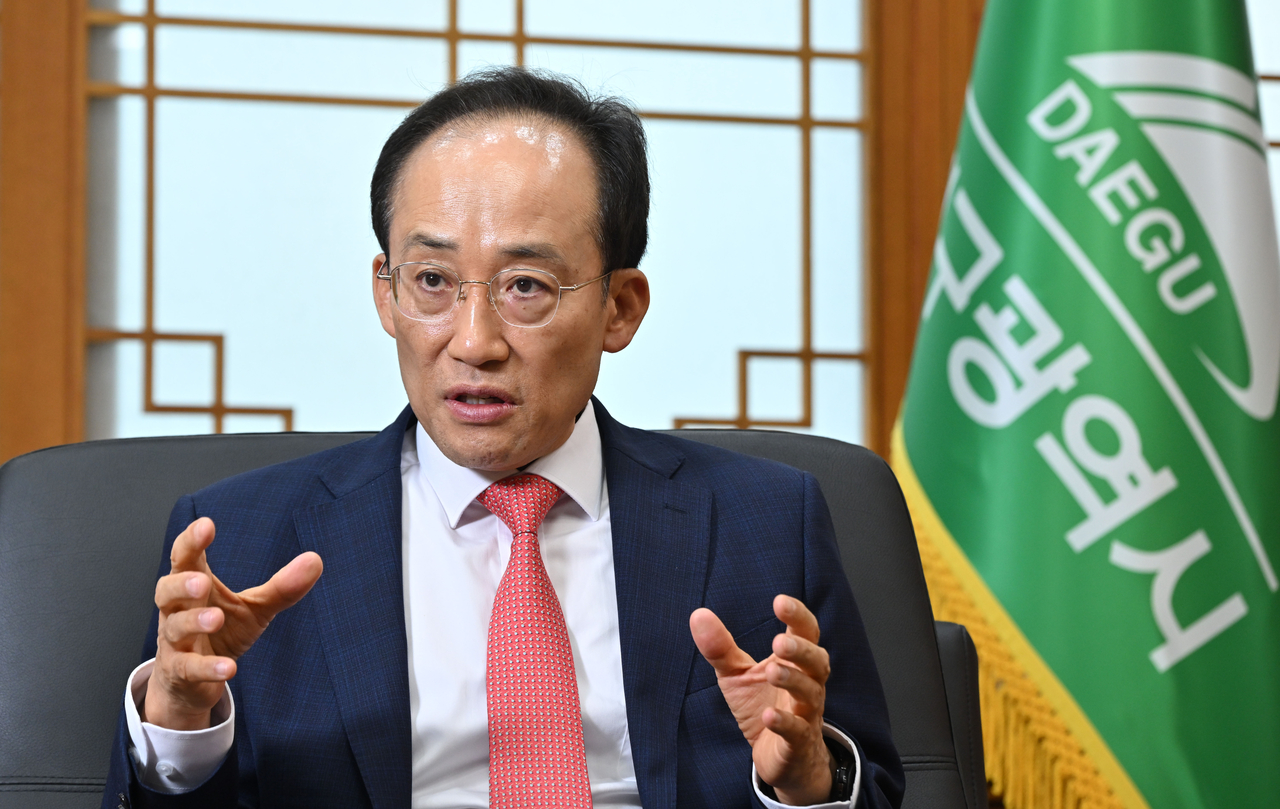
The Herald Business sat down with Choo at the Sanggyeok campus of Daegu City Hall on Friday to hear his plans for city governance, key policies and ambitions.
Choo passed the 25th national administrative examination in 1981 and spent his career at the heart of the country's fiscal management, moving through the Ministry of Government Administration, the Economic Planning Board, the Economic Planning and Finance Ministry, the Ministry of Economy and Finance, the Financial Services Commission and back to the Ministry of Economy and Finance. He served as minister-level director of the Office for Government Policy Coordination under President Park Geun-hye, then won three consecutive terms representing Dalseong in Daegu in the National Assembly. Under President Yoon Suk Yeol, he became the inaugural deputy prime minister for economic affairs and minister of economy and finance. After returning to the Assembly, he served as People Power Party floor leader.
"I worked in the central government for nearly 35 years and spent more than a decade as a constituency lawmaker, which gave me experience in local administration and direct contact with public sentiment," he said. "Because of that experience, I don't find the mayor's role unfamiliar or uncharted — I have the confidence of a prepared mayor."
Asked about the administrative integration of Daegu and North Gyeongsang Province, Choo said he was "100 percent in favor." "Reorganizing the spatial layout of industry, culture and daily life zones could make the region genuinely competitive, but narrow administrative divisions are holding back development," he said. "If local public opinion wants integration, there is no reason for the central government or the National Assembly to refuse." The full interview follows.
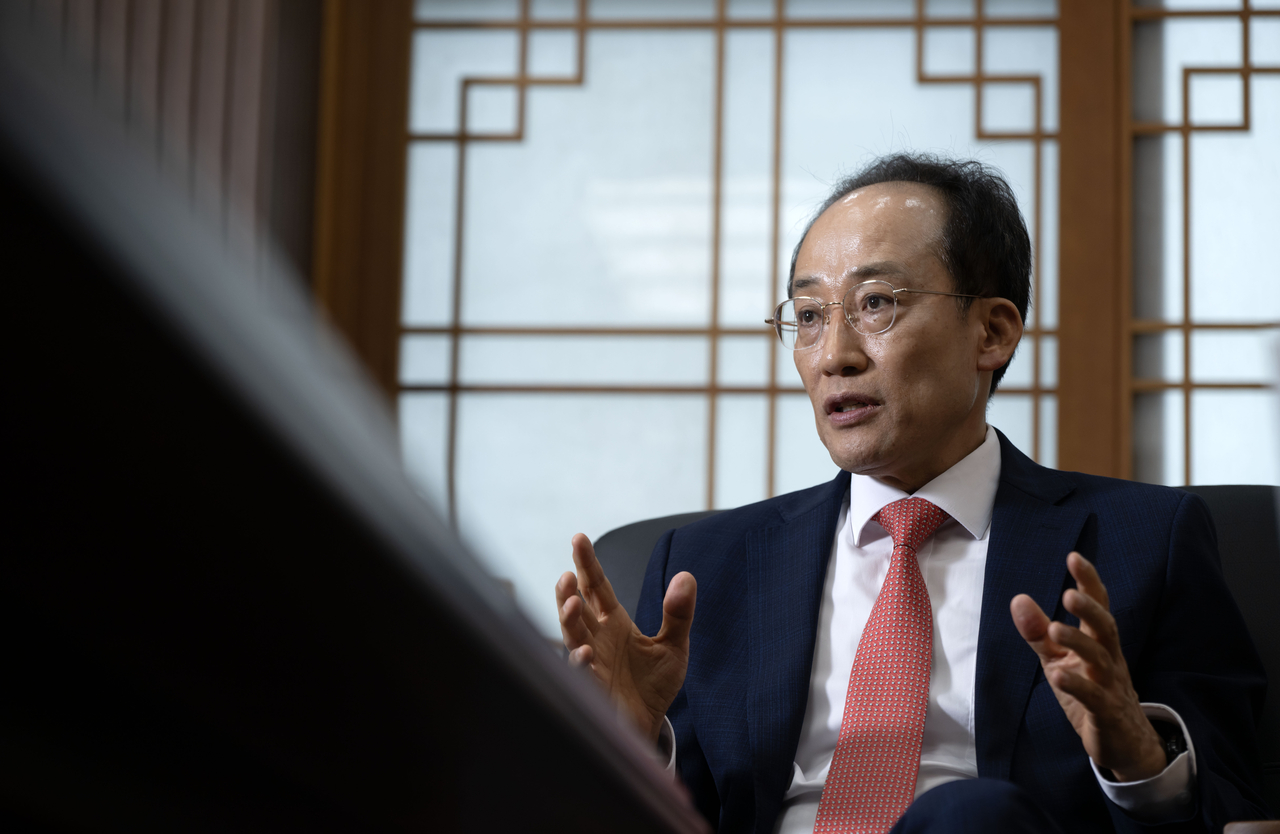
— It has been two months since you took office. What are your reflections?
▶ I am grateful to the citizens who trusted me with the city's governance, and I feel the weight of that responsibility deeply. The thing I have focused on most since taking office is communication — being present at the scene and centering everything on citizens. I visited businesses and industrial sites, markets, alleyways and low-income neighborhoods to hear people's voices, and the most urgent message was: "Revive Daegu's economy."
In response, I launched an emergency economic task force that brings together business leaders and private-sector experts. In the short term, we will restore the everyday economy; in the long term, we will secure new growth engines. I have also cut unnecessary procedural formalities — introducing working dosirak lunch meetings and a "two-minute core briefing" format. We will remove needless regulations and entrenched practices so that citizens can feel real change.
— What local issues have you come to understand more acutely as mayor, and what do you see as the most pressing challenge?
▶ The most urgent tasks are restoring the everyday economy and creating jobs for young people. To that end, we are simultaneously pursuing "everyday economic recovery" and a "comprehensive restructuring of Daegu's economy." We are looking closely at the difficulties facing small merchants, self-employed business owners and small and medium-sized enterprises, and we plan to expand support for neighborhood commercial districts and traditional markets through a second-half supplementary budget focused on people's livelihoods.
At a more fundamental level, Daegu's industrial structure must change. We will raise competitiveness by pursuing AI transformation — integrating AI into the existing core industries of machinery, metals, textiles and components. By securing future growth engines, we will build a city that attracts both capital and people.
— Your governing vision is "Change and Growth, a Better Tomorrow." What is the philosophy behind it, and what is your top priority for the next four years?
▶ I believe that breaking free from existing frameworks and entrenched practices is the starting point for reawakening Daegu's latent potential. The phrase "Change and Growth, a Better Tomorrow" captures my intention to ensure that change leads to growth — growth that transforms the city's competitiveness, its economy, its jobs and the lives of its citizens.
We will build an advanced-industry ecosystem spanning AI, robotics, future mobility, biotech and semiconductors to attract corporate investment and create an economic structure where young people can pursue their dreams in Daegu. Policies to restore livelihoods for small merchants and the self-employed will run in parallel. Four years from now, I want to be remembered as the mayor who opened a new growth chapter for Daegu's economy and revived people's livelihoods.
— You announced the creation of a youth policy adviser reporting directly to the mayor. What will that role involve?
▶ I established the position of mayoral youth adviser to make young people not merely recipients of support but active participants in shaping policy. Following an open recruitment process, Park Seong-min was appointed to the role on Aug. 10.
The adviser will meet directly with young people in the community, listen to their on-the-ground difficulties and policy suggestions, and work with relevant departments to translate those into concrete policies and projects. The adviser will also continuously monitor how existing youth policies are landing in practice to improve their effectiveness.
— What policy will you prioritize most to make Daegu a city where young people want to stay?
▶ Creating an environment where young people can work, live and plan their futures in Daegu is essential. We will foster advanced industries — AI, robotics, future mobility, semiconductors and biotech — to increase the quality jobs that young people actually want.
We also plan to improve living conditions, including housing, daily life and culture. Starting in 2027, we will introduce a "Youth Settlement Allowance" that provides 200,000 won ($145) to young people who move to Daegu from other regions, with an additional 100,000 won for those who maintain their registered address for six months. We will also launch the "D-Youth Pass," which supports spending on culture, leisure and self-development.
— Which industries will Daegu focus on to maintain and expand its advanced-industry competitiveness, and how do you plan to attract investment from the government and private sector?
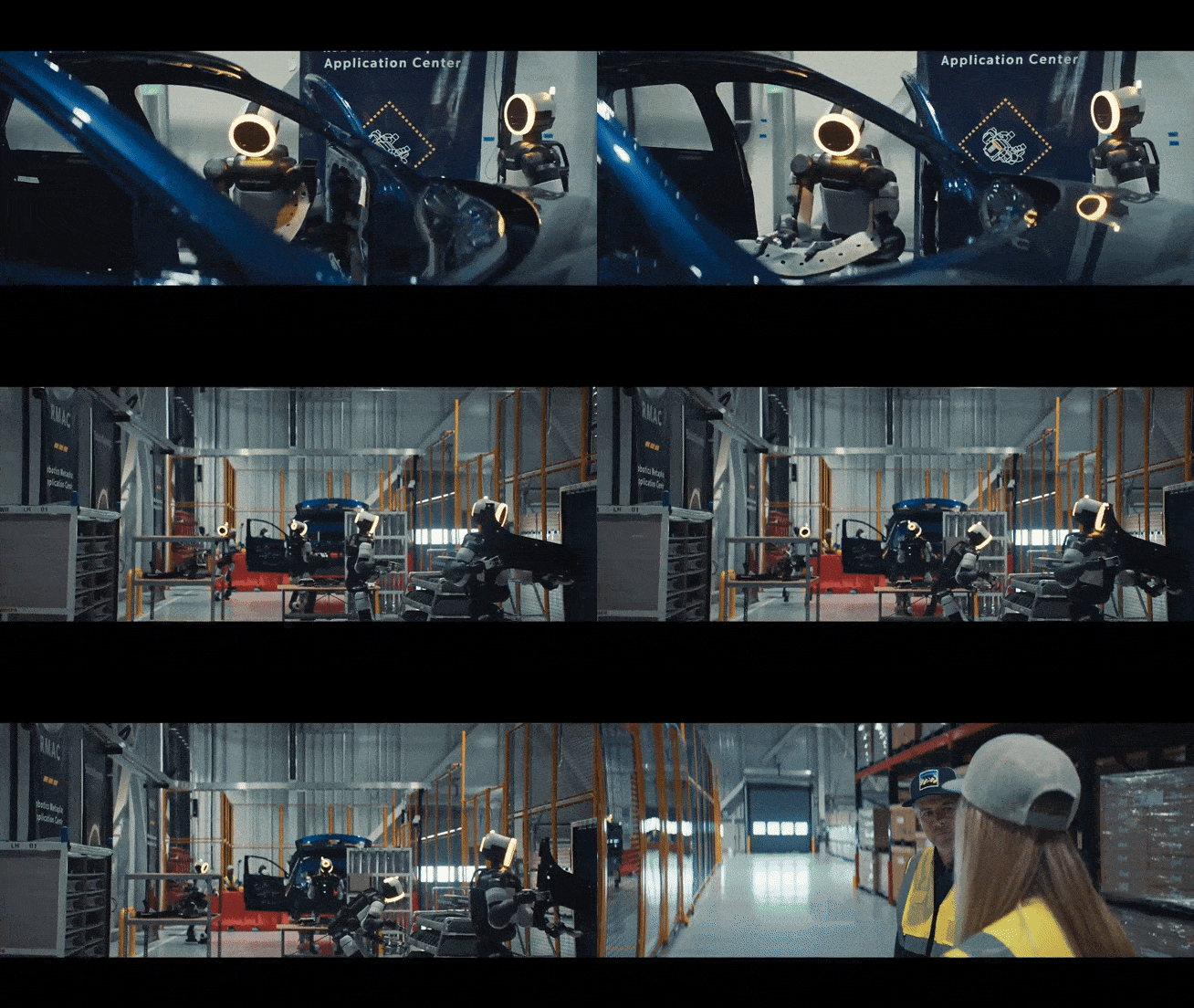
▶ Building on our strengths in automobiles, machinery, components and materials, we will develop humanoid robots and future mobility as core growth engines. We will also pursue a sweeping AI transformation — integrating AI into the production floors of manufacturing companies.
Centered on a mayoral "AX Committee," we will link Suseong Alpha City and the Seongseo industrial complex to support companies in adopting and piloting AI. For semiconductors, we will leverage Daegu and North Gyeongsang Province's industrial ecosystem and value chain to build the region into a key pillar of national semiconductor competitiveness.
We are also preparing an investment attraction team to recruit large corporations and promising domestic and international companies. Through a "Regulation and Business Grievance 119 Integrated Support Center," we will resolve companies' on-the-ground difficulties and unnecessary regulatory burdens quickly.
— The land sale agreement recently signed with Shinsegae Simon has moved the Daegu premium outlet project into full execution. What does this investment mean, and what do you expect from it?
▶ It is significant that an investment agreement signed in December last year has translated into an actual project in just seven months. The Shinsegae premium outlet is currently in architectural design, with ground-breaking scheduled for April next year and an opening planned for the second half of 2028.
Once the outlet opens, the Ansim New Town area can grow into a mixed-use living space with shopping and cultural amenities. We expect it to generate more than 1,000 direct and indirect jobs and draw more than 6 million visitors a year. It will also stimulate local consumption and surrounding commercial districts, and lay the groundwork for a stay-and-spend economy linking shopping, dining, culture and accommodation. The city will actively support permitting and the expansion of transportation and infrastructure.
— What changes would the administrative integration of Daegu and North Gyeongsang Province bring?
▶ Administrative integration is a strategic imperative for the region's survival and advancement. It is also a pathway to resolving major pending issues, including the integrated new airport, the second round of public institution relocations and the development of future industries.
Once integration is achieved, industrial, transportation, talent, tourism and medical resources can be utilized across administrative boundaries. Combining Daegu's urban capacity with North Gyeongsang Province's industrial, agricultural and tourism base would generate synergies in attracting businesses, creating jobs, and developing industries linked to the wide-area transportation network and the new airport. Daegu and North Gyeongsang Province must move as one team to counter the dominance of the Greater Seoul area.
— Medical tourism and the cultural industry are often cited as Daegu's strengths.
▶ We will restore the standing of "Medi-City Daegu" by reviving the medical tourism sector, which contracted after COVID-19. In 2025, Daegu's growth rate in attracting foreign patients was 31.4 percent, falling short of the national average of 71.7 percent. We will strengthen ties between medical institutions and attraction agencies and expand our target markets from Southeast Asia to North America. By building an AI-based attraction platform and other tools, we aim to attract 60,000 foreign patients by 2030.
In the cultural sphere, we plan to leverage existing assets such as the Daegu International Musical Festival and the Daegu International Opera Festival. We will develop a national musical complex and a national museum of modern art on the former site of the North Gyeongsang Provincial Government building, and pursue the relocation of the National Opera of Korea to Daegu. In gaming and webtoons, we will establish a "D-Content ecosystem hub" — including the Daegu Global Webtoon Center, set to open in 2027 — to support creators from startup through production, investment and overseas expansion.
— Large-scale projects such as the integrated new airport require central government support. How do you plan to secure that cooperation?
▶ When it comes to regional development, there is no ruling party or opposition party. We will cooperate with the central government and the National Assembly with "Daegu's development" and "citizens' interests" as our top priorities.
My experience as deputy prime minister for economic affairs and as a lawmaker taught me that making large projects happen requires logic and economic justification more than political slogans. I will make a strong case to the government and the National Assembly for why the integrated new airport, the Daegu–North Gyeongsang wide-area railway, and the AI, robotics and future mobility projects are necessary for strengthening national competitiveness.
The integrated new airport in particular is not just a Daegu and North Gyeongsang project — it is a national project that enhances balanced regional development and logistics and industrial competitiveness. We will work closely with the central government, the National Assembly and North Gyeongsang Province to advance these key priorities.
mp1256@heraldcorp.com