
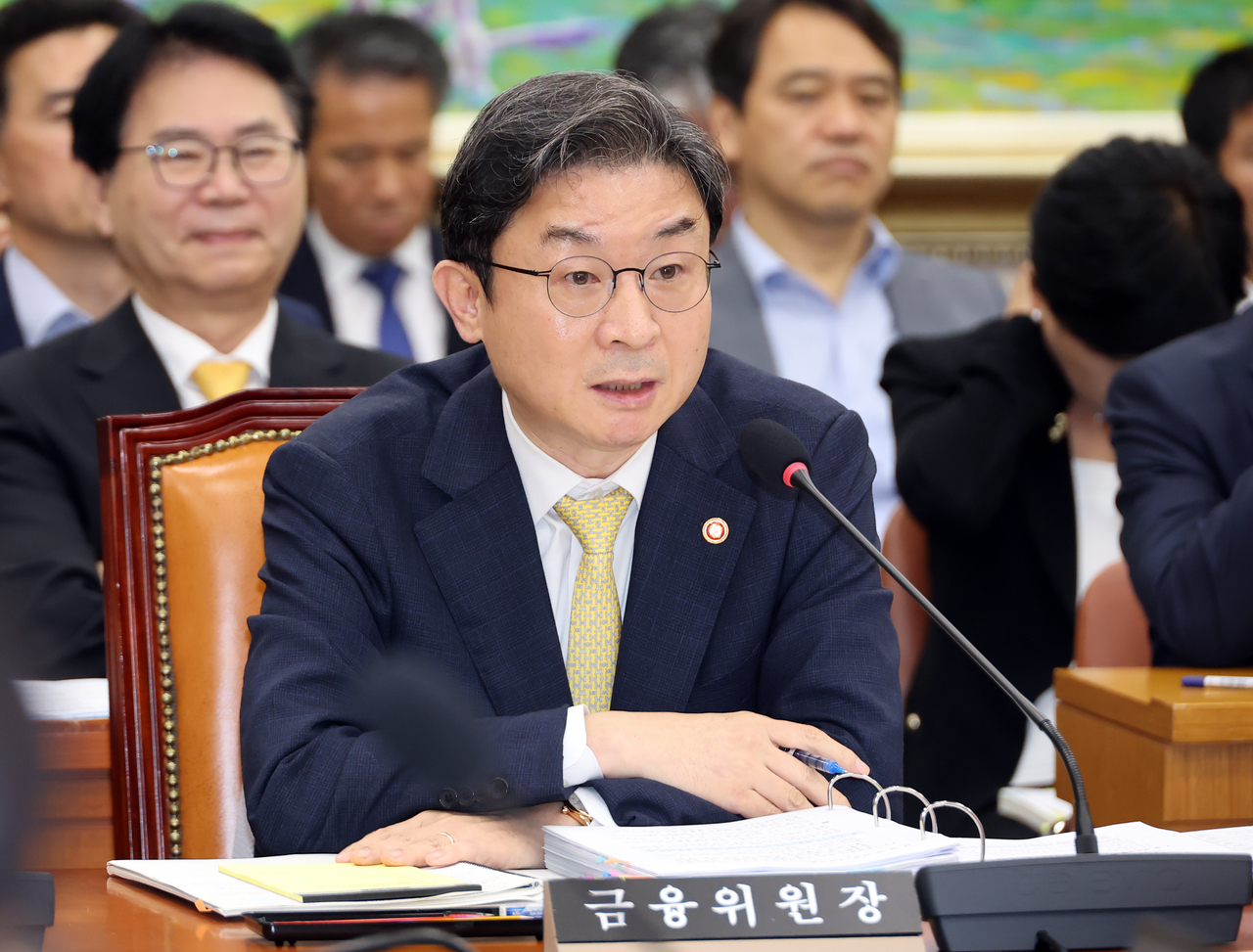
Tightened Kosdaq listing-maintenance rules designed to swiftly remove insolvent companies are set to undergo a review for refinement just over a month after taking effect. Concerns have emerged that even profitable companies with solid equity bases could fall within delisting range solely because of low share prices or market capitalizations. Financial Services Commission Chairman Lee Eok-won said Monday at the National Assembly that he would "review areas for fine-tuning" in response to criticism that the rules could push out even profitable companies.
According to the financial investment industry, 26 Kosdaq-listed companies had market capitalizations below 20 billion won ($14.5 million) as of Monday while posting cumulative operating profit in the black over the most recent four quarters and maintaining total equity of at least 20 billion won. Even when the threshold was raised to companies with operating profit of at least 1 billion won, 16 firms still met the criteria.
The market-cap threshold issue had already been raised in the National Assembly. According to Democratic Party of Korea lawmaker Kim Hyeon-jeong, 45 of the 149 stocks with market caps below 20 billion won as of the end of last month were profitable. Many of those also held assets valued above 20 billion won. A fresh look using Monday as the reference date and adding the condition of total equity of at least 20 billion won still turned up 26 companies — underscoring that the tightened market-cap standard is not catching only loss-making or capital-weak firms.
At the individual company level, some cases show a stark gap between market capitalization and earnings power or equity size. Based on Monday's closing prices, Wing YIP Food had a market cap of 18.2 billion won while posting cumulative operating profit of 11.6 billion won over the past four quarters and total equity of 263 billion won. Fashion Platform had a market cap of 15.7 billion won against operating profit of 13.2 billion won and total equity of 84.1 billion won, while Starflex had a market cap of 19.6 billion won against operating profit of 9.2 billion won and total equity of 76.9 billion won.
Fashion Platform is in fact a case where the tightened market-cap standard has already been applied. Korea Exchange designated Fashion Platform as a supervised issue on Aug. 13 on the grounds that its market cap fell below 20 billion won.
Operating profit or equity alone cannot determine a company's value — future earnings, growth potential, cash flow and other factors are all reflected in share prices. However, the possibility that even genuinely profitable companies with adequate capital could be subject to delisting solely on the basis of a market-cap threshold has emerged as a central issue in the current debate over refining the regime.
"I understand the intent to remove insolvent companies, but I question whether market cap or penny-stock status alone should determine delisting," said one IR industry official. "There also needs to be a process to verify whether companies that are generating operating profit and working on shareholder returns have simply not had the chance to be properly valued by the market."
Supervised-issue designations under the tightened listing-maintenance standards have already begun. The first batch of designations for stocks that failed to meet the share price or market-cap threshold for 30 consecutive trading days took effect after the close of trading on Aug. 12. Companies flagged on Aug. 5 as having missed the threshold for 25 consecutive trading days failed to recover over the following five trading days, resulting in their formal designation as supervised issues from Aug. 13.
According to Korea Exchange's supervised-issue registry, 36 stocks were newly designated as supervised issues between Aug. 13 and Monday for falling below the 1,000-won share price threshold or the market-cap threshold. Of those, 26 were Kosdaq-listed companies. On Kosdaq, 20 stocks were designated for trading below 1,000 won and eight for falling below the 20 billion won market-cap threshold; Hyungji Global and E8 each triggered both criteria.
Under the revised Kosdaq listing rules, a stock is designated as a supervised issue if its share price stays below 1,000 won for 30 consecutive trading days or its market cap falls below 20 billion won. If the stock fails to recover the relevant threshold for at least 45 consecutive trading days within the subsequent 90 trading days, grounds for delisting arise.
Market participants also point out that companies with low market caps find it increasingly difficult to be reassessed for their true value. Once a market cap falls below a certain level, institutional investors often exclude the stock from their investment universe, making it hard for improved earnings to translate directly into better supply-demand dynamics.
"Even when we consistently attend non-deal roadshows and explain to institutions that the company is undervalued relative to its operating performance, there are cases where firms below a certain market-cap threshold are simply not added to the investment list regardless of intrinsic value," said another IR industry official.
IR industry insiders say that when a company loses institutional attention due to a low market cap, trading volume dries up and depressed valuations can persist. In market environments where capital concentrates in large-cap stocks or specific sectors, earnings improvements at small- and mid-cap companies may not be immediately reflected in share prices.
"There are cases where a company delivers earnings and carries out whatever shareholder returns it can, yet the share price does not move because the market simply is not paying attention," said one IR industry official. "Demanding IR activity and shareholder returns from companies is necessary, but so is creating an environment where companies can be properly valued by the market."
The tightening of delisting standards was pursued to prevent insolvent companies from lingering in the market for extended periods. Financial authorities concluded that a structure of many listings but few delistings — sometimes called a "high-birth, low-death" dynamic — was eroding confidence in the capital markets, and last month strengthened delisting requirements covering market cap, share prices below 1,000 won, complete capital impairment and disclosure violations.
Chairman Lee has indicated he intends to maintain the broad direction of the policy. At the National Assembly's Political Affairs Committee on Monday, he said that "removing insolvent companies must come first" in restructuring and normalizing the Kosdaq market, while also signaling that a wholesale policy reversal would be difficult given the need to preserve the credibility of measures already in force.
Overseas markets apply multiple listing-maintenance criteria in combination. The United States uses equity and net profit standards alongside market capitalization, while Japan determines delisting eligibility based on average market cap over a set period. With Lee having raised the possibility of "fine-tuning" on Monday, attention is now focused on what supplementary measures financial authorities will devise while keeping their existing policy direction of removing insolvent companies intact.
hajun825@heraldcorp.com





