Oh proposes Tancheon as alternative to Yongsan Park housing
UK, France, Germany already bundle employment, education and welfare with housing
Can a youth-focused complex combining residential and R&D space work?
![A youth safe housing complex in Nowon-gu. [The Herald Business DB]](https://wimg.heraldcorp.com/news/cms/2026/08/26/news-p.v1.20260324.54b7b3b326d24887b6a399c0a49b796f_P1.jpg)
Seoul Mayor Oh Se-hoon proposed the Tancheon Water Reclamation Center site in Gangnam-gu as an alternative to Yongsan Park during a second meeting with Land, Infrastructure and Transport Minister Kim Yun-deok over housing supply plans. The proposal calls for creating a tentatively named "southeastern youth-specialized industrial complex" that would link jobs with housing — a markedly different approach from the government's focus on housing supply alone.
Briefing reporters at Seoul City Hall after the meeting Wednesday, Oh said he had "formally proposed a specialized complex featuring youth housing combined with physical AI and advanced industrial R&D facilities," adding that "if the Seoul Metropolitan Government provides seed funding, private capital can come in and build the housing."
![Seoul Mayor Oh Se-hoon briefs reporters at Seoul City Hall on Wednesday after meeting with Land, Infrastructure and Transport Minister Kim Yun-deok to discuss housing supply plans. [Yonhap]](https://wimg.heraldcorp.com/news/cms/2026/08/26/rcv.YNA.20260826.PYH2026082608390001300_P1.jpg)
Oh's proposal reflects a view that simply increasing the volume of youth housing is not enough. A shortage of housing for young people in major cities is a challenge shared by South Korea and countries across Europe and beyond. Overseas, however, the trend is shifting away from providing physical spaces such as rental housing alone toward integrated residential support that combines employment, education and lifestyle assistance.
According to a study by the Korea Land and Housing Corporation's Land and Housing Research Institute comparing overseas youth housing policies, major countries are increasingly adopting models that go beyond rental housing to bundle employment, education and psychological support services together.
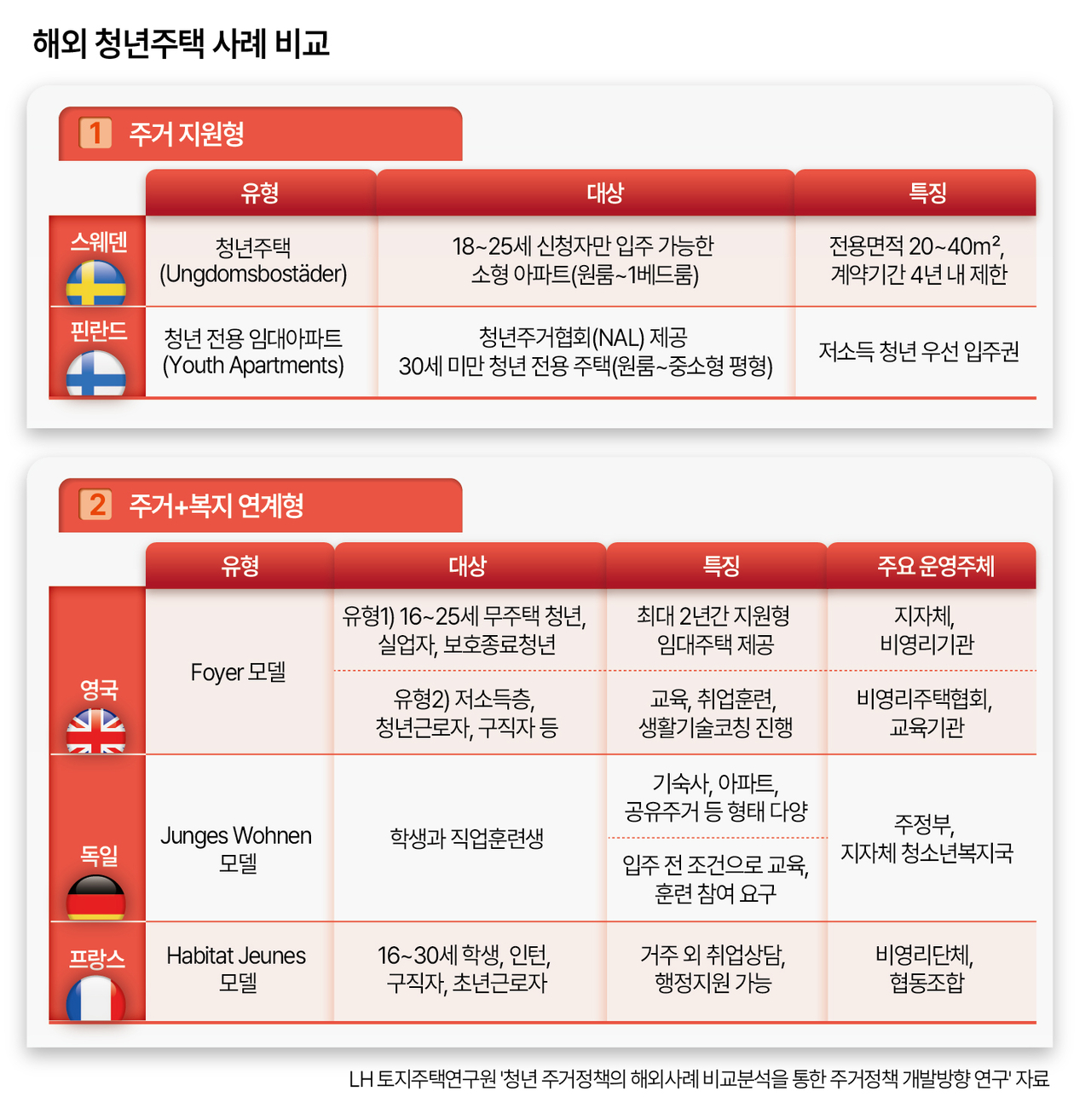
South Korea's youth housing policy has largely centered on hardware-focused public rental housing alongside financial support such as loans. Programs including the Seoul Metropolitan Government's youth safe housing, the Seoul Housing & Communities Corporation's happiness housing for young people and newlyweds, long-term jeonse housing for newlyweds, and purchased rental housing for youth and newlyweds allow applicants to access public housing at below-market prices, serving as a stepping stone before homeownership.
Providing dedicated rental housing for young people is, of course, a common approach worldwide. Sweden has Ungdomsbostäder — small apartments (studios to one-bedrooms) available only to applicants aged 18 to 25, with restrictions on unit size (20 to 40 square meters of exclusive-use area) and tenancy duration (capped at four years). Finland similarly has youth-only rental apartments provided by the National Youth Housing Association, where residents under 30 can live in dedicated units ranging from studios to mid-sized units.
![A housing program run by the Foyer Foundation in London for people aged 16 to 25. [Foyer Foundation website]](https://wimg.heraldcorp.com/news/cms/2026/08/26/news-p.v1.20260826.736ef826fa59480fa8ec3dc0c56dd0d6_P1.jpg)
Overseas, however, youth housing is increasingly treated as temporary accommodation with the ultimate goal of supporting independent living. The United Kingdom's foyer system is a leading example: it provides rental housing to homeless young people aged 16 to 25, the unemployed, care leavers, low-income earners, young workers and job seekers, while going beyond shelter to offer education, job training and life-skills coaching to help residents become self-sufficient.
In France, the Habitat Jeunes model provides rental housing to students, interns, job seekers and early-career workers aged 16 to 30, along with social integration and administrative support. Habitat Jeunes is a transitional housing facility for young people with unstable finances, operated by nonprofits and cooperatives, and has become so widespread that more than 1,200 locations exist across the country.
Germany operates Junges Wohnen, a youth housing support program that runs dedicated rental units for students and vocational trainees. Participation in education or training is required as a condition of entry, meaning the program extends well beyond simply providing a place to live.
Oh has previously cited this kind of integrated residential and service model as the future of housing, based on what he observed during overseas trips. In July last year, on a visit to Europe, he inspected public housing sites in Vienna, Austria, including the Nordbahnhof district — a redevelopment of a disused railway station.
After touring the site's Junges Wohnen units for one- and two-person youth households and Nordbahnhof 43, a 247-unit smart public rental complex, Oh said "public rental housing where diverse groups — single- and two-person households, young people, the elderly and newlyweds — live together, and high-quality rental housing in well-connected locations equipped with care, medical and community facilities, are the core of future public housing supply."
With that in mind, the southeastern youth-specialized industrial complex is expected to incorporate housing of varied types and functions. To gain traction as a credible alternative to youth housing at Yongsan Park, the proposal will need to stand apart not just in volume but as a self-sustaining hub that offers jobs and quality housing alike.
![A mixed-use residential complex in Paris (Résidences Étudiants et Jeunes Actifs). [Korea Land and Housing Corporation Land and Housing Research Institute report]](https://wimg.heraldcorp.com/news/cms/2026/08/26/news-p.v1.20260826.42f2bdaca13442c1a32d73595ff60ce7_P1.jpg)
As such complexes take shape overseas with the involvement of not only the public sector but also private companies and nonprofits, private-sector cooperation is expected to be a key variable for any similar project in Seoul. The Korea Land and Housing Corporation's Land and Housing Research Institute made the same point in the study cited above, recommending that "policy must evolve to integrate support for young people's independence into their lives, not merely provide a place to stay," and calling for "the development of a package-style youth housing model that bundles housing with services — employment, education and welfare — such as making job-placement packages from employment centers mandatory for young people in public rental housing."

hope@heraldcorp.com