
Seoul says raising the FAR cap to 1.2 times current limits could add 43,000 homes; the Land Ministry quickly distanced itself, and analysts warn that rental obligations, construction costs and legislative hurdles could blunt the benefit
![Homes in the redevelopment zone of Cheongpa-dong, Yongsan-gu, Seoul, seen the morning of Aug. 11. [The Herald Business DB]](https://wimg.heraldcorp.com/news/cms/2026/08/27/news-p.v1.20260811.c8bedc3ee7ca4b9abdeaa59f810fdeea_P1.jpg)
As the government and Seoul Metropolitan Government discuss raising the floor-area ratio cap for private redevelopment and reconstruction projects, attention is turning to whether the change will actually translate into more housing supply and lower member contribution fees. Allowing more homes to be built on the same land is likely to improve project viability, but analysts say the real-world impact will vary widely depending on conditions such as the required share of rental housing, public contributions, construction costs and relocation loans.
Seoul: raising FAR to 1.2 times limit could add 43,000 homes, cut contributions by over 100 million won
According to the government and the Seoul Metropolitan Government, Ministry of Land, Infrastructure and Transport Minister Kim Yun-deok and Seoul Mayor Oh Se-hoon met Wednesday to discuss raising the statutory maximum floor-area ratio for private redevelopment and reconstruction projects by up to 1.2 times. After the meeting, Oh said he had confirmed that the ministry was "reviewing the matter with an open mind," adding that increasing the FAR for redevelopment projects by 1.2 times would further boost the net increase in housing supply.
In a proposal for regulatory improvements to the redevelopment and reconstruction system that Seoul submitted to the central government in June, the city had already called for allowing private projects to apply up to 120 percent of the statutory maximum FAR and for a reduction in the share of rental housing required in exchange for the higher ratio.
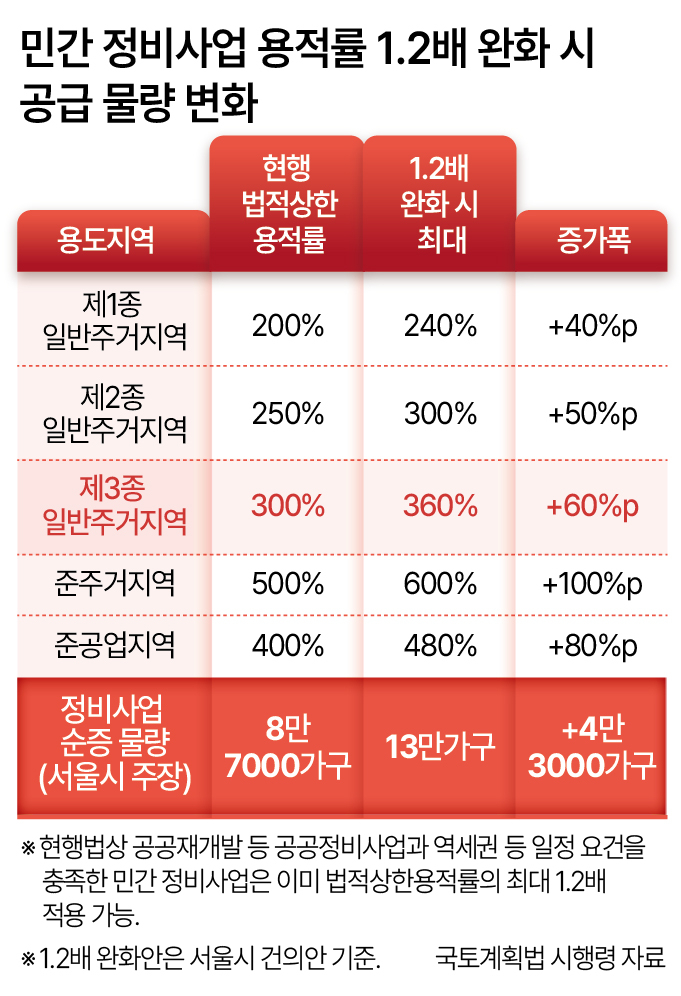
If the measure is realized, projects in third-category general residential zones — where the statutory maximum FAR is currently 300 percent — could build up to 360 percent. In simple terms, that would give developers 20 percent more total floor area than before.
Seoul expects the supply impact to be substantial. Oh said that of the roughly 310,000 units the city plans to break ground on through 2031, the net increase above existing housing stands at about 87,000 units, but that raising the FAR by 1.2 times could add approximately 43,000 more, bringing the total net increase to as many as 130,000 units.
The higher FAR would also reduce the contribution fees borne by existing members of reconstruction associations. According to a report on the economic effects of regulatory improvements in semi-industrial zones released by the Seoul Semi-Industrial Zone Development Forum on Aug. 7, researchers at Chung-Ang University compared statutory maximum FARs of 300 percent and 400 percent for a reconstruction complex of about 500 units and found that the average member contribution fell from 499 million won ($360,000) to 322 million won — a reduction of 177 million won, or 35.5 percent.
A Seoul city incentive program already applied in practice also showed a reduction in contribution fees. At the Banghak Sindonga 1 Complex in Dobong-gu, applying a project-viability correction factor of 2.0 expanded the allowable FAR incentive from 20 percentage points to 40 percentage points, increasing the number of units available for pre-sale from 3,671 to 3,819 — a gain of 148 units. Seoul estimated that pre-sale revenue would rise by about 106 billion won as a result, cutting each member's contribution by roughly 38 million won.
Projects that have already drawn up redevelopment plans may also revisit their financial calculations. If existing redevelopment zones are included in the scope of application following legislative amendments and the adoption of detailed criteria, associations would have the option of revising their plans to secure additional FAR.
There is precedent for boosting supply by revising existing redevelopment plans in response to regulatory easing. In Jeongnong District 12 in Dongdaemun-gu, a revision to the urban renewal promotion plan approved in April raised the FAR from 240 percent to as high as 360 percent, expanding the project from 297 units to 548 units. Half of the additional floor area made possible by the higher statutory FAR was required to be provided as public housing.
The Sindonga Apartment in Yangpyeong-dong, Yeongdeungpo-gu, also benefited after a revised redevelopment plan was approved in July, with the project qualifying for relaxed FAR standards for apartment buildings in semi-industrial zones and growing from 563 units to 762 units — an increase of 199 units. Seoul expects member contribution fees to fall as a result.
Land Ministry pushes back; legislative process and construction costs cast doubt on pace
Even if the Ministry of Land, Infrastructure and Transport agrees to raise the FAR cap, procedural constraints make it difficult to move quickly. In a separate briefing document released the same day as the meeting, the ministry said no decisions had been made regarding "the direction of review related to raising the FAR for private redevelopment and reconstruction projects by 1.2 times." The statement was a clear signal to temper expectations after Seoul announced that the government had agreed to review the FAR increase with an open mind.
Market observers therefore believe that as the government and Seoul trade proposals over housing supply in the capital, reaching a quick agreement may prove difficult.
Even if an agreement is reached, National Assembly legislation could take time. The ruling and opposition parties had discussed passing amendments to the Urban and Residential Environment Improvement Act and the Urban Renewal Promotion Act — which include measures to shorten redevelopment procedures — at a plenary session Wednesday, but failed to reach a final agreement and the bills were not put to a vote. The draft amendment to the Urban and Residential Environment Improvement Act did not include an expansion of the statutory maximum FAR for private projects. A separate bill introduced by People Power Party lawmaker Kim Hee-jeong that would raise the statutory maximum FAR for private projects by up to 1.3 times is, however, already pending before the Land and Infrastructure Committee.
Analysts also note that reducing the rental housing and public contribution burden is essential if the higher FAR is to actually accelerate supply. Even if the total number of units rises with a higher FAR, the revenue an association can earn from general pre-sales may be limited if a substantial share of the additional floor area must be provided as public housing or if the government's purchase price for that housing falls well short of actual project costs.
The cost of building taller is another variable. Adding floors or buildings to absorb the additional FAR raises structural, mechanical and construction costs, and may require a fresh review of traffic, landscape and infrastructure plans. That is why the percentage increase in FAR cannot simply be converted into an equivalent increase in housing supply.
"Even if the FAR is raised to 1.2 times the statutory maximum, the practical benefit to associations could be limited if public housing obligations, government purchase prices and pre-sale price regulations remain unchanged," said an industry official. "When you factor in the construction costs and review burden that come with building higher, simply multiplying the FAR by 1.2 to calculate supply is out of touch with reality."
Kim Je-gyeong, director of Toomi Real Estate Consulting, said associations have no reason to oppose the FAR relaxation but would weigh the actual benefit against conditions such as rental housing requirements rather than automatically applying the higher ratio. "To genuinely accelerate supply, FAR relaxation alone is not enough — it needs to be backed by financial support such as relocation loans," Kim said.
quq@heraldcorp.com





