The corporation builds its own ESSG framework by adding Safety to the standard ESG pillars, highlighting zero serious accidents, barrier-free access across all stations, and greenhouse gas reductions — CEO Kim Tae-gyun vows to strengthen the virtuous cycle linking ESG management to lasting results.
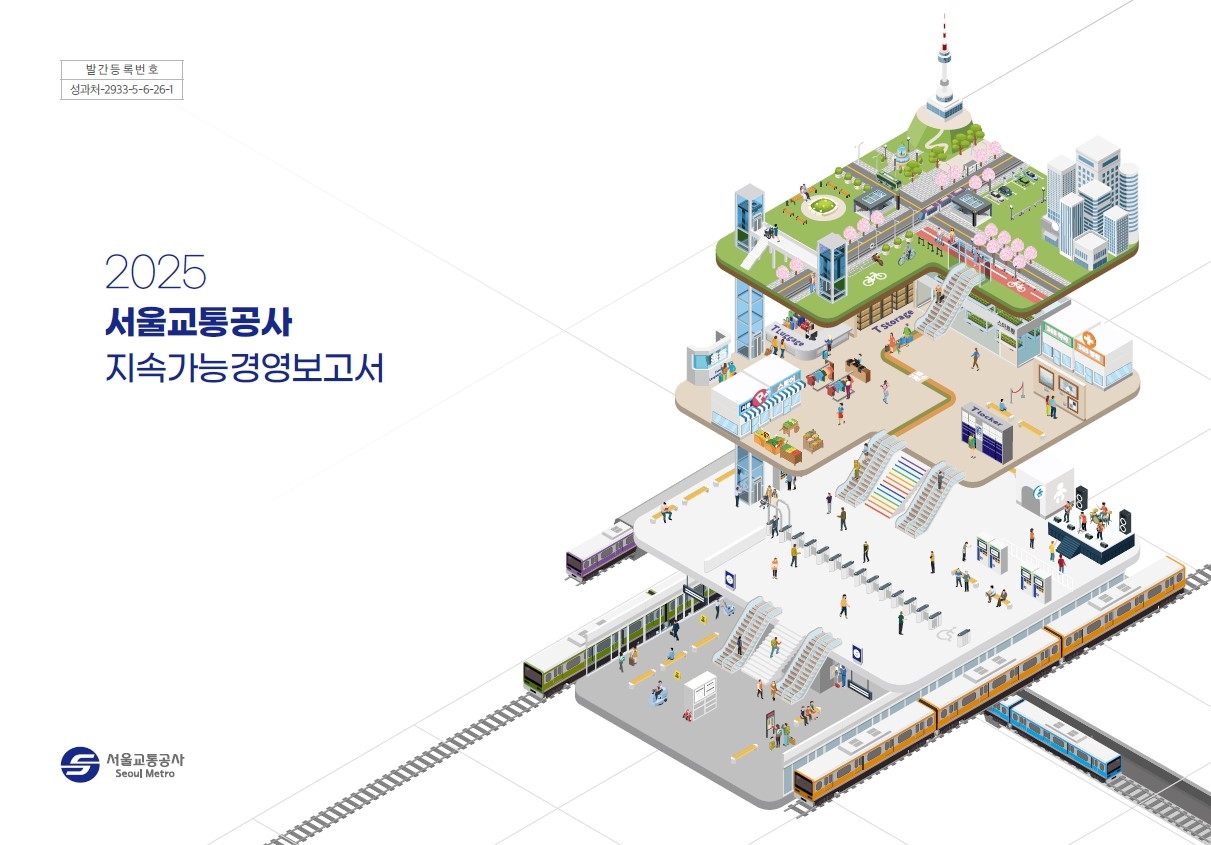
Seoul Metro, which last year received the top rating in the ESG report category at the Vision Awards — organized by the Los Angeles-based League of American Communications Professionals (LACP), a globally recognized authority in public relations and marketing — has released its third sustainability report.
Seoul Metro announced Friday that it has published its "2025 Sustainability Report," consolidating key achievements across safety, environmental stewardship, social responsibility and cooperative partnerships.
The report was produced in compliance with GRI (Global Reporting Initiative) Standards 2021, the UN Global Compact principles, TCFD recommendations, SASB industry standards, and both the K-ESG and public institution ESG guidelines.
A defining feature of the report is Seoul Metro's proprietary ESSG (Environment, Safety, Social, Governance) framework, which departs from the conventional ESG structure by elevating safety out of the social category and establishing it as one of four core pillars. The move reflects the corporation's philosophy of treating safety not as a secondary indicator but as the very foundation of management.
The report also places "Metronext," the corporation's future growth strategy, in a dedicated section at the very top of the main text.
Sweeping achievements across safety, accessibility and climate response
The standout results are in safety. Under its "Safety First" vision, Seoul Metro drew up a mid-to-long-term safety management plan and increased safety investment by 111 percent year-on-year to 64.8 billion won ($46.8 million). Last year, not a single serious accident occurred, and railway incidents fell 25 percent from the previous year to just three cases. Crowd-crush incidents were recorded at zero for the second consecutive year, and cybersecurity breaches at zero for the third consecutive year, demonstrating the corporation's safety management capabilities.
On accessibility, Seoul Metro completed an 18-year goal by finishing barrier-free movement routes across all stations. All 276 stations on lines 1 through 8 now offer a "one station, one route" system, allowing passengers with mobility challenges to travel between street level, the concourse and the platform using elevators without assistance.
The corporation also deployed 250 digital guides at subway stations to help passengers use kiosks and other self-service equipment, and became the first urban rail operator in South Korea to introduce a hearing loop system, further advancing an inclusive transit environment.
On climate, the rollout and expansion of the Climate Companion Card helped cut annual greenhouse gas emissions by approximately 123,000 metric tons, achieving 102.4 percent of the target. In February last year, Seoul Metro established its first environmental management framework and issued 150 billion won in green bonds.
In the social and cooperative partnership sphere, women accounted for 11.9 percent of managerial positions — the highest ratio among urban rail operators nationwide — while the male parental leave utilization rate rose from 7.9 percent in 2021 to 25.5 percent in 2025.
Advance payments to partner companies grew 31 percent year-on-year to 248.3 billion won, and the procurement rate for small and medium-sized enterprise products reached 87 percent, exceeding the statutory threshold of 50 percent by 37 percentage points.
Global standing reaffirmed as corporation targets 'S1st-ESG' in 2026
Seoul Metro's sustained innovation efforts have also been recognized through a series of domestic and international evaluations and awards. In last year's COMET benchmarking survey, the corporation ranked first in the world for both platform screen door installation rate and in-station Wi-Fi coverage — both at 100 percent — and also topped the global rankings for non-fare revenue ratio. It maintained ISO 45001 (Occupational Health and Safety Management System) certification for the sixth consecutive year.
COMET (Community of Metros Benchmarking Group) comprises 45 urban rail operators across 42 cities worldwide. Seoul Metro is the only South Korean member and engages in dialogue and cooperation with rail operators around the globe.
ISO 45001 is an international standard designed to systematically manage workplace hazards, prevent industrial accidents and create safe working environments.
In December last year, Seoul Metro became the first organization nationwide to win awards at the Railway Safety Innovation Competition — organized by the Ministry of Land, Infrastructure and Transport and hosted by the Korea Transportation Safety Authority — for five consecutive years, taking two prizes simultaneously (grand prize and excellence award). In the K-ESG performance assessment conducted by the Korea Public ESG Research Institute, it was the only urban rail operator in the country to receive an A rating for three consecutive years, reaffirming strong performance in information disclosure, human rights management, ethical management, and community and public safety.
This year, Seoul Metro plans to advance its ESSG framework a step further by upgrading to "S1st-ESG (Safety First-ESG)" management. The core objective is to embed safety — alongside environment, social and governance considerations — into all corporate management activities.
The corporation will also pursue a phased normalization of its financial health to overcome accumulated structural fiscal challenges. Seoul Metro views fiscal soundness as a critical foundation for sustaining safe urban rail services and plans to pursue cost efficiency, revenue diversification and a rational expansion of fiscal support in parallel.
"Seoul Metro will continue to respond proactively to changes in domestic and international ESG disclosure standards and regulations, while actively leveraging advisory mechanisms such as the ESG Management Committee to closely monitor key sustainability policies and outcomes," Seoul Metro CEO Kim Tae-gyun said. "On that basis, we will further solidify the virtuous cycle in which ESG management translates into lasting, sustainable results."
The full text of the "2025 Seoul Metro Sustainability Report" is available for viewing and download on Seoul Metro's official website.
seouldream01@heraldcorp.com