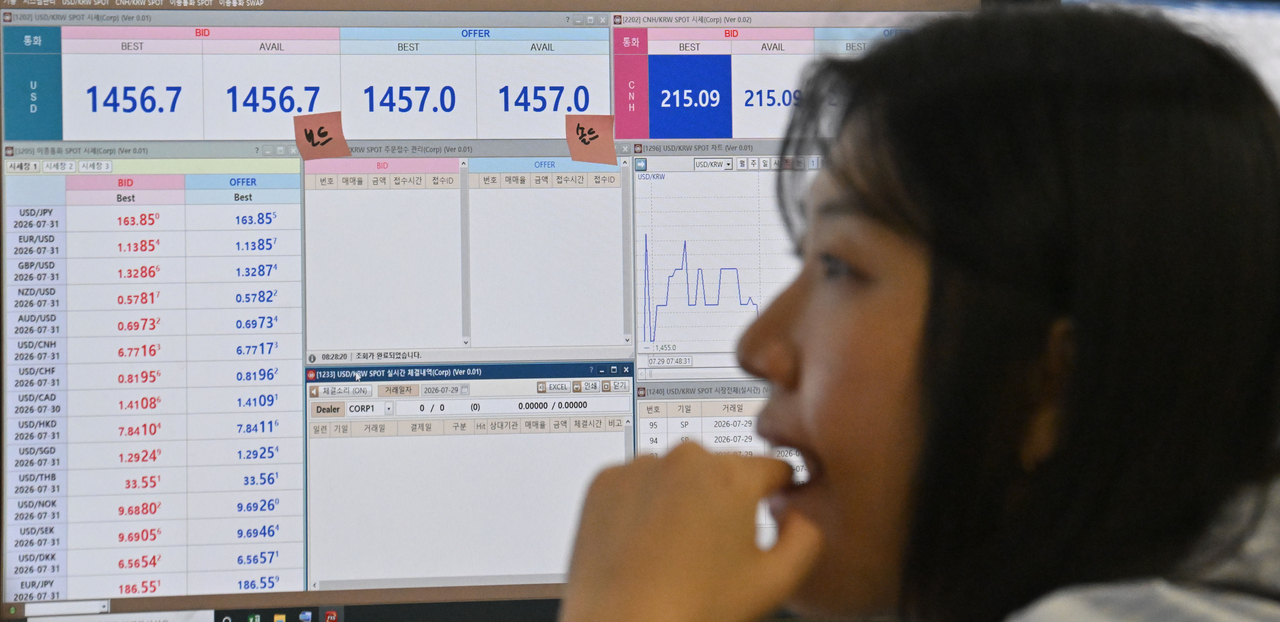
As share price volatility subsides, the flow of funds and trading volumes moving through the domestic stock market are declining rapidly. Analysts say investor interest that had poured in to chase large price swings is cooling alongside the easing volatility.
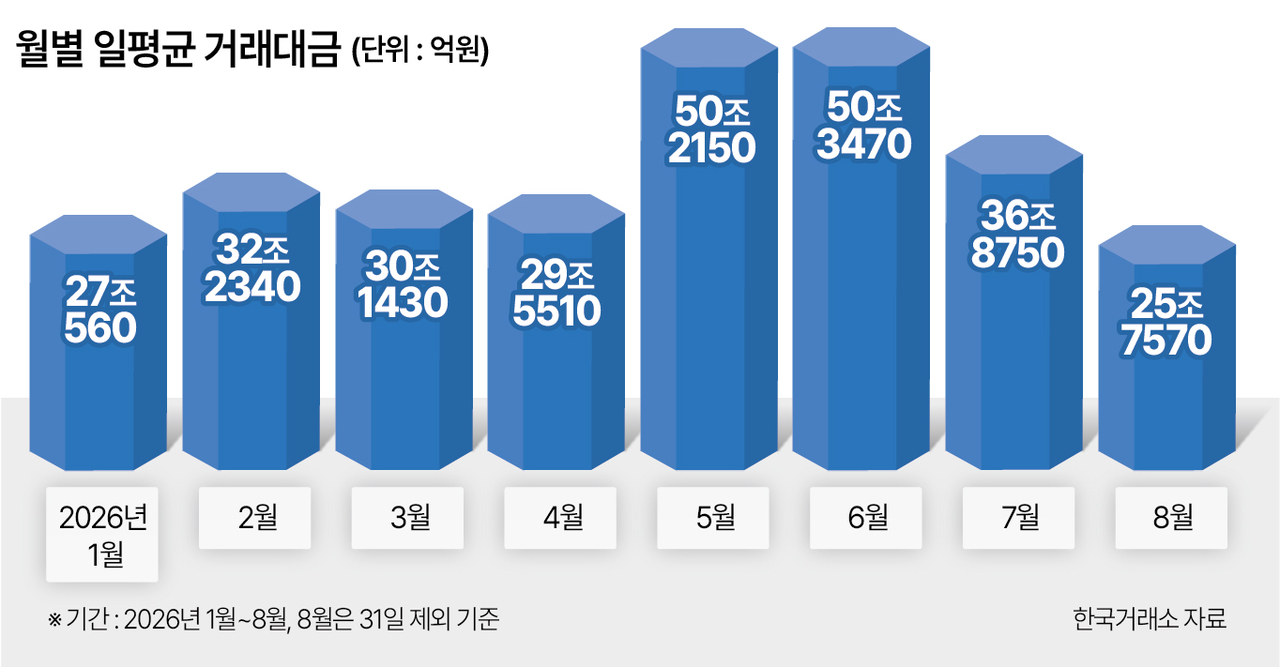
According to Korea Exchange data released Monday, average daily trading value on the Kospi market stood at around 26 trillion won ($18.9 billion) in August, based on figures compiled before the market opened that day.
That is roughly half the level of just two months ago. Daily average trading value on the Kospi market reached around 50 trillion won in both May and June, before falling to around 37 trillion won in July and sliding further to the mid-20 trillion won range in August.
The decline in trading volume is even more pronounced. Average daily trading volume on the Kospi market reached about 1.1 billion shares in March. It then fell to around 900 million shares in April and about 700 million in May, before dropping to around 500 million in June and about 400 million in July. This month, average daily volume has fallen to around 300 million shares — a quarter of the March level in just five months.
Analysts point to the recent calming of market volatility as the key driver behind the sharp contraction in trading activity. The domestic stock market experienced both historic surges and steep drops within a short span this year.
The Kospi soared to an intraday high of 9,385.59 on June 19, breaking above the 9,000 mark for the first time in history. Expectations spread in the market that the index could push past 10,000 — a milestone traders dubbed "Manspi."
The situation reversed sharply, however, as a correction in global semiconductor stocks combined with the burden of an overextended rally. The Kospi plunged to an intraday low of 5,262.77 on July 29, falling more than 40 percent from its peak in just over a month and sending fear in the market to an extreme.
The index has rebounded considerably from that low this month, though the violent swings of the earlier period have largely subsided. On Aug. 18, the Kospi climbed to an intraday high of 7,216.62, crossing back above the 7,000 level, but it could not hold the gain and closed in the 6,000 range. The last time the Kospi closed above 7,000 was July 23, when it finished at 7,096.89.
As index movements stabilized, the frequency of market safety-mechanism activations also fell noticeably. The Kospi sidecar — a short-term trading halt triggered by sharp futures moves — was activated 10 times in June and 15 times in July. Given that July had 22 trading days, the sidecar fired on 15 of them. Of the 49 sidecar activations recorded so far this year, more than half — 25 — were concentrated in those two months.
August has been a different story. The sidecar was activated just five times this month, about a third of July's count. The circuit breaker, which halts all trading when the market falls sharply, has not been triggered once in August.
The circuit breaker — activated when the Kospi falls more than 8 percent from the previous close for at least one minute — was triggered twice in March, three times in June and four times in July, with the pace accelerating rapidly. It has not fired at all so far in August, signaling that the extreme swings have largely run their course.
The concern, however, is that trading enthusiasm is fading just as quickly as market anxiety. Typically, when stock market volatility rises, fear of price declines grows, but so does trading activity from investors hoping to profit from large short-term price moves.
Particularly in markets where the index swings sharply within a single day, demand for leveraged products and short-term trading tends to concentrate, driving sharp increases in both volume and trading value. Conversely, when the index moves within a narrower range and daily swings shrink — as has been the case recently — the potential profit window for short-term investors narrows as well.
In fact, the domestic market saw extreme volatility in June and July, with safety mechanisms triggering repeatedly, and daily trading value hit its highest levels during that period. In August, as both volatility indicators and sidecar activations fell simultaneously, trading value and volume dropped sharply as well.
While the easing of fear is a positive sign for market stability, the simultaneous decline in investor interest and capital inflows is a source of concern.
"Single-stock leveraged products had been concentrating buying pressure on specific stocks, but after the related regulations took effect, trading itself contracted," an industry official said. "Ultimately, these changes can be interpreted as having affected market supply and demand as well." The official added that fresh capital will need to flow in for the market to regain momentum.
th5@heraldcorp.com