Child Independence Fund allocated 146.5 billion won in next year's budget
Sept. 1 cutoff tied to Cabinet approval date
Children born Aug. 31 excluded despite one-day difference
Low-income families can receive up to 22.8 million won over 19 years
Tax benefits under review for pre-cutoff births; National Assembly may adjust terms

A new government child savings program will restrict its matching contributions to children born on or after Sept. 1, 2026, creating a stark support gap based solely on birth date. Even families with identical incomes will be treated differently: a child born on Sept. 1 qualifies for government support, while one born the day before — Aug. 31 — does not. For low-income households, the difference in government contributions alone could reach as much as 22.8 million won ($16,600).
According to the government's 2027 budget proposal released Wednesday, the Financial Services Commission has allocated 146.5 billion won in new funding to establish the Child Independence Fund, a long-term child savings vehicle. Under the program, parents open a fund in their child's name, and the government contributes alongside them from birth until the child turns 18.
The level of government support varies by household income. For families earning at or below 50 percent of the median income, the government contributes 1.2 million won per year even if parents make no contributions of their own. Families earning between 50 and 100 percent of the median income receive up to 1 million won annually from the government when parents contribute 500,000 won a year, while those earning between 100 and 150 percent of the median receive up to 1 million won in matching funds when parents put in 1 million won. Families above 150 percent of the median income receive no government support.
The problem lies in the cutoff date. Although the Child Independence Fund is funded through the 2027 budget, the government set the eligibility start date at Sept. 1 of this year — four months before the budget year in which the program's funding actually takes effect.
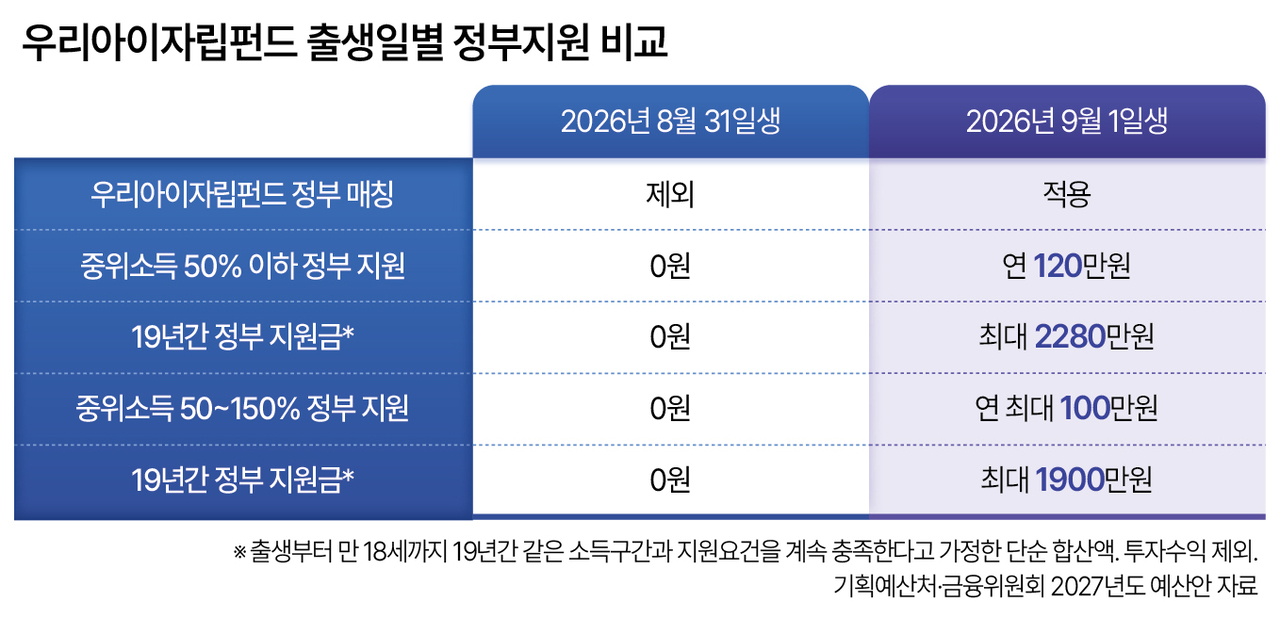
As a result, a child born on Sept. 1 is eligible for government matching contributions, while a child born the day before — Aug. 31 — is not, even if both families have the same income.
For low-income households in particular, the gap can exceed 20 million won. A family earning at or below 50 percent of the median income that continuously meets eligibility requirements from birth through age 18 would receive 1.2 million won per year, totaling 22.8 million won in government contributions. Because those contributions are also invested within the fund over the long term, the actual gap in assets at maturity could be even larger once investment returns are factored in.
An FSC official said the eligibility date was set to coincide with when the budget proposal is finalized through the Cabinet meeting. "Rather than delaying support further, the intent was to begin helping children being born right now," the official said.
The issue of support gaps tied to birth dates has already surfaced in other child-rearing policies. The government had originally planned to replace the existing first-welcome voucher, parental allowance and child benefit with a new child-welcome grant and basic child allowance starting with children born on or after July 1 next year.
That decision meant children born just one day apart — on June 30 and July 1 — would receive vastly different levels of support. For a first child raised at home in the greater Seoul area, a child born on July 1 and covered under the new system would receive 12.8 million won more than one born on June 30.
As the "birth-date cliff" problem drew public attention, President Lee Jae Myung directed the Cabinet meeting on Tuesday to review retroactively extending eligibility to children born on or after Jan. 1 next year.
![The Financial Services Commission office inside Government Complex Seoul in Jongno-gu, Seoul [Yonhap]](https://wimg.heraldcorp.com/news/cms/2026/09/02/news-p.v1.20260813.95987ee547804aa7bea606b809b3a517_P1.png)
As concerns mount over the birth-date support gap, the government is exploring ways to extend benefits to children born before the cutoff date under the Child Independence Fund as well. Separately from the matching contributions, the government is considering offering additional tax benefits to those families. The Ministry of Economy and Finance said in a press release that it is "reviewing the possibility of providing additional tax support benefits beyond the government contribution funding reflected in the 2027 budget." The specific form of support — such as a reduced separate tax rate on income or a full tax exemption — and its scope have not yet been determined.
Whether children born before Sept. 1 will ultimately be excluded from the government matching contributions has also not been finalized. Because the fund's budget and detailed rules must still go through National Assembly deliberations, there remains a possibility that the eligibility criteria or the cutoff date could be adjusted during that process.
rim@heraldcorp.com