Korea Future Population Institute analyzes big data from workplace community app Blind; 37.7% of retirement-related posts tied to marriage; share of posts scrutinizing a partner's background jumps 15 percentage points in three years
![A wedding ceremony. [Yonhap]](https://wimg.heraldcorp.com/news/cms/2026/09/03/news-p.v1.20260903.347a26ab839f4c7aafe4e111ac5eeeac_P1.jpg)
As South Korea enters a super-aged society, interest in retirement preparation has never been higher — but the way office workers talk about it is growing increasingly anxious, according to a new analysis.
The Korea Future Population Institute, a think tank specializing in demographic research, released findings Thursday from an eight-year study of posts and comments on the workplace community app Blind related to retirement, pensions and retirement-age extension, covering 2018 through 2025.
The analysis found that 37.7 percent of all retirement-related posts were tied to marriage and dating. The share of posts scrutinizing a potential partner's attributes — including appearance, income, age and family background — jumped from 25.6 percent in 2020 to 40.4 percent in 2023, a rise of 15 percentage points in three years.
What was once a general desire for a financially stable partner has shifted into more specific calculations, with users now factoring in whether a prospective partner's parents have adequately prepared for their own retirement.
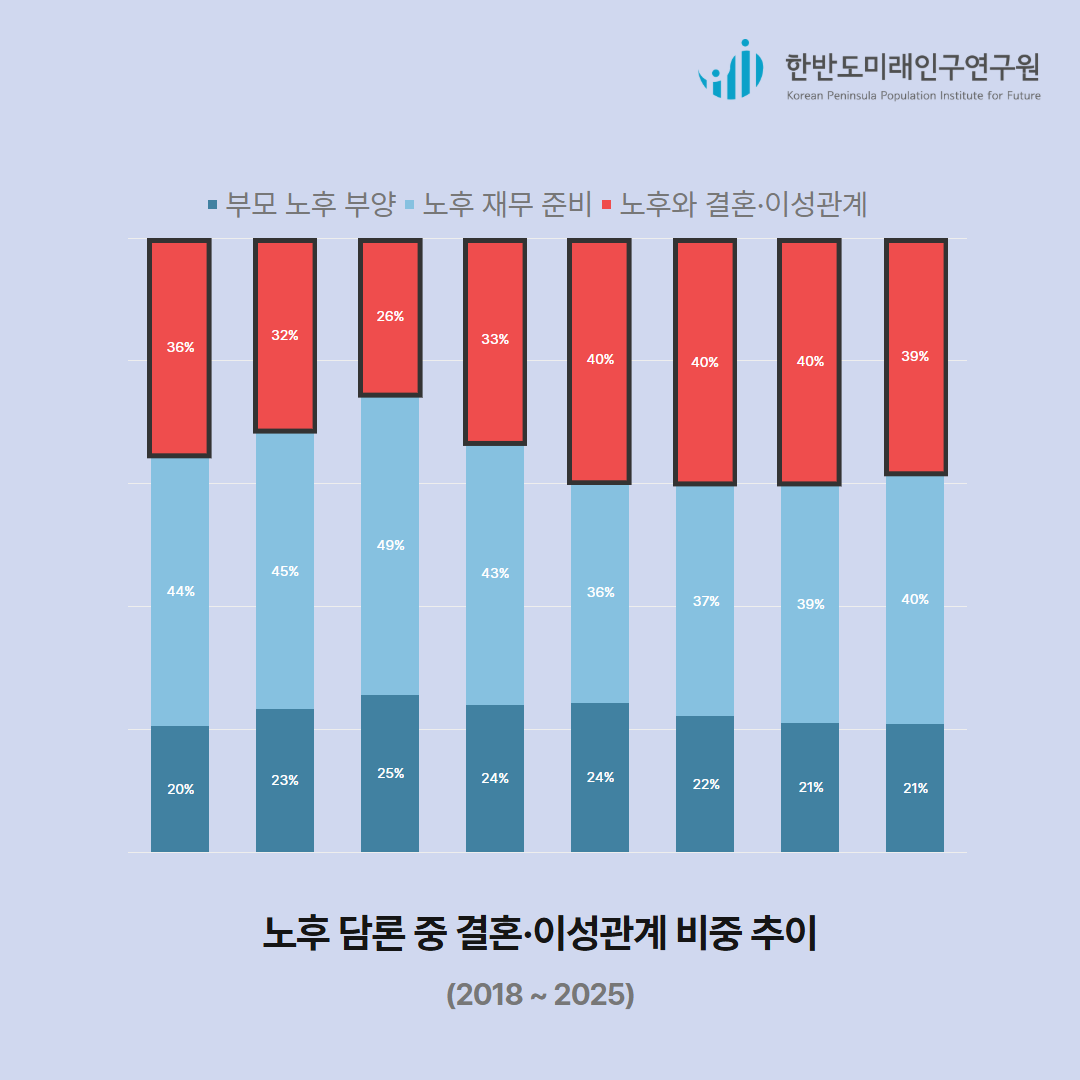
Across all major themes in retirement-related posts — financial preparation (50%), marriage (54%) and parental support (54%) — negative emotions were the dominant tone.
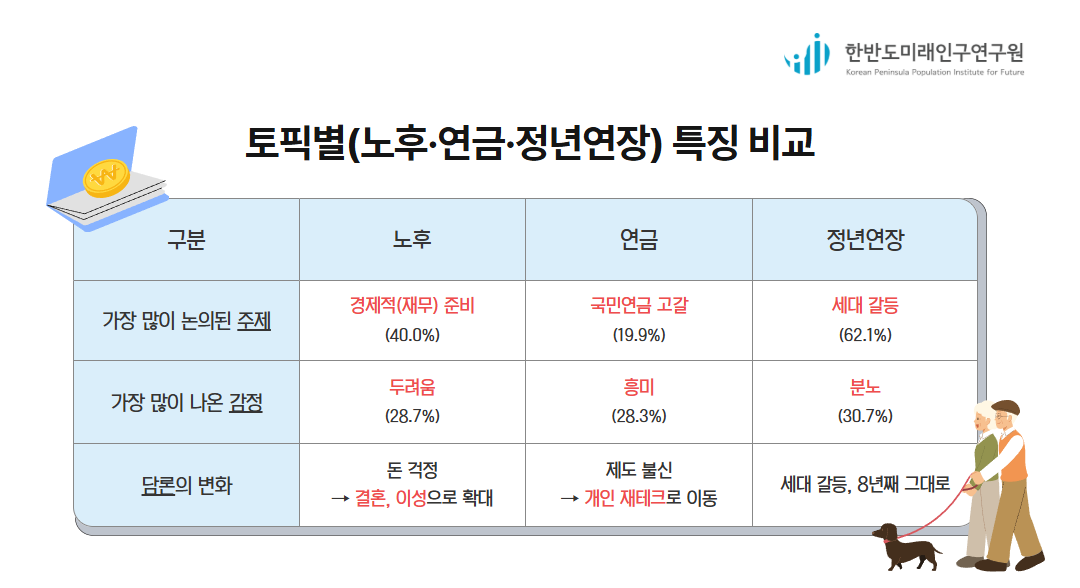
"Fear" was the most frequently expressed emotion overall, appearing in 32 percent of posts about financial preparation — the highest share of any category. Words related to financial planning, such as pension, savings, insurance, investment and retirement, frequently appeared alongside residential terms like apartment, loans, jeonse and cash.
Attitudes toward pensions have also shifted markedly.
For most of the eight-year period, "interest" was the most common emotion in pension-related posts — but in 2025, "fear" overtook it for the first time.
However, posts about individually managed products such as pension savings accounts and retirement pension plans still showed "interest" as the leading emotion. Sentiment toward the national pension was far more negative, with 62 percent of related posts expressing negative feelings; "anger" was the single largest emotion within that group, accounting for 36 percent.

Of the three major topics examined, discussions about retirement-age extension drew the strongest negative reactions.
Posts covering union wage negotiations were 73 percent negative, with "anger" accounting for 51 percent of those responses. Posts on generational conflict were 65 percent negative. Some 62 percent of retirement-age extension discussions touched on generational and demographic issues, a pattern that remained largely unchanged across all eight years. The findings suggest that for office workers, raising the retirement age is less a personal question about when to stop working and more a generational issue intertwined with youth employment.
Yoo Hye-jeong, head of the institute's population research center and the study's lead researcher, said retirement anxiety is spreading well beyond retirement itself — into marriage, housing, pensions and generational conflict. "This is not simply a matter of preparing for old age; it is one facet of the demographic crisis our society faces," she said. "Retirement is no longer a distant future concern — it has already become a present-day issue for the younger generation, bound up with marriage and employment. If we do not act now, it could return as a burden too heavy for our entire society to bear."
thlee@heraldcorp.com