Diesel tops $5.68 a gallon, futures up 13%, reigniting inflation fears; US debt hits record $40 trillion as Treasury supply swells; investors demand higher term premium for long-dated bonds; Warsh's Fed adds uncertainty even as Bessent's intervention proves short-lived
![New York Stock Exchange [123RF]](https://wimg.heraldcorp.com/news/cms/2026/09/03/news-p.v1.20260603.b7c9d26e34f14651874ec6f76346073c_P1.jpg)
Four forces are bearing down on global bond markets at once: inflation fears stoked by the war with Iran, US national debt that has surpassed $40 trillion, rising term premiums demanded by long-bond investors, and monetary policy uncertainty surrounding newly installed Federal Reserve Chair Kevin Warsh.
Each headwind feeds the others. War drives up energy prices and, through them, inflation. Swelling deficits force the government to flood markets with more Treasury supply. As price and fiscal uncertainty mount, investors demand higher yields in exchange for locking up money for years. The unpredictability of the new Fed leadership has now been layered on top.
The Wall Street Journal on Wednesday (local time) analyzed the key variables driving global long-term government bond yields to their highest levels in years, noting that multiple factors are working in combination.
① War reignites inflation fears
Of the four forces, war is currently pressing hardest on the bond market.
Energy prices surged sharply this summer after a US-Iran truce collapsed and Ukraine intensified strikes on Russian oil refineries — Russia being a major diesel exporter.
Bond markets are watching diesel prices in particular. The national average retail price of diesel in the United States topped $5.68 per gallon on Wednesday, roughly $2 more than a year ago. That is within a cent of the peak reached last spring when fighting broke out in the Persian Gulf and traffic through the Strait of Hormuz was disrupted. It is also just 13 cents below the 2022 record set when Russia's invasion of Ukraine sent energy prices soaring.
Prices could climb further. Diesel futures for October delivery rose about 13 percent over the past week.
Rising diesel costs ripple through the broader economy more forcefully than gasoline price increases. Diesel powers trucks, trains, construction equipment and farm machinery, so when its price rises, transportation and production costs follow — and those costs eventually pass through to food, manufactured goods and other consumer prices.
"The sharp rise in bond yields globally reflects investors reassessing inflation," said Mike Goosay, chief investment officer at Principal Asset Management.
Inflation is the bond investor's greatest enemy. Because bonds pay a fixed rate of interest, rising prices erode the real return an investor receives. The longer inflation is expected to persist, the higher the yield investors demand before they will buy government debt.
![Ships are anchored near Larak Island in the Strait of Hormuz off southern Iran as an Iranian flag flutters in the wind on May 16. [Getty Images]](https://wimg.heraldcorp.com/news/cms/2026/09/03/news-p.v1.20260831.f06d560675b14846b9604cfc5c1bd0e6_P1.jpg)
② $40 trillion in debt — who will buy all those Treasuries?
The second source of pressure is the state of US government finances.
US national debt surpassed $40 trillion for the first time last month. The ratio of public debt to GDP is climbing rapidly toward levels not seen since World War II.
The more debt accumulates, the more Treasuries the government must issue. When supply hits the market faster than demand can absorb it, bond prices fall and yields rise.
Higher yields, in turn, compound the fiscal burden. Bonds issued years ago at rates of 1 to 2 percent are maturing and must be refinanced at today's much higher rates — a steady conversion of cheap debt into expensive debt.
Annual interest payments by the US government have already surpassed defense spending, a situation rarely seen since World War II.
Fiscal anxiety is not confined to the United States. In the United Kingdom, surging gilt yields are pressuring the government to cut its debt load. In Japan, a debate over tax cuts and mounting fiscal deterioration have pushed 10-year government bond yields to their highest level in roughly 30 years.
Governments around the world are simultaneously flooding markets with large volumes of debt, competing for the same pool of global bond investors.
③ 'Pay us more to lend for 10 or 30 years' — term premium rises
The third force is the term premium.
The term premium is the extra yield investors demand as compensation for the risk of tying up their money in a bond for an extended period.
In plain terms, it is investors telling the US government: "If you want to borrow from us for 10 or 30 years, you need to pay us more interest."
The harder it is to predict future inflation, how much more debt the government will issue, or how wide the deficit will grow, the higher that premium becomes.
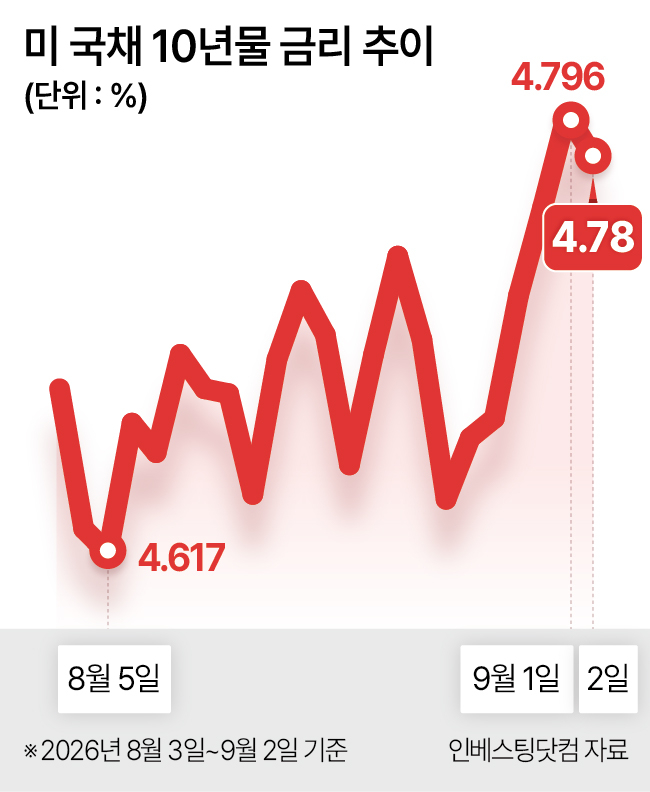
The US term premium has been trending upward recently, with the shift most pronounced since the outbreak of the war with Iran. It signals that investors are pricing into long-dated Treasuries the possibility that a prolonged conflict will push energy prices and inflation still higher.
Term premiums on long-dated bonds are rising in Europe and Japan as well — a sign that the cost of lending money for a long time is becoming more expensive across global bond markets, not just in the United States.
The AI investment boom is adding further pressure on Treasury supply and demand. Big tech and AI-related companies are issuing large volumes of corporate bonds to fund data center and power infrastructure construction, competing with government debt for investor capital.
Global AI-related bond issuance has reached around $500 billion. Robin Wigglesworth, editor of the Financial Times' Alphaville, said AI bond issuance may push government bond yields up to some degree, but its impact is limited compared with fiscal and inflation pressures.
![Federal Reserve Chair Kevin Warsh holds a press conference at the Fed's Washington headquarters on Saturday (local time). [Reuters]](https://wimg.heraldcorp.com/news/cms/2026/09/03/news-p.v1.20260902.fa638bb734b5482a89baa3c2c74befcd_P1.jpg)
④ Where is 'Warsh's Fed' headed? Uncertainty adds its own premium
The final source of pressure is the Fed itself.
Chair Warsh signaled his commitment to containing inflation in his Jackson Hole speech late last month, easing some market concern that the Fed might not be tough enough on prices.
But unlike his predecessors, he offered no clear guidance on the specific path of interest rates ahead.
Markets now find it harder to gauge what level of rates the Fed considers appropriate, or how aggressively it would respond if inflation reaccelerates. That uncertainty itself is being priced into long-term Treasury yields as a new risk premium, analysts say.
"If I had to name one thing that is clearly different from a few months ago, it is the Fed's behavior since Kevin Warsh took over as chair," said David Kelly, chief global strategist at JPMorgan Asset Management. "I think a Fed risk premium, even if small, has been added to the market."
As the four pressures intensified simultaneously, the Donald Trump administration moved to intervene directly in the market.
Treasury Secretary Scott Bessent unveiled a plan to expand purchases of existing long-dated Treasuries — an attempt to boost market liquidity and cap rising yields by buying back bonds that trade relatively infrequently.
The effect did not last. Yields dipped briefly after the announcement, then resumed their climb.
The US Treasury market is roughly $32 trillion in size, with daily trading volume exceeding $1 trillion. Analysts say buying tens of billions of dollars in additional Treasuries is far too small to reverse the direction of a market of that scale.
Wigglesworth likened the Treasury's bond-buying effort to "trying to put out a wildfire with a water pistol."
Kelly also compared Bessent's response to a credit card. He said that rather than raising taxes and cutting spending to narrow the deficit, simply expanding the government's bond-buying capacity is like "finding one more credit card among the 20 you already have that hasn't quite hit its limit yet."
The deeper problem is that the four pressures are not moving independently — they are amplifying one another.
A prolonged war pushes energy prices and inflation higher; higher inflation leaves the Fed less room to cut rates. Elevated rates compound the interest burden on a government already carrying more than $40 trillion in debt; and as fiscal concerns deepen, investors demand an ever-higher term premium to hold long-dated Treasuries.
sjy@heraldcorp.com