Gangnam-gu, Seocho-gu post four straight weeks of declines after tax reform plan
Songpa-gu's direction seen as key bellwether
Long-term capital gains deduction changes remain a wild card
Dongdaemun-gu, Seongbuk-gu, Jungnang-gu notch new price records
![A real estate agency in Songpa-gu, Seoul. [Yonhap]](https://wimg.heraldcorp.com/news/cms/2026/09/04/rcv.YNA.20260831.PYH2026083109510001300_P1.jpg)
Home prices in Gangnam-gu and Seocho-gu have fallen for four consecutive weeks since the Aug. 3 tax reform package was announced, raising questions about whether further declines lie ahead. Songpa-gu has also seen its rate of price gains slow, suggesting the broader Gangnam area is entering a period of correction.
Experts say the trajectory of prices will depend heavily on how the National Assembly handles remaining variables in the reform package, particularly proposed changes to the long-term capital gains special deduction on property transfers. Meanwhile, record-high transactions continue to emerge in outer Seoul districts dominated by mid- to lower-priced apartments, making it unlikely that the Gangnam downturn will spread across the city.
According to real estate big data platform Asil, the total number of listings in the three Gangnam-area districts stood at 26,268 as of Thursday, up 18 percent from 22,182 a month earlier. Over that period, listings rose across all three districts — Gangnam-gu from 9,453 to 11,194, Seocho-gu from 7,630 to 9,048, and Songpa-gu from 5,099 to 6,026.
Compared with a year ago, when total listings stood at 16,298, the increase reaches 61 percent. Year-on-year, Seocho-gu listings jumped 69 percent, Gangnam-gu 65 percent and Songpa-gu 45 percent.
The trend in the three Gangnam districts stands in sharp contrast to the rest of Seoul, where total listings fell 12.7 percent over the past year, from 78,894 to 68,910. End-user demand has concentrated in mid- to lower-priced apartments below 1.5 billion won ($1.1 million), which are more accessible to mortgage borrowers, driving listings down by roughly half in outer districts such as Jungnang-gu (down 55.3 percent), Gangbuk-gu (down 50.9 percent) and Seongbuk-gu (down 48.7 percent).
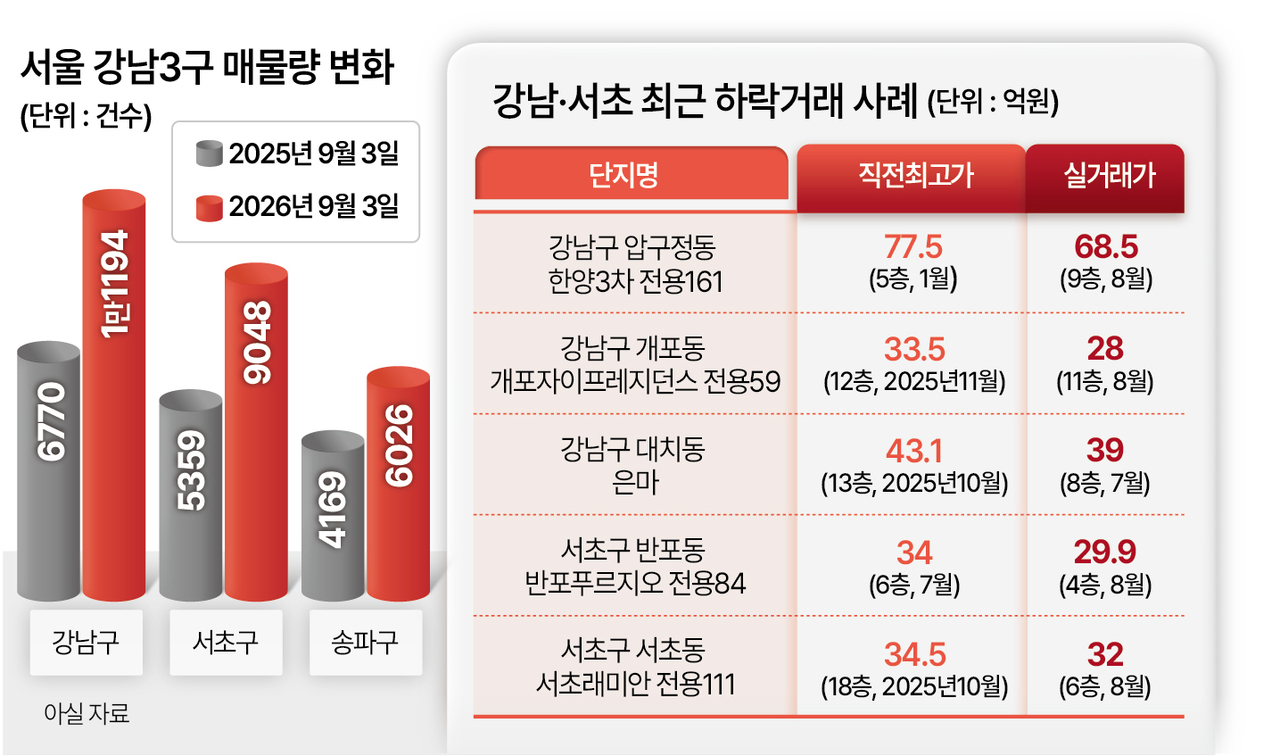
The buildup of listings in the three Gangnam districts has translated into actual price declines. A 61-square-meter unit at Hanyang 3-cha in Apgujeong-dong, Gangnam-gu changed hands this month for 6.85 billion won — 900 million won below the previous record of 7.75 billion won set in January for a fifth-floor unit. The latest transaction involved a ninth-floor unit.
In Seocho-gu, a 111-square-meter unit at Seocho Raemian in Seocho-dong sold last month for 3.2 billion won — 250 million won below the previous record of 3.45 billion won set last October — with the sixth-floor unit finding a new owner after the 18th-floor record was set.
Industry observers said the combination of tightened regulations and higher taxes targeting high-end properties, along with growing investment uncertainty from rising interest rates, has deepened the slowdown in transactions and the accumulation of unsold listings in the Gangnam area. President Lee Jae Myung recently posted on X, formerly Twitter, that "home prices in Gangnam are falling sharply." According to the Korea Real Estate Board, the sale price index in both Gangnam-gu and Seocho-gu has declined for four consecutive weeks since the second week of August.
![Apartment complexes across Seoul as seen from the observation deck of the 63 Building in Yeouido, Yeongdeungpo-gu. [Yonhap]](https://wimg.heraldcorp.com/news/cms/2026/09/04/rcv.YNA.20260830.PYH2026083004370001300_P1.jpg)
Experts cautioned that it remains to be seen whether the current correction will persist over the medium to long term. New record-high transactions are still occurring in some Gangnam complexes, making it premature to call the move a sustained downtrend. For instance, an 84-square-meter unit at Hillstate Seocho Gentris, a relatively new apartment complex in Sinwon-dong, Seocho-gu, set a new record on Aug. 6 when it sold for 2.1 billion won on the seventh floor. The current asking price ceiling at that complex starts at 2.2 billion won — a contrast to complexes such as Apgujeong Hyundai, where distressed listings have appeared at prices several hundred million won below previous records.
Nam Hyeok-woo, a real estate researcher at Woori Bank, said the key question is whether the correction spreading through Gangnam-gu and Seocho-gu will extend to Songpa-gu as well. "Right now, localized corrections are occurring mainly in complexes with heavy tax burdens, so asking prices at individual complexes, weekly price change rates and whether the weakness spreads to neighboring complexes will be the important market indicators to watch," he said.
Experts also said the fate of the long-term capital gains special deduction — left out of the government's final plan adopted at the Cabinet meeting on Tuesday — will be a key factor shaping Gangnam home prices going forward, depending on whether the National Assembly moves to abolish or delay it.
One real estate expert said the market still views the proposed 1 billion won cap on the long-term capital gains deduction and the potential abolition of holding-period benefits as major sources of uncertainty. "Depending on the outcome of the National Assembly deliberations, the market will see a mix of responses — some owners rushing to list at distressed prices, others pulling their listings," the expert said.
![A real estate agency in Songpa-gu, Seoul. [Yonhap]](https://wimg.heraldcorp.com/news/cms/2026/09/04/rcv.YNA.20260831.PYH2026083109500001300_P1.jpg)
Many analysts also see limits to how far the localized downturn centered on Gangnam-gu and Seocho-gu can spread across Seoul as a whole.
The sale price index for Seoul excluding Gangnam-gu and Seocho-gu has held above a 0.2 percent weekly gain for four consecutive weeks through this week, according to the Korea Real Estate Board. Outer districts have actually accelerated, with Dongdaemun-gu's weekly gain widening from 0.37 percent to 0.42 percent. Record-high transactions have continued in Seongbuk-gu, which has seen prices rise a cumulative 13.05 percent this year, as well as in Dongdaemun-gu (up 9.81 percent) and Jungnang-gu (up 8.43 percent).
In Seongbuk-gu, a 59-square-meter unit at Raemian Artrich in Seokgwan-dong set a new record on Aug. 12, selling for 1.26 billion won on the eighth floor. In Dongdaemun-gu, a 59-square-meter unit at Jeonong Usung in Jeonong-dong changed hands on Aug. 22 at a record 880 million won on the eighth floor, 30 million won above the previous transaction. In Jungnang-gu, an 84-square-meter unit at Hansin Apartment in Junghwa-dong set a new record on Aug. 10 at 1 billion won, and asking prices for regular listings at the complex have since climbed above 1 billion won.
Market participants expect the upward momentum in outer districts to continue, supported by shrinking rental supply and loan regulations that still favor apartments priced below 1.5 billion won. Nam said accommodative lending policies aimed at non-homeowning people in their 20s and 30s — including a planned 3 percentage point expansion of total loan volume management and a relaxation of income eligibility requirements for the Bogeumjari mortgage program — should sustain a "rotation effect" in which mid- to lower-tier areas below the 1.5 billion won threshold continue to drive Seoul-wide price gains independently of trends in Gangnam.
hope@heraldcorp.com