Deal signed during lithium downturn; profits at two mines jump more than eightfold in a year
Posco-backed mines post record earnings; locals ask if shares were sold too cheaply
Mineral Resources CEO: 'Satisfied with the deal… Posco is an excellent partner'
Transaction expected to close this year; full earnings contribution seen from next year
Posco's hard-rock lithium refining capacity to reach 73,000 tonnes
![The Wodgina lithium mine in Western Australia, operated by Australia's Mineral Resources, in which Posco Holdings has made an equity investment. [Posco Holdings]](https://wimg.heraldcorp.com/news/cms/2026/09/04/news-p.v1.20260109.1c4dc671eee4499eb07a6507dd646ccb_P1.jpg)
A 1 trillion won ($736 million) bet placed by Posco Group Chairman Chang In-hwa during the lithium downturn appears to be paying off. The profits generated by the Wodgina and Mount Marion mines in Australia, in which Posco Holdings has invested, more than octupled in a single year.
According to industry sources, Australia's Mineral Resources reported lithium division sales of A$1.31 billion for fiscal year 2026 (July 2025–June 2026), more than double the prior year's figure. Profitability improved sharply as well: earnings before interest and tax (EBIT) swung from a deficit of A$227 million the previous year to a profit of A$560 million this year.
Total revenue at Mineral Resources rose 44 percent to A$6.5 billion, the company's best result in the 20 years since its 2006 listing.
Both volume and price drove the lithium rebound. Combined spodumene concentrate sales from Wodgina and Mount Marion reached 559,000 tonnes, an all-time high and a 28 percent increase from the prior year.
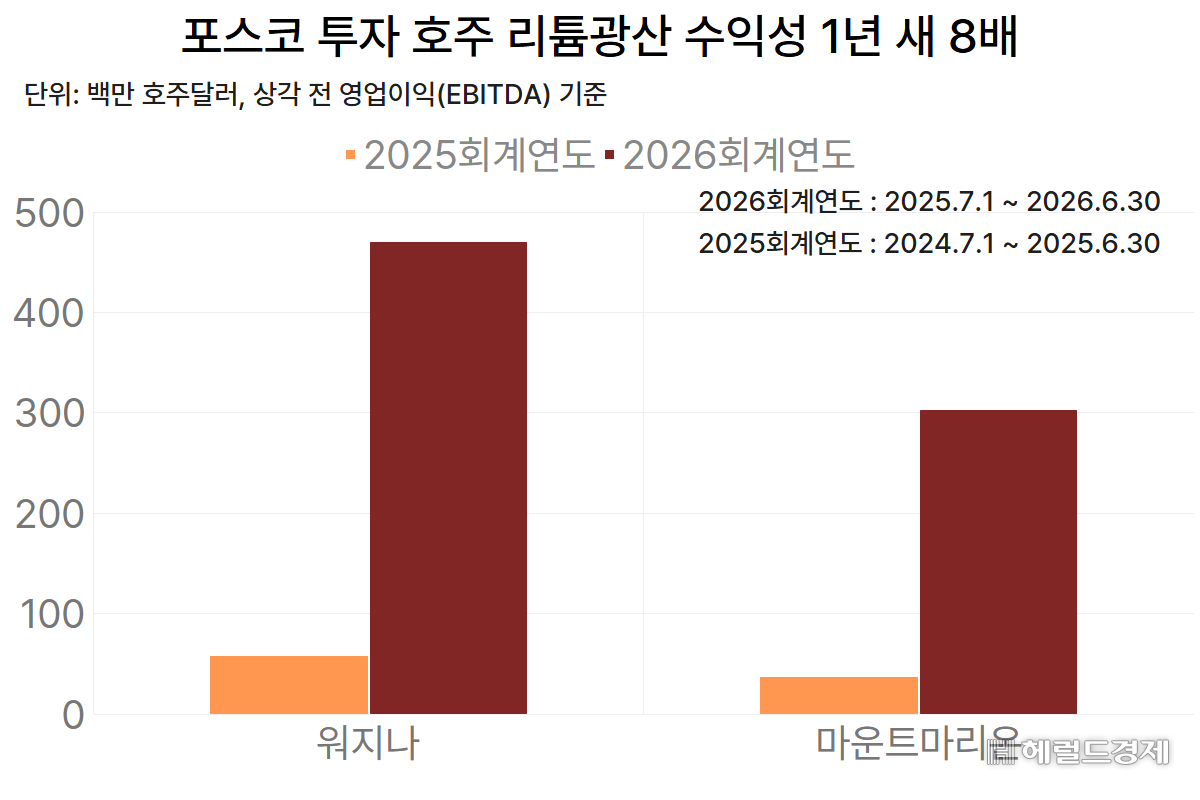
Profits at the two Posco-backed mines surge eightfold
The profitability of the individual mines makes Posco Holdings' investment timing all the more striking.
The combined EBITDA of the Wodgina and Mount Marion lithium mines in Western Australia — in which Posco Holdings is acquiring stakes — surged 8.3 times in a year, from A$93 million to A$772 million.
Higher selling prices were the primary driver: the average realized price for spodumene concentrate (SC6) sold by Mineral Resources rose 106 percent year on year. Cost reductions also contributed — production costs at Wodgina fell 13 percent over the year, while Mount Marion's dropped 6 percent.
'Did we sell too cheaply?' — a question raised in Australia
Posco Holdings signed a $765 million equity investment agreement with Mineral Resources in April this year.
The structure does not involve a direct stake in Mineral Resources itself. Instead, Posco Holdings is investing in an intermediate holding company that holds Mineral Resources' interests in Wodgina and Mount Marion. Through the deal, Posco Holdings will effectively acquire 30 percent of the 50 percent stake Mineral Resources held in each mine, giving it an indirect 15 percent interest in both Wodgina and Mount Marion once the transaction closes. Mineral Resources' share in each mine will fall from 50 percent to 35 percent.
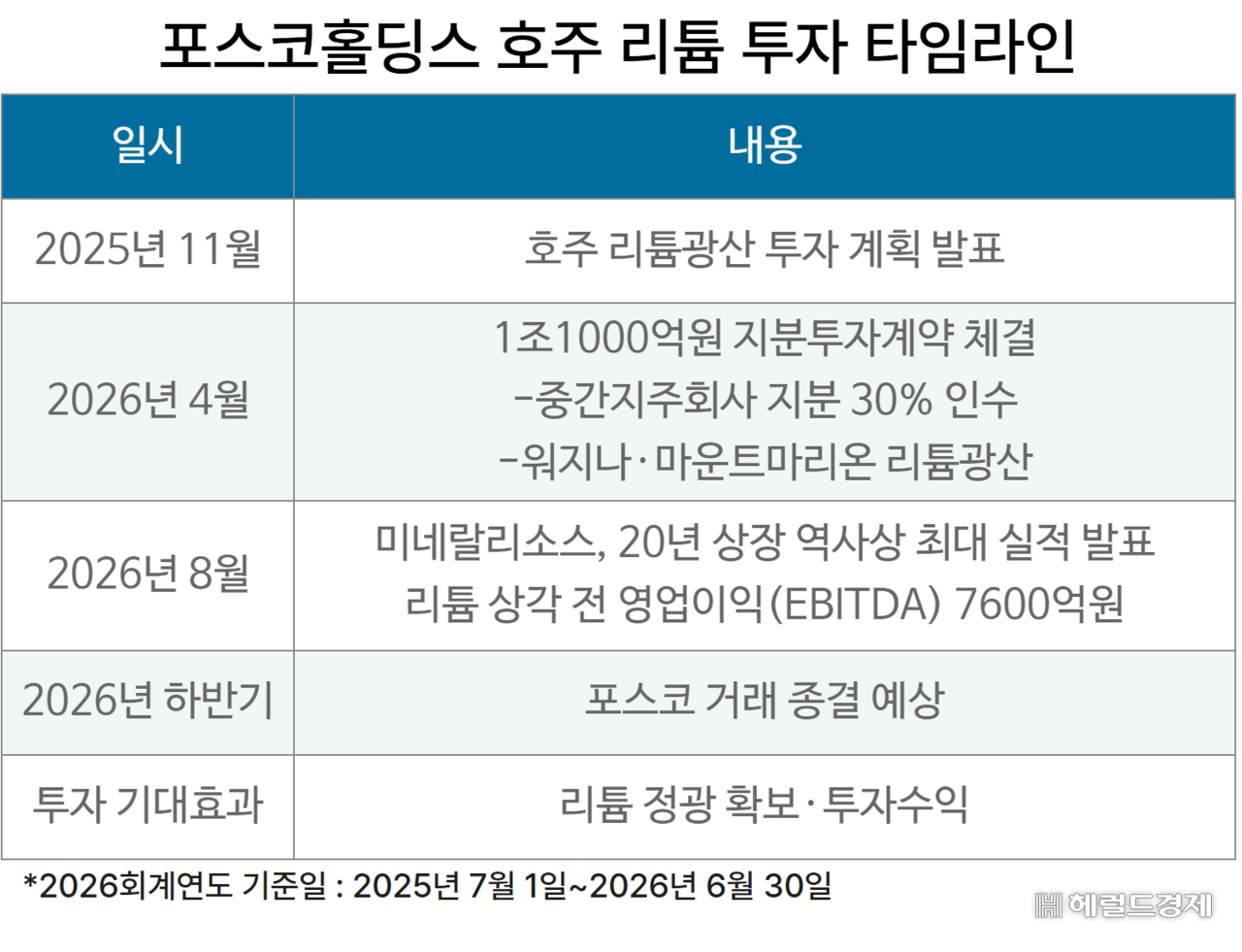
With the value of the two mines rising rapidly since the deal was signed, analysts have begun to credit Posco with buying at the bottom of the market.
At Mineral Resources' earnings conference call on Aug. 26, Bank of America analyst Kate McCutcheon raised the question of whether the company had sold its stakes to Posco too cheaply, pointing to the sharp increase in the mines' asset values since the agreement was reached.
Mineral Resources CEO Chris Ellison said he was satisfied with the deal and called Posco "an excellent partner." He said that even after transferring part of its stake, Mineral Resources' own production volumes would not fall significantly because of planned output expansion investments. The company intends to use the cash received from Posco to reduce debt and is also considering new growth investments in areas such as copper.
![Posco Group Chairman Chang In-hwa (left) and Martin Ferguson, chair of the Australia-Korea Business Council, pose for a photo at the 47th Korea-Australia Economic Cooperation Committee joint meeting held in Adelaide, Australia, on Wednesday. [Posco Holdings]](https://wimg.heraldcorp.com/news/cms/2026/09/04/news-p.v1.20260902.7303b2e1ecdd470a9a06b8c4f26e263b_P1.jpg)
Outlook for Australian lithium even brighter next year
The broader outlook remains largely positive. Mineral Resources projects spodumene concentrate sales at Wodgina for fiscal year 2027 at 360,000 to 390,000 tonnes, a 14 to 23 percent increase from the prior year, with production costs expected to fall a further 4 to 13 percent. The company is also pursuing a 30 percent expansion of production capacity.
Mount Marion faces near-term cost pressures. Sales volumes for fiscal year 2027 are expected to decline roughly 1 to 17 percent from the prior year, while production costs are projected to rise 13 to 20 percent, reflecting preparation expenses tied to the development of a new mining area. Mineral Resources plans to offset this by expanding processing facilities and developing underground mining operations to lift capacity by about 20 percent to 600,000 tonnes, with costs expected to come back down from fiscal year 2028 onward.
Deal seen closing this year; Posco earnings boost expected
The transaction between the two companies has not yet been finalized. Mineral Resources expects to complete the deal by year-end, pending regulatory approvals and other procedural steps.
Once the deal closes, Posco Holdings will hold indirect 15 percent stakes in both Wodgina and Mount Marion, along with a corresponding right to offtake spodumene concentrate from the two mines. If the mines maintain their current level of profitability, the investment could have a positive effect on Posco Holdings' net profit and cash flow through returns on investment and dividends.
Should the transaction close before year-end, some benefit could begin to flow this year, though the full annual earnings contribution is more likely to be reflected from next year.
![Posco Group Chairman Chang In-hwa (left) and Australian Prime Minister Anthony Albanese pose for a photo at Posco's Pohang steelworks in Pohang, North Gyeongsang Province, on Oct. 30, 2025. [Posco Group]](https://wimg.heraldcorp.com/news/cms/2026/09/04/news-p.v1.20251030.cd7a7faa88b445ea9715d72ffc3a0a69_P1.jpeg)
The investment is also a centerpiece of Chairman Chang's strategy of securing premium resources ahead of the curve. Chang traveled to Australia on Tuesday to meet with local government officials and resource company executives in a push to broaden Korea-Australia resource cooperation beyond iron ore into lithium and natural gas.
Building on the Australian ore supply, Posco Group plans to add a new refinery with annual capacity of 30,000 tonnes by 2029 to its existing hard-rock lithium processing capacity of 43,000 tonnes per year, bringing the total to 73,000 tonnes. Combined with brine lithium from Argentina, the group's overall lithium production capacity target for 2033 stands at 173,000 tonnes.
Whether the bet ultimately proves a jackpot is not yet certain. Lithium prices remain highly volatile, and some mines — Mount Marion among them — face near-term cost and capital expenditure pressures. Even so, output, prices and profitability at the targeted mines all recovered simultaneously shortly after Posco committed to the large-scale investment, and the deal price has drawn favorable commentary in local markets. Observers say Chairman Chang's 1 trillion won Australian lithium wager has, at least in terms of timing, gotten off to a promising start.
"Over the medium to long term, the risk of a lithium supply shortage is growing, and further price increases are expected as China cuts output and Zimbabwe tightens export regulations," said Kang Min-a, an analyst at Daishin Securities. "Posco Holdings has secured stakes in both mines along with a preferential purchase right for about 270,000 tonnes of spodumene concentrate, laying the groundwork to capitalize on a future lithium market recovery."
kwater@heraldcorp.com