218-square-meter unit's reserve price drops from 22.6 billion won to 21.46 billion won
Gangnam price correction pushes reconstruction associations to discount reserve units
Delayed sales could push back association dissolution and wind-up
![An exterior view of Cheongdam Le El in Cheongdam-dong, Gangnam-gu, Seoul. [Provided by Lotte Engineering & Construction]](https://wimg.heraldcorp.com/news/cms/2026/09/04/news-p.v1.20251120.8822810df1fe4ed7b87fcb37ee4b1469_P1.jpg)
As high-end apartment prices in Seoul's Gangnam-gu and Seocho-gu areas have come under pressure following the government's tax reform proposal, reconstruction associations are moving to sell their reserve units at a discount. The Cheongdam Samik Apartment Housing Reconstruction and Improvement Project Association has cut the reserve price on Cheongdam Le El penthouses by more than 1 billion won ($736,000) over two months in a bid to find buyers.
According to the reconstruction industry on Friday, the association is conducting its ninth round of bidding on seven reserve units through Wednesday. Reserve units are properties that associations set aside rather than offer in the initial pre-sale, as a buffer against unforeseen circumstances. They do not require a housing subscription account, and buyers who purchase without a mortgage are exempt from the owner-occupancy requirement that applies in land transaction permit zones.
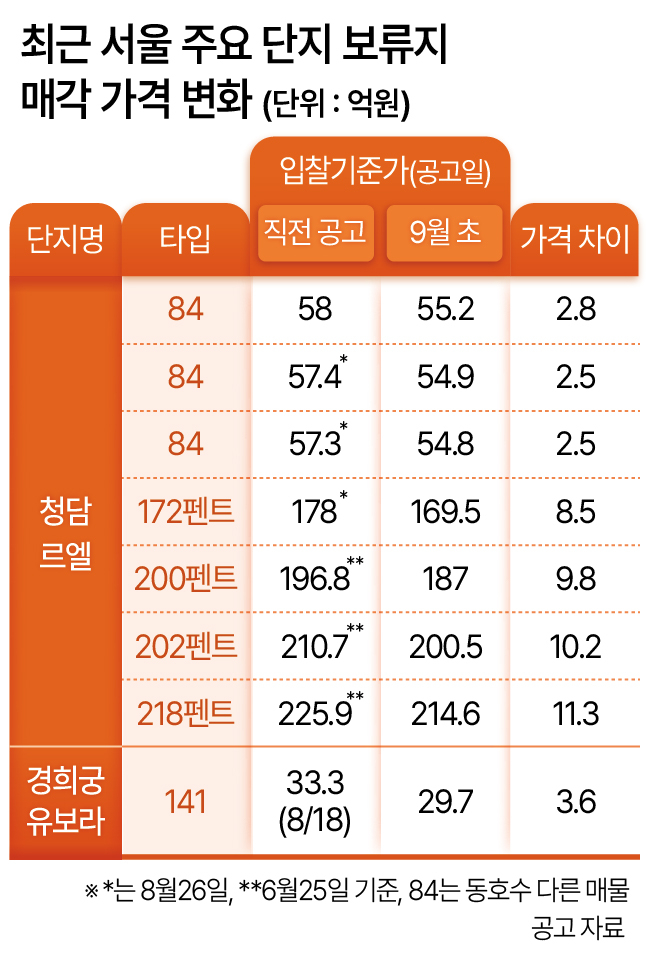
The most notable development is that reserve prices have fallen nearly 5 percent from the previous round. The largest penthouse unit — 218 square meters in exclusive use area — was re-listed roughly two months after the June announcement, with its reserve price dropping more than 1.1 billion won, from around 22.6 billion won to 21.46 billion won. Reserve prices for the 172-, 200- and 202-square-meter units were also sharply revised, falling from a range of 17.8 billion won to 21.07 billion won down to a range of 16.95 billion won to 20.05 billion won.
Among those, three 84-square-meter units were re-listed on Wednesday — just one week after the eighth-round announcement on Aug. 26 — after their reserve prices were cut by 250 million won to 280 million won each. The prices, which had been in the range of 5.73 billion won to 5.8 billion won, were reduced to around 5.5 billion won.
Cheongdam Le El is not the only development cutting reserve unit prices. At Gyeonghuigung Ubora in Yeongcheon-dong, Seodaemun-gu, a 141-square-meter reserve unit failed to attract a buyer at 3.33 billion won in last month's listing and is now being offered at 2.97 billion won — a reduction of 360 million won — two weeks later.
The price cuts reflect a broader decision by associations to act as high-end apartment values continue to slide. In major Gangnam-gu and Seocho-gu complexes, distressed listings from owners seeking to reduce their tax burden have begun to appear at prices below those of reserve units, giving buyers cheaper alternatives.
According to the Korea Real Estate Board, the sale price index for Gangnam-gu and Seocho-gu has fallen for four consecutive weeks since the second week of August. The reserve price for an 84-square-meter unit (Building 105) at Cheongdam Le El stands at 5.52 billion won, while asking prices for comparable units on similar floors in the same building range from 5.2 billion won to 5.5 billion won — meaning buyers who can meet owner-occupancy and other requirements have cheaper options than the reserve units.
Associations are responding by adjusting reserve prices to push sales through. A prolonged delay in selling reserve units could affect the timeline for association dissolution and wind-up, as each additional month of operations adds to administrative and staffing costs.
"Prospective buyers of high-end homes are sitting on the sidelines and waiting to see whether the National Assembly revises the tax reform proposal in September, so brisk transactions will be hard to come by," said Park Hap-su, an adjunct professor at Konkuk University's Graduate School of Real Estate. "If reserve units go unsold, the association's wind-up could be delayed, so from the association's perspective it will want to wrap things up quickly even if that means lowering the price."
Kim Je-gyeong, director of Tumi Real Estate Consulting, said the reserve units — even at the 84-square-meter level — remain expensive relative to the original pre-sale price of 2.5 billion won, and that buyers' indifference ultimately signals the market is not yet ready to absorb them at current prices. "There is no real alternative to a discounted sale, since associations cannot hold on to reserve units indefinitely," he said.
hope@heraldcorp.com