
Yeongtong-gu posts nation's highest weekly gain at 0.65%
Dongtan, Giheung still rising two months after land-transaction controls
Samsung Electronics in-house loan scheme seen as new demand driver
![An aerial view of apartment complexes in Gwangyo new town, Suwon, Gyeonggi Province. [Yonhap]](https://wimg.heraldcorp.com/news/cms/2026/09/04/ams.V01.photo.HDN.P.20170806.201708060000005967615115_P1.jpg)
Housing prices in southern Gyeonggi Province are heating up again, with "national-size" 84-square-meter apartments in Gwangyo new town in Suwon trading repeatedly near 2 billion won ($1.47 million). Despite the government designating Hwaseong's Dongtan-gu and Yongin's Giheung-gu as regulated zones and land-transaction permit areas in July over surging prices, the upward trend has continued across southern Gyeonggi, including Suwon's Yeongtong-gu. Analysts also warn that a Samsung Electronics in-house mortgage loan program that took effect this month could further stoke demand.
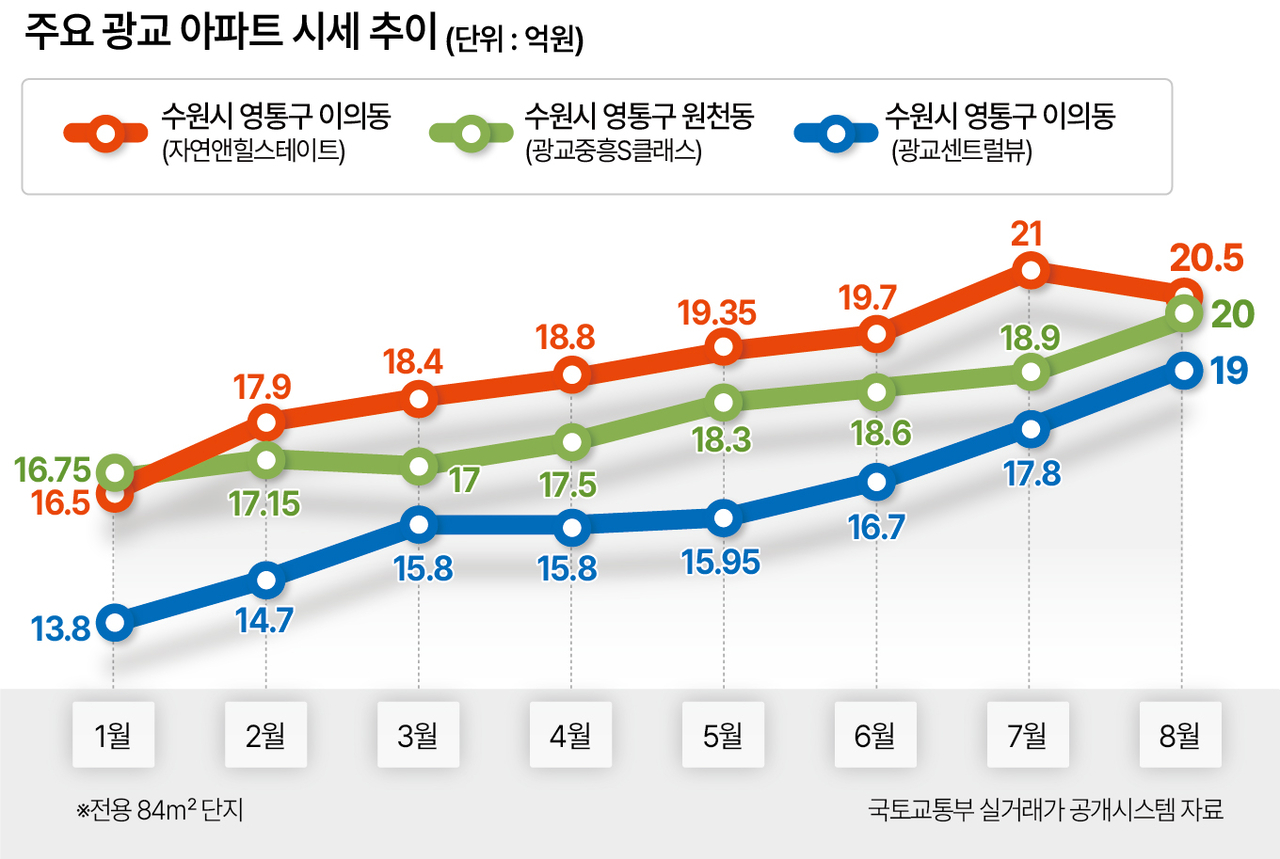
According to the Ministry of Land, Infrastructure and Transport's actual transaction price disclosure system, an 84-square-meter unit at Gwangyo Jungheung S-Class in Woncheon-dong, Yeongtong-gu set a new high of 2 billion won on the 19th floor on Saturday. An 84-square-meter unit at Gwangyo Central View in Uui-dong also changed hands at a record 1.9 billion won on the 13th floor on Aug. 8.
Jayeon & Hillstate in Uui-dong, widely regarded as Gwangyo's flagship complex, saw an 84-square-meter unit trade at 2.1 billion won on the 23rd floor in July — the first time a national-size unit in Gwangyo crossed the 2 billion won mark. The same floor plan sold again for 2.05 billion won on the ninth floor on Aug. 11, underscoring a sustained run of transactions above 2 billion won at major Gwangyo developments.
Yeongtong-gu's gains have been particularly striking. In the fifth week of August (as of Monday), apartment sale prices in Yeongtong-gu rose 0.65 percent from the previous week — the highest weekly gain recorded anywhere in the country — according to the Korea Real Estate Board's weekly apartment price index. The week before, the district posted a 0.75 percent rise.
The upswing extends beyond Gwangyo to other key areas in southern Gyeonggi, including Hwaseong's Dongtan-gu and Yongin's Giheung-gu. Over the same period, apartment prices in Giheung-gu rose 0.43 percent and in Dongtan-gu 0.25 percent. The week prior, the two districts gained 0.63 percent and 0.54 percent, respectively. While the pace of increase has eased somewhat, both districts continue to outpace or match the 0.19 percent gain recorded for Gyeonggi Province as a whole.
Dongtan-gu and Giheung-gu are the very districts the government moved to rein in two months ago. The Ministry of Land, Infrastructure and Transport on June 30 designated Dongtan-gu, Giheung-gu and Guri as speculative overheating districts and adjustment target areas. At the time, Dongtan-gu was seeing sharp price gains driven by rising housing demand tied to a favorable semiconductor industry cycle and expectations of improved infrastructure, including the opening of the GTX-A commuter rail line.
Immediately after the restrictions took effect, the pace of gains briefly slowed under the weight of the rapid run-up and the regulatory designation. Dongtan-gu's weekly apartment price increase fell from 0.73 percent in mid-July to 0.25 percent in the fourth week of the same month, while Yeongtong-gu's gain narrowed from 0.64 percent to 0.34 percent over the same period.
Last month, however, price gains in Yeongtong-gu, Dongtan-gu and Giheung-gu began widening again, prompting assessments that the curbs have run their course. Analysts say that while gap investment demand has receded, the underlying demand base tied to the semiconductor industry and expectations of better transport links proved too resilient to suppress.
Samsung Electronics' in-house housing loan program is seen as another potential catalyst for southern Gyeonggi prices. Since Tuesday, the company has offered home-purchase loans of up to 500 million won at an annual interest rate of 1.5 percent to employees who do not own a home. Eligible properties must be priced at no more than 2.5 billion won and, in the greater Seoul metropolitan area, must have an exclusive use area of no more than 85 square meters — but crucially, the loans are not subject to the stringent debt service ratio and other lending regulations that apply to conventional mortgages.
A significant share of national-size units in Gwangyo and Dongtan currently trading near 2 billion won would qualify under both the price and size thresholds. The areas around Samsung Electronics' Suwon campus and its Hwaseong and Giheung facilities draw heavy commuter demand from company employees. Even before the program launched, market watchers had predicted that end-users with expanded purchasing power from the in-house loans would flow into the local housing market.
Some analysts caution, however, that the strength of southern Gyeonggi prices cannot be explained solely by proximity to workplaces. They point to a broader shift in residential preferences: unlike in the past, when high-income workers in Gyeonggi Province tended to settle in outer Seoul, many are now gravitating toward premium Gyeonggi addresses such as Bundang, Dongtan and Gwangyo.
"Take SK hynix — it operates in both Icheon and Cheongju, but prices have risen only in Cheongju while Icheon has stagnated," said Kim Hak-ryeol, director of the Smart Tube Real Estate Research Institute. "Once an area offers the full package — schools, transport and everyday amenities — people may actually prefer Bundang, Dongtan or Gwangyo over the outskirts of Seoul."
quq@heraldcorp.com





