
Agencies under Agriculture Ministry cite fears of worsening conditions and heavier workloads; pay gap seen as flashpoint
Integrating rural development bodies faces legal, dissolution and budget hurdles
Oceans Ministry to form port authority task force this year to map out merger roadmap
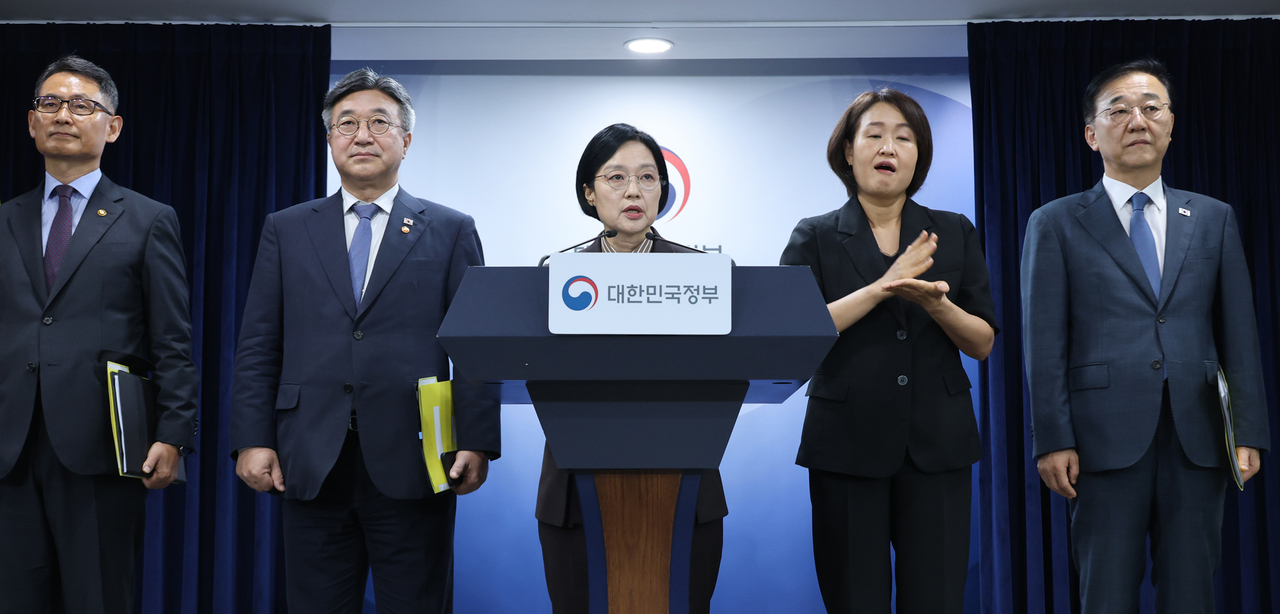
Public institutions slated for consolidation are on edge as the government moves forward with a sweeping reorganization plan. Although the government has pledged to guarantee job continuity and maintain existing benefits for employees at affected agencies, workers on the ground say uncertainty remains high, with no concrete guidance yet on restructuring timelines, budgets or staffing. Differences in pay scales across merging institutions are also being flagged as a potential source of internal conflict.
The government announced its "Public Institution Function Reform Plan" on Thursday, targeting a reduction of 109 public institutions in total, according to related ministries and the agencies involved. Three institutions under the Ministry of Agriculture, Food and Rural Affairs and 11 under the Ministry of Oceans and Fisheries are to be reduced through mergers and consolidations. The government said it would guarantee job continuity for all employees — excluding executives — at the affected institutions, and would manage pay structures to ensure compensation does not fall as a result of the mergers.
The most significant change under the Agriculture Ministry involves merging the Korea Institute for Animal Products Quality Evaluation, the Livestock Sanitation Management Division and the Korea Livestock Environment Management Institute into a new body tentatively named the Korea Livestock Promotion Corporation. The three agencies have staff rosters of 502, 1,286 and 57, respectively, for a combined total of 1,845. The Korea Agricultural and Rural Community Corporation is also set to absorb the Korea Rural Hope Foundation.
The institutions targeted for integration say they will cooperate with the government's plan, but internally, anxiety over uncertainty outweighs any sense of anticipation. An official at an agency under the Agriculture Ministry said nothing has been concretely decided yet and that employees are watching how things unfold. The official added that sufficient communication throughout the integration process and proper attention to employee welfare would be essential.
Considerable procedural steps remain before the mergers can be completed. Relevant laws will need to be enacted or amended, labor union consultations must take place, and adjustments will be required based on the specific circumstances of each institution. The government has said each ministry will develop function reform plans for its respective agencies while simultaneously pursuing the necessary legislative changes and labor-management consultations.

The Korea Agricultural and Rural Community Corporation, which is set to absorb the Rural Hope Foundation, also faces no shortage of procedural hurdles. An official at an Agriculture Ministry agency said the corporation first needs to assess the foundation's staffing and budget situation, adding that no specific guidance has yet been issued on the timing, relocation or funding of the integration.
Because the Rural Hope Foundation is a public-interest corporation that handles donation-related work, the merger will require legislative amendments and the formal dissolution of the legal entity. The corporation itself will also need to update relevant designations and overhaul its systems and procedures. There are also concerns that without additional staffing and budget support, existing employees could face a heavier workload. Office space is already tight at the corporation, meaning the integration process will also need to resolve questions of space and operating costs.
Pay structures present another sensitive issue. The central question is how to reconcile the different wage levels that existed across the separate institutions within a single organization. An official at one of the agencies said that once the merger takes effect, employees will inevitably learn the details of each other's compensation by rank, and that any disparities could become a source of internal friction. The official added that aligning different pay levels would require additional funding, making the actual adjustment process far from straightforward.
Under the Oceans Ministry, plans are moving forward to merge the port authorities of Busan, Incheon, Ulsan and Yeosu-Gwangyang into a single body tentatively named the Korea Port Authority. Five other companies — Yeosu-Gwangyang Port Management, Ulsan Port Management, Busan Port Security, Incheon Port Security and Yeosu Expo Management — are to be combined into a body tentatively called the Korea Port Security and Facilities Corporation. The National Marine Science Museum in Uljin, the National Incheon Maritime Museum and the National Maritime Museum are to be merged into a body tentatively named the Korea Maritime Culture Promotion Agency. The National Marine Biodiversity Institute of Korea is to be folded into the Korea Institute of Ocean Science and Technology, while the Korea Aids to Navigation Technology Institute is to be merged into the Korea Maritime Transportation Safety Authority.
The Oceans Ministry plans to begin practical groundwork for the port authority merger first. A ministry official said the consolidation was decided following a comprehensive government review, and that the ministry plans to form a port authority establishment task force this year to draw up a detailed integration roadmap.
adastra@heraldcorp.com





