
21 projects reflected in next year's government budget proposal, a 22-fold increase from this year
83% of total allocated to universal AI service support for all citizens
Lifestyle-focused projects include national park stamp tours and youth-led state property redesign
Spending-efficiency proposals introduced for first time, yielding real savings on military supplies
![Park Hong-keun, minister of the Ministry of Planning and Budget [The Herald Business DB]](https://wimg.heraldcorp.com/news/cms/2026/09/07/news-p.v1.20260807.6572b12ef70e49f78ccf3776a00f3c75_P1.jpg)
South Korea's citizen participatory budget — a system that lets the public propose and help select government spending projects — has been set at a record 301 billion won ($221 million) for next year, more than 22 times the 13.7 billion won allocated this year. Of that total, 250 billion won is earmarked for a single initiative to help all citizens access AI services in their daily lives.
The Ministry of Planning and Budget said Monday that the government has incorporated 21 citizen-proposed projects worth a combined 301 billion won into its draft budget for fiscal year 2027. Compared with this year's nine projects totaling 13.7 billion won, the number of projects has grown by 12, or 133 percent, and the total budget has surged by 287.3 billion won, or 2,097 percent. It is the largest allocation by budget value since the citizen participatory budget system was introduced in 2018.
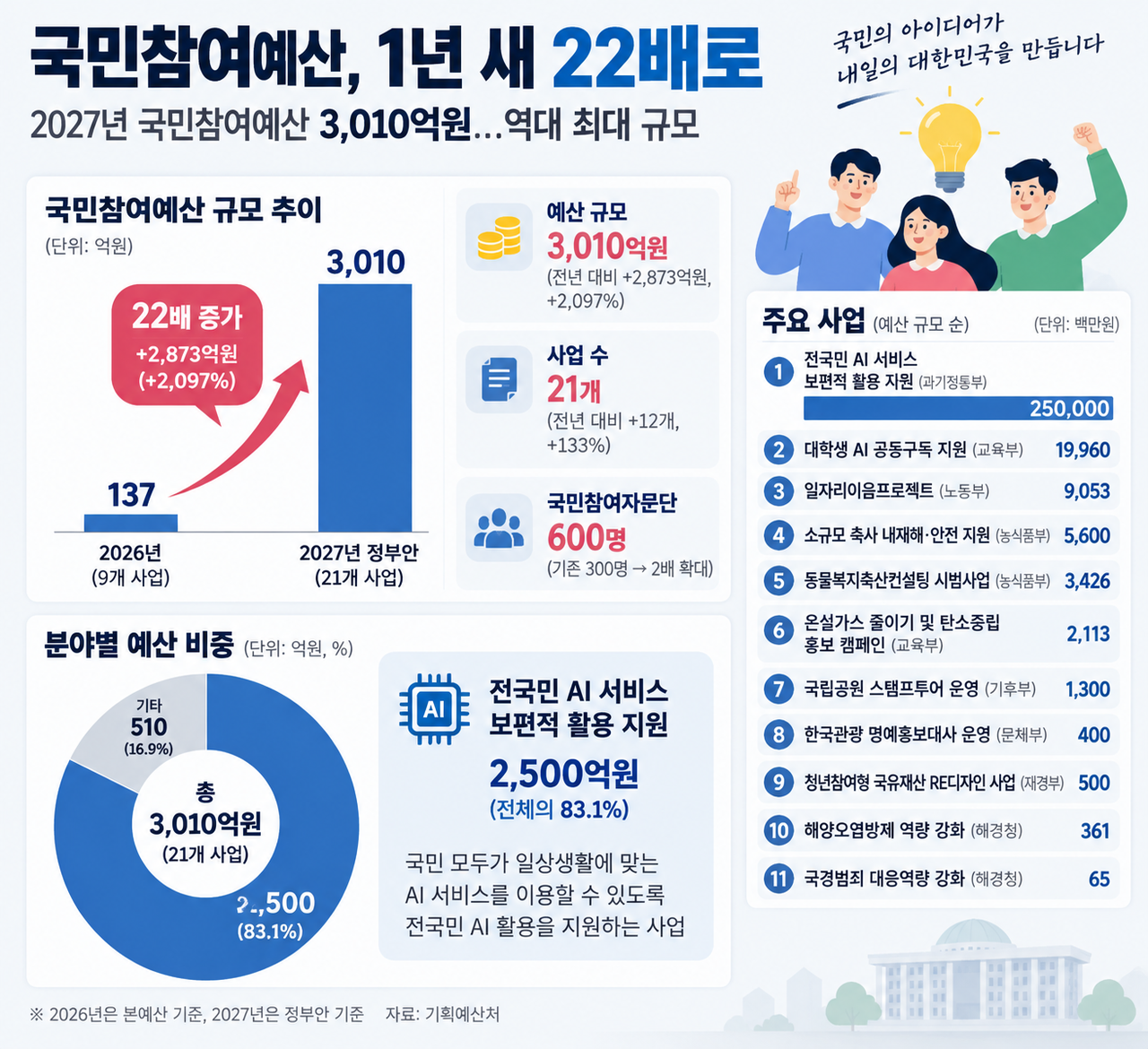
The citizen participatory budget allows members of the public to propose projects they consider necessary and weigh in on the selection process during the government's annual budget planning cycle. This year, the government significantly expanded the scope of proposals and the scale of participation with the aim of making citizen fiscal sovereignty a practical reality.
Previously, the system focused on identifying new projects, but starting this year citizens can also propose ways to improve spending efficiency within existing programs. The citizen advisory panel responsible for reviewing and deliberating on proposals was doubled from 300 to 600 members, and an open public recruitment process was added.
Government ministries identified candidate projects based on public submissions received through an online platform and other channels from May last year through April this year. After a deliberation process that included project briefings with the citizen budget panel, ministries requested 43 projects worth a combined 381.3 billion won. The Ministry of Planning and Budget then finalized the government proposal, incorporating the results of a preference vote by the citizen panel.
The largest single project in next year's citizen participatory budget is the Ministry of Science and ICT's initiative to support universal access to AI services for all citizens, with 250 billion won — about 83 percent of the total citizen budget — allocated to help people use AI services suited to their everyday lives.
The Ministry of Education's program to subsidize shared AI subscriptions for university students received 19.96 billion won. The Ministry of Employment and Labor's job-bridging project received 9.05 billion won, and the Ministry of Agriculture, Food and Rural Affairs' program to support disaster resilience and safety at small-scale livestock farms received 5.6 billion won.
Several lifestyle-oriented projects were also included. The Ministry of Climate, Energy and Environment allocated 1.3 billion won for a national park stamp tour program, under which visitors can collect stamps at parks and key attractions and participate in a digital stamp tour. The Ministry of Finance and Economy set aside 500 million won for a youth-led redesign project for state-owned properties.
Other projects selected through public proposals include the Korean National Police Agency's development and operation of an online assembly notification system, the Ministry of Employment and Labor's career support program for middle-aged workers, the Ministry of Climate, Energy and Environment's greenhouse gas reduction and carbon neutrality awareness campaign, and the Ministry of Agriculture, Food and Rural Affairs' pilot animal welfare consulting program for livestock farms.
A spending-efficiency proposal track, introduced for the first time this year, also produced tangible budget savings. One notable example — a proposal to cut costs by adjusting military supply items based on the preferences of younger service members — was partially reflected in the spending restructuring process for the 2027 government budget. The measure streamlines clothing supply standards in line with changes such as shorter mandatory service periods.
Public participation channels were also broadened. The online platform was overhauled and its proposal menu expanded, while outreach efforts were extended to reach vulnerable groups and frontline workers directly. The government is also pursuing a plan to link the participatory budget platforms of central and local governments.
The Ministry of Planning and Budget plans to submit the 2027 government budget proposal — including all citizen participatory budget projects — to the National Assembly on Oct. 3. Citizens can submit proposals for new projects or spending-efficiency improvements to existing programs at any time through the citizen participatory budget platform.
fact0514@heraldcorp.com





