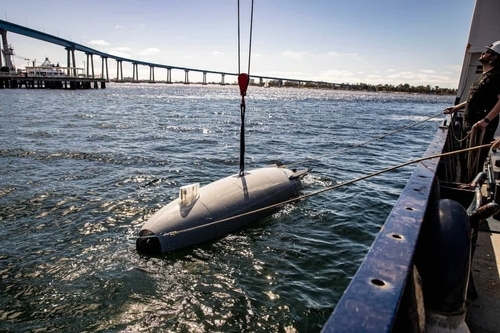
The naval branch of Iran's Islamic Revolutionary Guard Corps said Tuesday (local time) that it had captured a US military unmanned underwater vehicle in the Strait of Hormuz. Iran touted the seizure as proof it had obtained a "state-of-the-art" American unmanned asset, but the US military rebuffed the claim, saying the equipment was an outdated model that had malfunctioned and carried no sensitive intelligence or classified gear.
According to Iran's state-run IRNA news agency, the Revolutionary Guard's naval force said in a statement that it had seized "an advanced smart unmanned underwater vehicle belonging to the terrorist US military" at the entrance to the Strait of Hormuz through "a complex intelligence and military operation" on Wednesday morning.
The Revolutionary Guard said the vehicle was equipped with "the latest underwater technology" and had been due for delivery to the US military fleet in 2025.
Sepah News, a media outlet linked to the Revolutionary Guard, reported that the captured device was the Dive-LD, an autonomous unmanned underwater vehicle developed by US defense technology company Anduril Industries.
The Dive-LD is a large autonomous underwater vehicle roughly 5.8 meters long and weighing about 3 tons, capable of operating independently in deep water for up to 10 days. According to the manufacturer's specifications, it can dive to a maximum depth of 6,000 meters.
The vehicle features 3D-printing technology and a modular design that allows sensors and equipment to be quickly installed or swapped depending on the mission.
The Dive-LD can be used for a range of missions, including seabed reconnaissance and surveillance, mine detection, inspection of undersea cables and pipelines, and support for anti-submarine warfare. Anduril delivered its first Dive-LD unit to a US Navy unmanned undersea systems unit last year.
Sepah News described the Dive-LD as a key unmanned underwater asset of the US Navy, citing its autonomy, long-duration operating capability and mission adaptability.
However, the US account differs sharply from Iran's claims. CENTCOM said the underwater drone had malfunctioned more than a day earlier while conducting a survey mission in the region's waters.
The US military described the equipment as an "older model," stressing that it had not been collecting sensitive intelligence and was not carrying classified sonar or radar equipment.
A Revolutionary Guard spokesperson said, "Not even the advanced unmanned submarine 'Dawn Hunter' has the technology to evade the multilayered surveillance network we have built in the Strait of Hormuz."
"The Persian Gulf is the territorial waters of our innovative youth," he added, mocking a past US military failure — the Bay of Pigs invasion of Cuba — by saying, "Go back to your 'Pig Gulf.'"
Mohammad Bagher Ghalibaf, speaker of Iran's parliament and head of its end-of-war negotiating team, posted a cartoon on social media platform X mocking the capture of the advanced US submersible.
The cartoon depicted an arm in a uniform bearing the Iranian flag lightly tapping a submersible that had surfaced, with captions reading, "It seems the most modern intelligent unmanned underwater vehicle of the US military has received a knock from the Revolutionary Guard's navy," "Knock! Knock!" and "Knocked out!"
mokiya@heraldcorp.com