10,580 cases in Greater Seoul through August, surpassing last year's annual total
8 in 10 forced-auction transfers nationwide concentrated in Greater Seoul
Trend most pronounced in villa-dense areas such as Gangseo-gu and Michuhol-gu
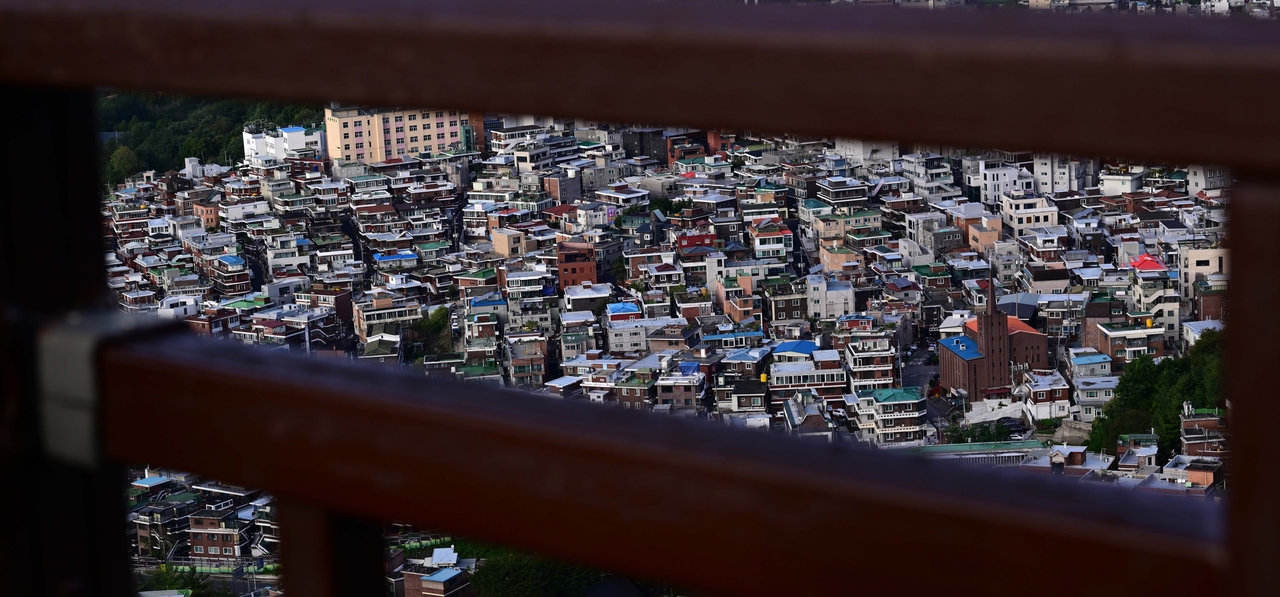
The number of collective residential buildings — apartments, row houses, officetels and similar properties — sold through forced auctions and transferred to new owners in the Greater Seoul area has surged this year, driven by landlords' debt problems. The tally through August has already surpassed last year's full-year total, reflecting the delayed fallout from the "villa king" scandals of 2022, in which tenants who lost their jeonse deposits pursued auction proceedings that have only now resulted in completed sales and ownership transfers.
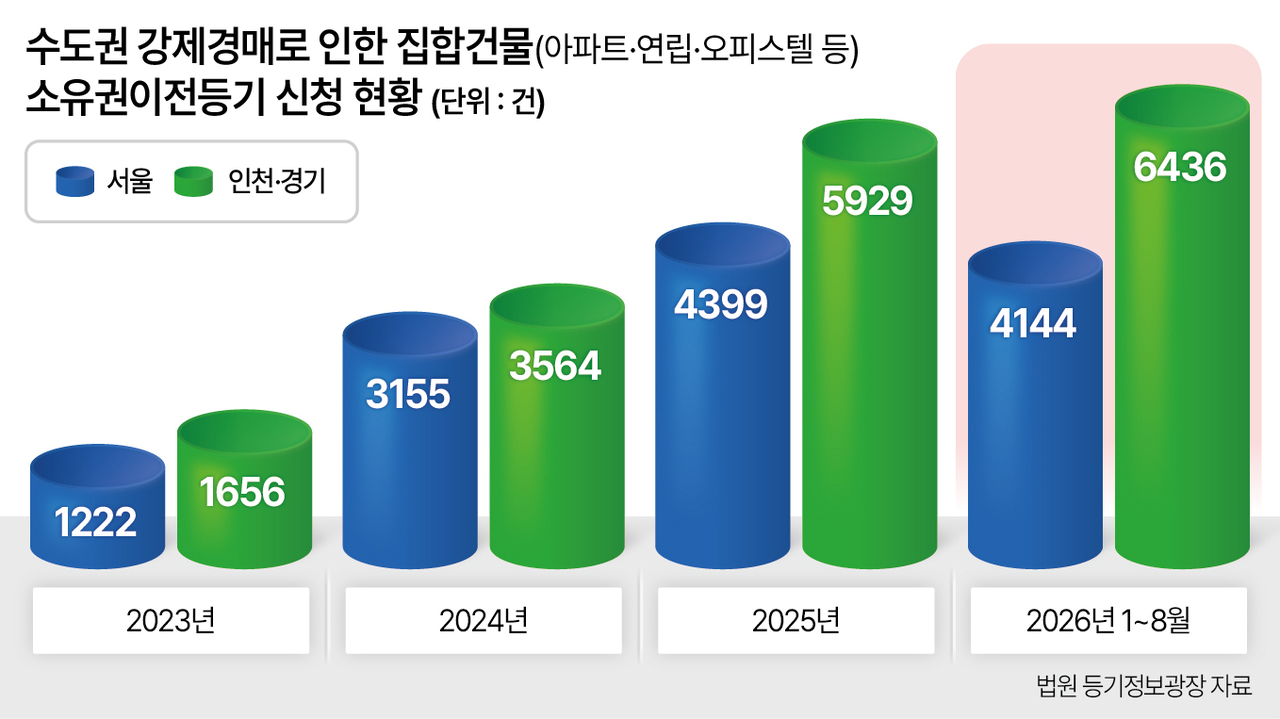
According to court registry statistics, 10,580 collective buildings in the Greater Seoul area had ownership-transfer registrations filed after forced auction sales in the first eight months of this year — already exceeding last year's full-year figure of 10,328. Nationwide, 13,224 such filings were recorded over the same period, approaching last year's total of 13,445.
A forced auction is typically initiated when a tenant who has not received their jeonse deposit back obtains a court ruling and puts the landlord's property up for auction. Once the property is sold through the auction process, a registration transferring ownership to the winning bidder is filed.
Forced auction registration filings were heavily concentrated in the Greater Seoul area, which accounted for 80 percent of the national total in the first eight months of this year. The breakdown by region was Seoul with 4,144 cases, Incheon with 3,302 and Gyeonggi Province with 3,134. In 2025, Incheon and Gyeonggi Province recorded 2,862 and 3,067 cases, respectively, for the full year — figures that both regions have already surpassed in just eight months this year. Seoul is also on pace to exceed its 2025 annual total in the near term.
Analysts attribute the surge to the delayed consequences of underwater jeonse contracts that proliferated during the real estate boom. In 2021 and 2022, jeonse deposits soared alongside sale prices, leading to a large number of contracts — particularly for villas — where the deposit-to-price ratio was dangerously high. When interest rate hikes and a real estate downturn sent home prices sharply lower, the "jeonse fraud" problem emerged: landlords could not return deposits even after selling their properties.
The 2022 "villa king" scandal compounded the problem, causing the volume of distressed properties to snowball. The villa kings exploited a zero-equity gap-investment scheme — simultaneously signing lease and sale contracts — to acquire hundreds or even thousands of villas without any capital of their own, effectively pocketing tenants' jeonse deposits.
Yang Ji-young, a senior adviser at Shinhan Premier Pathfinder, said forced auctions take a long time to show up in the data because they follow a lengthy chain of events — lease expiration, failure to return the deposit and a court order to register the tenancy. "Not all of these cases can be attributed to jeonse fraud, but the indicators are now appearing with a lag in Greater Seoul areas with high concentrations of row houses and multi-family homes," she said.
Another contributing factor is the Korea Housing and Urban Guarantee Corporation's more active role in resolving properties affected by jeonse fraud, which has accelerated the clearing of distressed inventory.
At the district level, 194 ownership-transfer registrations were filed in Seoul's Gangseo-gu in August alone. Other villa-dense areas also recorded high numbers, including 137 in Incheon's Michuhol-gu and 80 in Bucheon's Wonmi-gu.
The Greater Seoul area's share of the national total has also grown. While the nationwide figure rose from 4,917 cases in 2021 to 13,445 in 2025, the Greater Seoul area's count climbed steeply from 2,314 to 10,328 over the same period. This year, 10,580 of the 13,224 national cases were in Greater Seoul.
The Greater Seoul area's share dipped slightly from 52.06 percent in 2022 to 51.69 percent in 2023, then jumped to 67.84 percent in 2024. It rose further to 76.81 percent in 2025 and has reached 80 percent on a cumulative basis through August this year. Lee Ju-hyun, a senior researcher at GG Auction, said the concentration reflects both the sheer volume of listings in Greater Seoul and the fact that ownership transfers have been relatively less smooth outside the region due to weaker buyer demand.
The number of collective buildings with forced-auction commencement registrations — a leading indicator of future ownership transfers — also remains high. Such a registration marks the court's formal initiation of auction proceedings on a property; if a sale is completed, ownership passes to the winning bidder. The nationwide count of these filings rose from 23,681 in 2022 to 38,525 in 2025, while the Greater Seoul area's figure nearly doubled over the same period, from 13,803 to 26,929.
Experts expect the fallout from jeonse market instability to persist, with prolonged high interest rates adding further pressure. Yang said that if high rates continue for an extended period, landlords' rising interest burdens could increase the likelihood of defaults. Lee also noted that, as in the past, a rise in interest rates inevitably leads to more auction cases.
shy@heraldcorp.com
hope@heraldcorp.com