A century of heritage built on red-brick walls and patriotic resolve
Korea's 31st homegrown drug lazertinib takes hold in the US, China and Japan
33 billion won in free drug supply before reimbursement — founder's spirit lives on
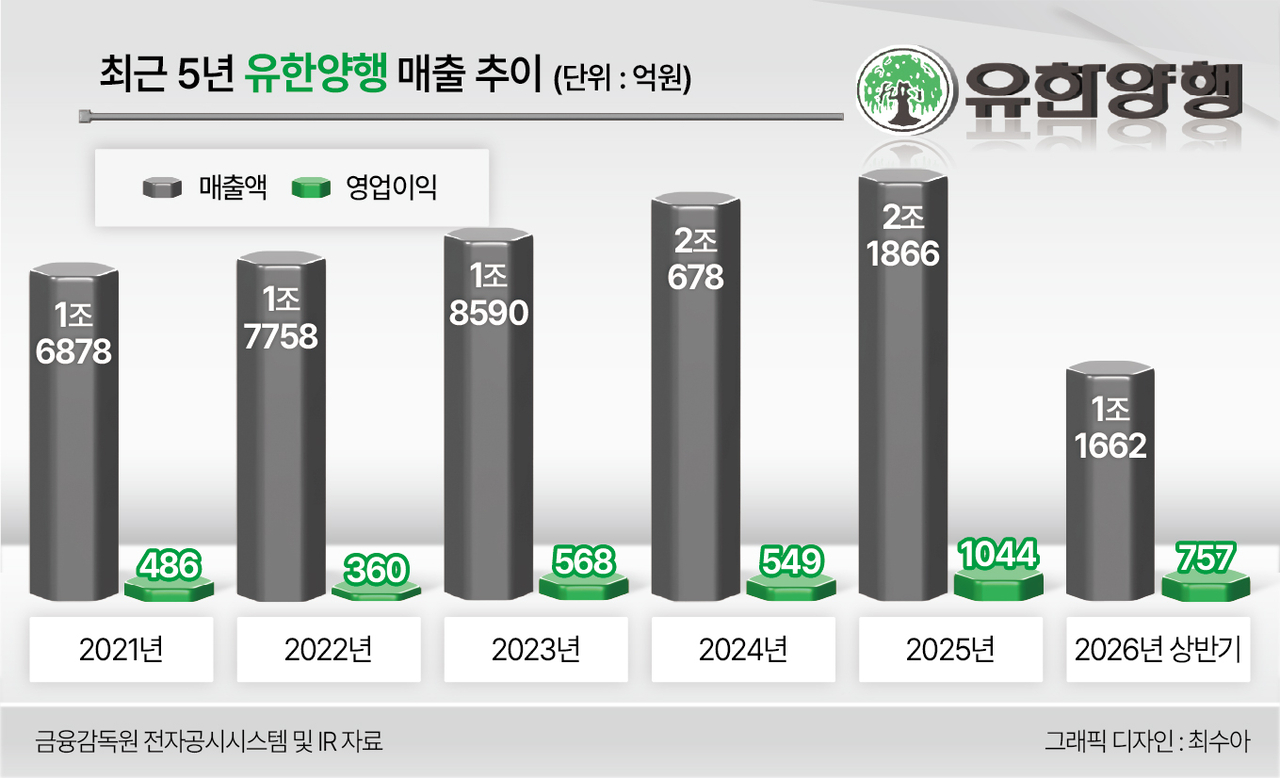
First-half consolidated sales top 1.17 trillion won
R&D investment crosses 1 trillion won, fueling the search for the next lazertinib
![Yuhan founder the late Dr. Yoo Il-han. [Yuhan]](https://wimg.heraldcorp.com/news/cms/2026/09/15/news-p.v1.20250814.34fa7b17a8b44b2d8959c83e5bc982a3_P1.jpg)
In the heart of Daebang-dong, Dongjak-gu, Seoul, a red-brick building called Willow House carries a weight that sets it apart from the glass towers surrounding it. The structure served as Yuhan's headquarters for 35 years beginning in 1962 and was reborn as a cultural complex this year to mark the company's centennial.
Rather than demolishing the old building, Yuhan salvaged the red bricks that teachers and students had laid by hand when Yuhan Industrial High School was established in 1961 and used them to rebuild the exterior wall. The decision was a deliberate statement: to physically preserve a century of history on the very ground where it was made, and to connect past, present and future within a single space.
![Willow House and Yuhan's headquarters in Daebang-dong, Dongjak-gu, Seoul. The remodeled Willow House opened Aug. 20 to mark Yuhan's 100th anniversary. [The Korea Herald]](https://wimg.heraldcorp.com/news/cms/2026/09/15/news-p.v1.20260701.e992c3019e754bacb600126ced7d5348_P1.jpg)
Buried in the outdoor garden, Willow Park, alongside a decorative stone pagoda from the founder's private residence, is a centennial time capsule set to be opened 50 years from now, in 2076. Before he became widely known as a successful entrepreneur, the late Dr. Yoo Il-han volunteered at the age of 50 for the top-secret anti-Japan infiltration mission known as the NAPKO Project — run by the Office of Strategic Services, the wartime predecessor to the CIA — serving as the leader of Unit 1 and an elite special operative under the code name "Agent A."
His spirit of independence, forged by the unwavering conviction that "only a healthy people can reclaim lost sovereignty," became the bedrock of the company he built. The red-brick space rooted in the site of the old headquarters stands as testament to how the legacy of a patriotic enterprise, first seeded by "Agent A," evolved over a century into a cradle of globally innovative medicines.
![The handwritten will of Yuhan founder and independence activist the late Dr. Yoo Il-han, displayed at the center of the Memorial Hall on the second floor of Willow House. [The Korea Herald]](https://wimg.heraldcorp.com/news/cms/2026/09/15/news-p.v1.20260701.ec5ab63b2a674810a389ae615e626ced_P1.jpg)
A national enterprise born in Deokwon Building — Korea's first employee stock ownership and professional management
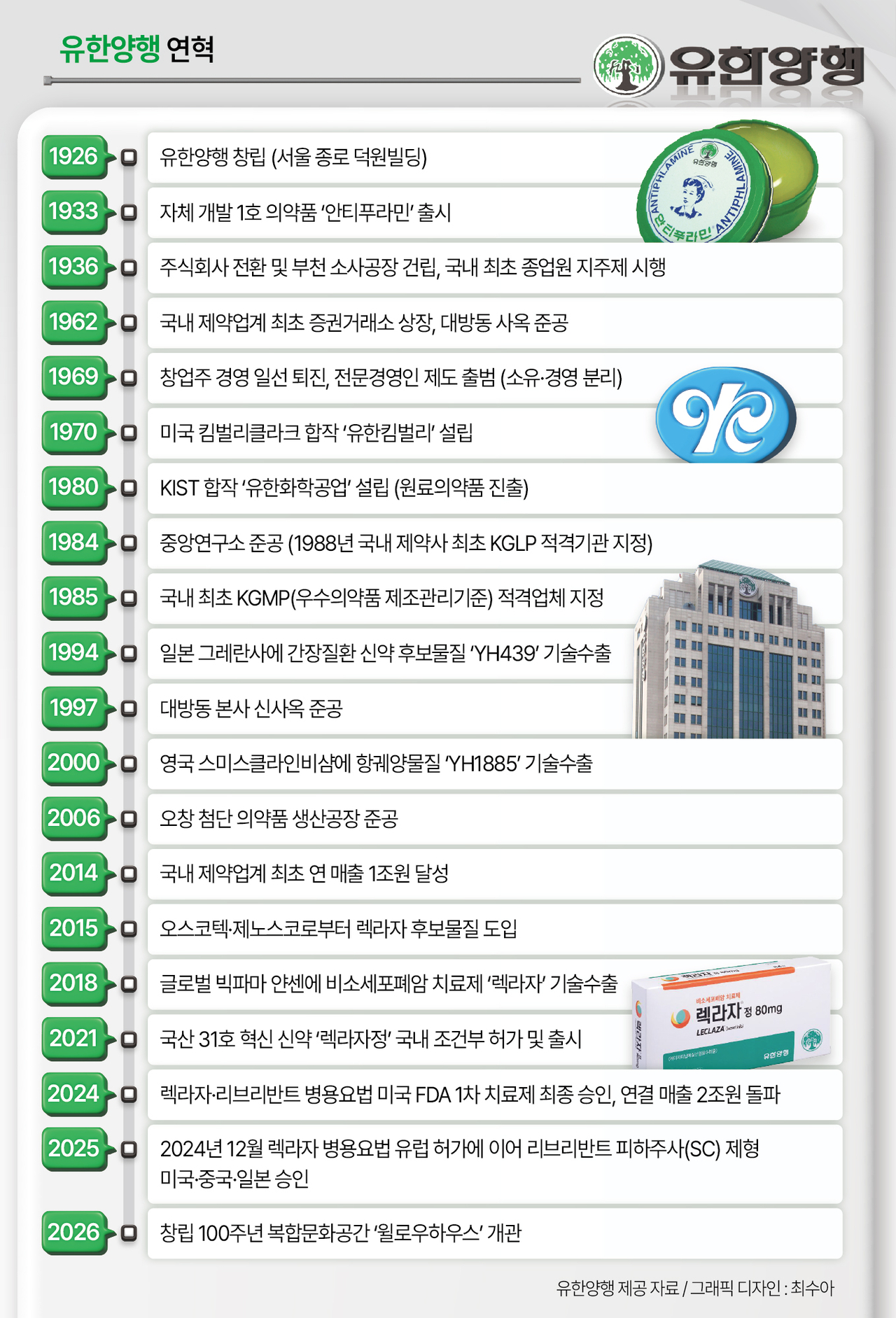
Yuhan's founding was never simply a commercial venture. When Dr. Yoo opened an office in Deokwon Building on Jongno in Seoul in December 1926 and began selling imported medicines in smaller quantities, it was an act of national resolve — to bring quality healthcare to compatriots suffering under Japanese colonial rule.
The company's very name carries that national spirit. Dr. Yoo embedded the character "han" — for Korea — at the end of his given name so he would never forget his identity even in a country whose sovereignty had been stripped away. His founding colleagues combined it with the character "yu," meaning willow, to form "Yuhan." The word "yanghaeng," meaning trading company, reflected a pioneering ambition to serve the Korean people across a wide range of needs — dyes, farm tools, automobiles, toothpaste and cosmetics — on a global stage. Even the company's willow-tree logo traces back to a wish expressed by Dr. Seo Jae-pil: that the company would flourish like a willow that bends but never breaks in the storm, offering steady shelter to the Korean people.
![Antiphlamine, Yuhan's first self-developed medicine, launched in 1933. [Yuhan]](https://wimg.heraldcorp.com/news/cms/2026/09/15/news-p.v1.20250814.fe608fb6cdf642699fbeb2c64037dfa9_P1.jpg)
Yuhan moved quickly beyond distributing imported drugs to build its own production infrastructure. Antiphlamine, the company's first self-developed medicine, launched in 1933 as a green tin-can ointment and remains a household staple today, generating hundreds of billions of won in annual sales more than 90 years later. In 1936, Yuhan completed the Sosa factory in Bucheon, Gyeonggi Province, equipping it with modern pharmaceutical manufacturing facilities.
Its management practices were equally pioneering. In 1936, Yuhan converted from a sole proprietorship to a joint-stock company and introduced Korea's first employee stock ownership plan — distributing shares as a reward for contributions — marking a landmark in the country's corporate history. Through the turmoil of liberation and the Korean War, the company produced military medicines at a temporary factory in Busan, and after the war rebuilt the devastated Sosa plant to become the first in Korea to successfully manufacture antibiotic preparations.
In 1962, Yuhan became the first pharmaceutical company in Korea to list its shares on the stock exchange. In 1969, the founding family stepped back entirely from management and appointed a president who had risen through the ranks as an ordinary employee, introducing a modern professional management system that separated ownership from operations. By the count of the Korea Listed Companies Association, Yuhan is the 11th listed company in Korea to reach its centennial.
When Dr. Yoo died in 1971 at the age of 76, his handwritten will sent another wave of inspiration through Korean society. He donated his entire estate — save for a granddaughter's tuition fund — to the public-interest Yuhan Foundation, embodying in full his belief that "a company is the enduring property of society."
![Lazertinib, Yuhan's innovative new drug, on display in the Vision Hall on the third floor of Willow House. [The Korea Herald]](https://wimg.heraldcorp.com/news/cms/2026/09/15/news-p.v1.20260915.9e093439e9a345dcbd9d7c2a5c4a796c_P1.jpg)
Open innovation that rewrote K-biotech history — the 'five-minute miracle' and 33 billion won returned to patients
The standout achievement in Yuhan's 100-year history is, by far, lazertinib. The drug's story marks a turning point that shifted the paradigm of Korea's pharmaceutical and biotech industry from generic manufacturing to globally innovative medicines — and at its center was an open-innovation strategy that Yuhan pioneered as the first successful model in the domestic pharmaceutical sector.
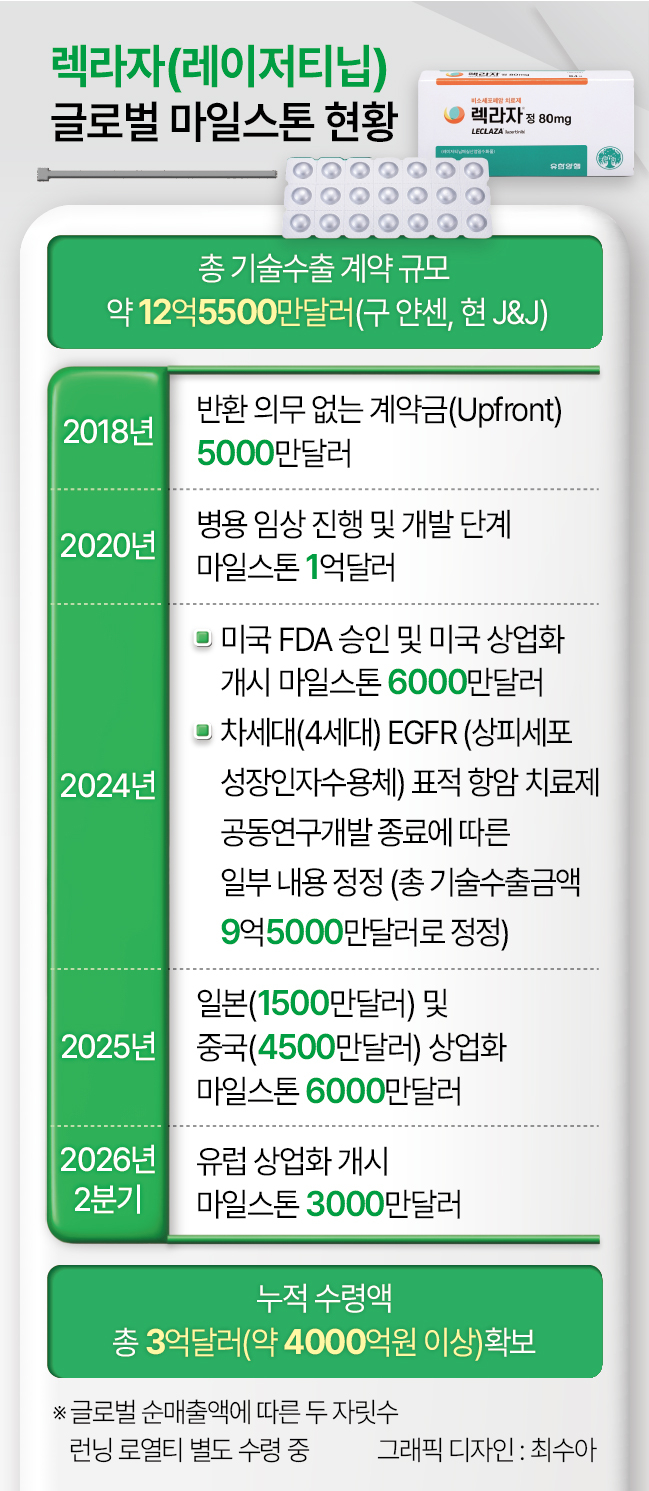
Yuhan in-licensed lazertinib, a non-small cell lung cancer treatment candidate at the pre-preclinical stage, combined it with internal R&D capabilities to maximize the compound's efficacy and value, and in 2018 struck a landmark technology-licensing deal with global pharma giant Janssen (J&J) worth a total of $1.25 billion.
The virtuous cycle — venture discovery, value enhancement at Yuhan, then global clinical development and commercialization by a major pharma — became the standard playbook for drug development in Korea. Thirty years after planting the first seed with the 1994 export of liver-disease drug YH439 to Japan, the combination therapy of lazertinib and J&J's Rybrevant received US FDA approval in August 2024. It was the first time a cancer drug developed by a Korean pharmaceutical company had won FDA first-line treatment approval.
![Lazertinib, a treatment for non-small cell lung cancer. [Yuhan]](https://wimg.heraldcorp.com/news/cms/2026/09/15/news-p.v1.20250325.e2323dd3b00c47128f424a2a85fef77c_P1.jpg)
The drug's global footprint is expanding rapidly. The partner drug Rybrevant's subcutaneous formulation has cleared regulatory hurdles in all major pharmaceutical markets — the United States, Europe, China and Japan. The new formulation cuts the grueling six-hour intravenous infusion time to roughly five minutes, sharply improving patients' quality of life and the convenience of administration for healthcare providers.
Listing as a Category 1 preferred regimen in the National Comprehensive Cancer Network guidelines and securing a J-code to facilitate US prescriptions have driven a sharp rise in prescription share. J&J projects peak annual global sales of the combination therapy at more than $5 billion.
Yuhan did not let commercial success overshadow its social responsibilities. From July 2023, six months before lazertinib received national health insurance reimbursement as a first-line treatment in Korea, the company ran an Early Access Program, supplying the drug free of charge to terminal lung cancer patients across the country with no cap on enrollment. A total of 895 lung cancer patients gained access to the treatment, and the value of the support — calculated at the drug's price at the time — reached 33 billion won ($24.5 million). It was a moment when the founding principle of "making the best products and returning the benefits to the nation and its people" became tangible through lazertinib.
Rather than stockpiling the returns from lazertinib's technology licensing, Yuhan has channeled them back into bold future R&D in a self-reinforcing investment cycle. Cumulative research and development spending over the past five years has exceeded 1 trillion won. In the first half of this year alone, the company allocated 10.5 percent of standalone sales — 117.6 billion won — to R&D. Yuhan is now widely credited with having fully established the standard formula of Korean biotech open innovation: reinvesting earned capital to discover the second and third lazertinib, rather than cutting costs to boost short-term earnings.
![Yuhan headquarters. [Yuhan]](https://wimg.heraldcorp.com/news/cms/2026/09/15/news-p.v1.20251231.ac61bf3dd97b450ab765234d7dde0a87_P1.png)
Second-quarter operating profit jumps 34% — large-scale capacity expansion in Ochang, Osong and Hwaseong
The global commercialization of lazertinib has fundamentally transformed Yuhan's financial profile. Cumulative consolidated sales for the first half of 2026 reached 1.17 trillion won, with cumulative operating profit hitting 75.6 billion won — both record highs. The twin engines driving the strong results are surging licensing revenue and active pharmaceutical ingredient exports. On a standalone basis, second-quarter licensing revenue came in at 58.9 billion won, a 130.6 percent jump from 25.5 billion won in the same period a year earlier. The leap reflects a one-time milestone payment of $30 million tied to the commercial launch of the lazertinib combination therapy in Europe, along with the full recognition of running royalties as global prescriptions expand.
The overseas business division is also reaping strong benefits from the reshaping of global supply chains. Following a raw material supply contract signed with US-based BridgeBio Pharma in May for a cardiomyopathy treatment worth approximately 56 billion won, Yuhan landed a large-scale API supply deal with Gilead Sciences worth approximately 210.2 billion won. On Sept. 1, the company signed an API supply contract worth 131.1 billion won, followed by another worth 78.6 billion won on Tuesday, bringing total orders in September alone to more than 200 billion won. Analysts attribute the string of wins to the contract development and manufacturing competitiveness of subsidiary Yuhan Chemical, as Western pharmaceutical companies accelerate their shift away from Chinese suppliers.
Yuhan is also moving quickly to expand its production infrastructure to meet growing domestic and overseas demand. To relieve the strain on its Ochang plant — which currently operates at 100 percent capacity producing 2.6 billion tablets a year — the company is building a new oral solid dosage facility in Osong capable of producing an additional 700 million tablets annually. At Yuhan Chemical's Hwaseong plant, which handles active pharmaceutical ingredients, construction of a large HC building with a capacity of 292,000 liters — on top of the existing 532,650-liter facility — broke ground in March and is on track for commercial operation in the first half of 2028.
![Quotes from Yuhan founder the late Dr. Yoo Il-han, on display at Willow House. [The Korea Herald]](https://wimg.heraldcorp.com/news/cms/2026/09/15/news-p.v1.20260915.84a997b054224a088f94c9124b6b8129_P1.jpg)
Bispecific antibodies, allergy and MASH — a pipeline aimed squarely at the next lazertinib
Yuhan's next chapter is focused on finding a successor to lazertinib. Rather than resting on the success of a single blockbuster, the company is running its open-innovation engine at full capacity to build a dense next-generation pipeline spanning multiple disease areas.
In oncology, the frontrunner is nesprotamig (YH32367), a HER2-targeting bispecific antibody immunotherapy co-developed with ABL Bio. The drug activates immune cells selectively within the tumor microenvironment, overcoming the liver toxicity limitations of existing immunotherapies, and is currently progressing through a global Phase 1/2 trial. An EGFR-targeting bispecific antibody, YH32364, and YH42946 — a next-generation HER2-TKI treatment for non-small cell lung cancer in-licensed from J2H Biotech — are also accumulating data in Phase 1/2 trials. A number of preclinical solid tumor pipeline candidates, including YHC3151, YHC3104 and YHC2124, provide further depth.
In immunology and inflammation, the top candidate is lesigercept (YH35324), a long-acting IgE trap for allergic diseases in-licensed from GI Innovation. Having demonstrated superior sustained IgE suppression compared with the standard-of-care Xolair, the drug is approaching interim Phase 2 data readouts, and discussions on additional technology licensing deals with global major pharma companies are actively under way.
The cardiovascular, metabolic and rare disease portfolio is equally strong. YH25724, a treatment for metabolic dysfunction-associated steatohepatitis, or MASH, has completed a Phase 1 trial with a dual FGF21/GLP-1 mechanism of action and is seeking a global partner. YH35995, a treatment for the rare genetic disorder Gaucher disease developed in collaboration with GC Biopharma, is an oral drug with improved blood-brain barrier permeability and has entered Phase 1 trials. Specialized pipeline candidates including YH14618 (SB-01) for degenerative disc disease and YH12852 for gastrointestinal motility disorders are advancing through late-stage clinical development. Backed by this diversified pipeline, Yuhan has set its sights on securing a firm place among the world's top 50 pharmaceutical companies.
![A decorative stone pagoda from the private residence of Yuhan founder the late Dr. Yoo Il-han, now installed in Willow Park. [The Korea Herald]](https://wimg.heraldcorp.com/news/cms/2026/09/15/news-p.v1.20260915.fba137ce31524f3693357961b1f97713_P1.jpg)
A century ago, Yuhan took its first steps from Deokwon Building in Jongno with a single purpose: to protect the health of the Korean people and help restore their sovereignty under Japanese colonial rule. Sharing the fruits of its success with society, nurturing the Korean biotech ecosystem through open innovation, and pressing forward into next-generation drug R&D, Yuhan's journey now reaches beyond Korea toward the center of global pharmaceutical innovation.
"As we enter our second century, we will carry forward the noble spirit of our founder, the late Dr. Yoo Il-han, guided by our core values of Progress and Integrity," Chief Executive Jo Uk-je said. "Building on the global breakthrough of our innovative drug lazertinib, we will leap forward as a global innovative pharmaceutical company that contributes to the health of humanity."

silverpaper@heraldcorp.com