Biomedical engineering professors' team maps early adaptation of cancer cells during organ metastasis
![(From left) Professors Cho Seung-woo and Park Tae-eun, and researchers Yoon Hee-jeong and Kim Da-young. [Provided by UNIST]](https://wimg.heraldcorp.com/news/cms/2026/09/17/news-p.v1.20260917.c1c6d0bb7f3e4b36a1412b98de17d467_P1.jpg)
Researchers have opened a new avenue for suppressing the spread of colorectal cancer to the liver by blocking signaling molecules from binding to proteins on cancer cell surfaces.
A research team led by Professors Cho Seung-woo and Park Tae-eun of the Department of Biomedical Engineering at the Ulsan National Institute of Science and Technology (UNIST) announced Thursday that inactivating the c-MET protein in colorectal cancer cells that have metastasized to the liver can reduce their survival rate and inhibit further metastasis. The c-MET protein acts as a receptor that relays external survival signals into the cell.
The team studied the metastatic process using a culture system in which patient-derived colorectal cancer cells were placed in a gel made from extracellular matrix (ECM) — the material left behind after cells are removed from an organ. ECM not only surrounds and supports cells but also interacts with surface receptors to influence cell growth and survival. The researchers produced four types of culture materials from the colon, liver, lung and brain of pigs, whose tissue composition is similar to that of humans.
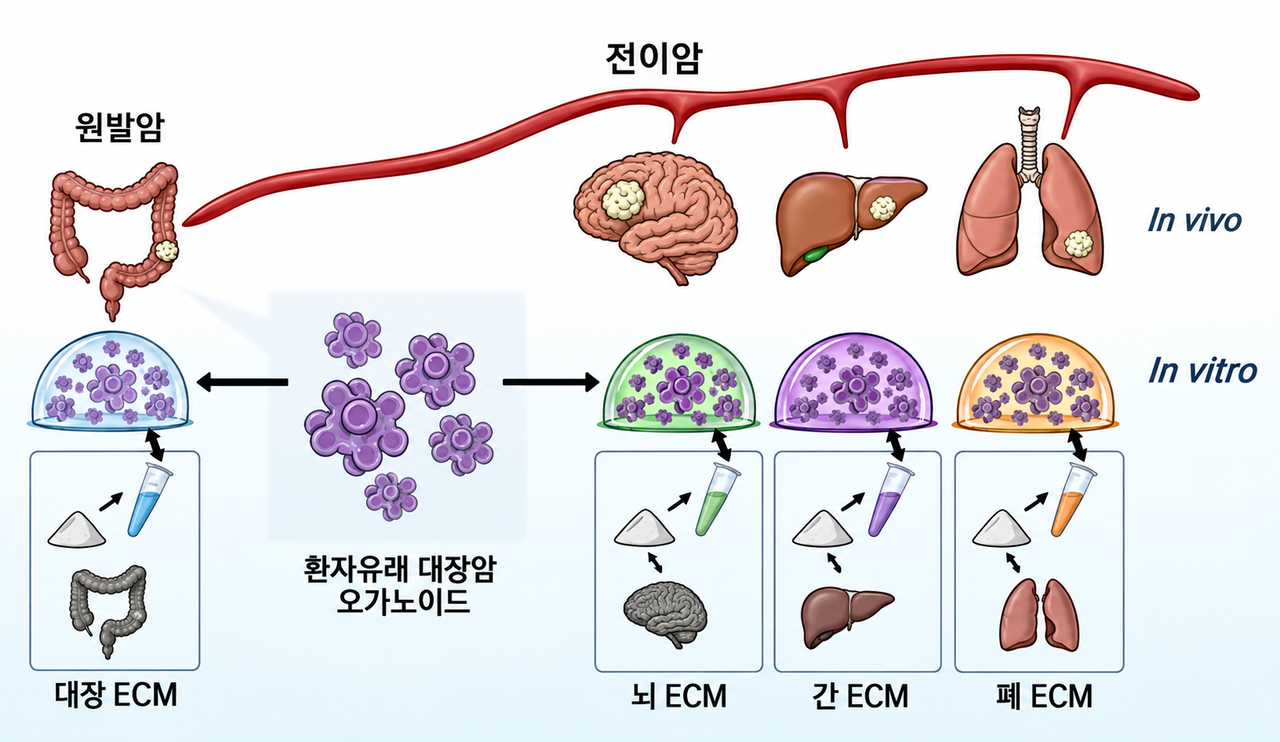
Experiments showed that the degree of tumor mass formation and epigenetic changes — modifications that regulate gene activity — varied depending on the culture material used. The findings confirmed that cancer cells adapt by selectively activating different genes based on the surrounding tissue environment.
In liver tissue culture material particularly, cancer cells were also vulnerable to drugs that block c-MET, the receptor protein that relays survival signals. Cell survival rates dropped markedly after drug treatment.
The team plans to develop a system that co-cultures immune cells alongside cancer cells to examine organ-specific interactions between the two cell types and to evaluate the efficacy and toxicity of immunotherapy drugs.
"This research reproduced the tissue environment of individual organs and identified how gene activity and survival mechanisms in cancer cells differ depending on where they take hold," the team said. "It can be applied to develop personalized treatments that target the specific vulnerabilities of a patient's cancer when it metastasizes to a particular organ, with potential expansion to a wide range of cancer types."
UNIST researchers Yoon Hee-jeong and Kim Da-young served as co-first authors of the study, which was published online Aug. 26 in Bioactive Materials, a leading international journal in the field of biomaterials with an impact factor of 23.6.
cityblue@heraldcorp.com