Approval rate tops 90% for those working 60 or more hours a week
Insufficient rest days carry highest approval rate at 64%
Short-term overwork cases approved at 74.2% when workload jumps 30%
![Office lights burn late into the night at buildings in Pangyo Technovalley in Seongnam, Gyeonggi Province. The area, home to a concentration of IT and gaming companies, is nicknamed "the squid boat of Pangyo" in the industry for its lights that never seem to go out. [The Herald Business DB]](https://wimg.heraldcorp.com/news/cms/2026/09/22/news-p.v1.20260616.a0cc73c1637e427ebc872b315167ae4d_P1.png)
The approval rate for workers' compensation claims tied to cardiovascular deaths more than doubles — jumping from 35.3 percent to 77.7 percent — once weekly working hours exceed 52, according to data released Tuesday. For those working 60 or more hours a week, the approval rate surpasses 90 percent.
The figures come from data on cardiovascular death compensation approvals broken down by working hours, which Democratic Party of Korea lawmaker Kim Ju-young of the National Assembly's Climate, Energy, Environment and Labor Committee obtained from the Korea Workers' Compensation and Welfare Service. The data covers January 2022 through August this year and shows that workers putting in between 48 and 52 hours a week had a compensation approval rate of 35.3 percent.
That rate rose sharply to 77.7 percent — 2.2 times higher and a jump of 42.4 percentage points — for workers in the 52-to-56-hour bracket. It climbed further to 82.1 percent for those working between 56 and 60 hours, reached 94.3 percent in the 60-to-64-hour range, and stood at 92.1 percent for those working 64 or more hours a week.
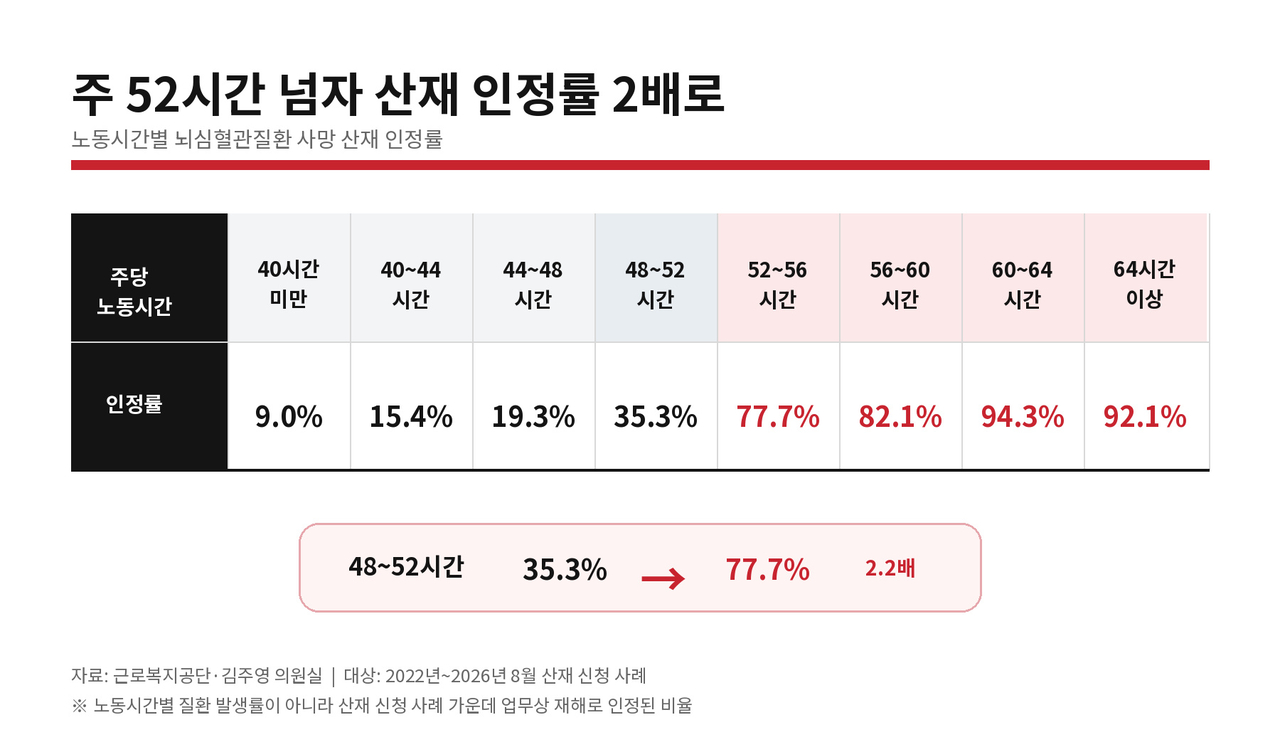
By contrast, the approval rate for workers putting in fewer than 40 hours a week was limited to 9.0 percent. Those working between 40 and 44 hours had a rate of 15.4 percent, while the 44-to-48-hour bracket stood at 19.3 percent.
The approval rate measures the share of cases — among bereaved families who applied for survivor benefits after a cardiovascular death — that were recognized as work-related injuries. It does not reflect the incidence of cardiovascular disease by working-hour bracket; rather, it represents the proportion of filed claims in which a link was established between the worker's death and job-related burdens such as long hours.
Beyond long hours, insufficient rest days and irregular or shift-based work schedules also emerged as factors raising the likelihood of a cardiovascular death being approved as a workplace injury.
Among the aggravating work-burden factors, "insufficient rest days" carried the highest approval rate at 64.0 percent — 114 of 178 applications were approved. Irregular work schedules had an approval rate of 62.5 percent, with 10 of 16 applications approved.
Shift work recorded an approval rate of 54.1 percent, with 380 of 703 applications approved. Mental stress came in at 47.2 percent, high-intensity physical labor at 43.0 percent, hazardous working conditions at 39.8 percent, and overseas travel involving time-zone changes at 35.3 percent.
Cases involving a sudden spike in workload over a short period also showed high approval rates. Over the past five years, 163 claims were filed under the "short-term overwork" category, of which 121 were approved — an approval rate of 74.2 percent.
Short-term overwork is defined as cases in which a worker's hours or workload in the week before the onset of illness increased by 30 percent or more compared with the weekly average over the preceding 12 weeks.
During the same period, "acute overwork" — involving sudden, unpredictable events or abrupt changes in the work environment — had 120 of 263 applications approved, for a rate of 45.6 percent. "Chronic overwork," covering prolonged exposure to excessive job demands, saw 979 of 2,930 applications approved, a rate of 33.4 percent.
The Korea Workers' Compensation and Welfare Service does not track overwork deaths as a separate cause of death. The statistics were compiled from records of survivor benefit applications and decisions for workers who died of cardiovascular disease.
"The approval rate for cardiovascular deaths rises sharply once weekly hours cross the 52-hour threshold, and exceeds 90 percent at 60 hours or more," Kim said. "We need a roadmap for reducing working hours to cut down on those hours and ensure adequate rest."
fact0514@heraldcorp.com