Geoje shipbuilding and offshore plant materials, parts and equipment specialized complex
Government selects complex in national materials, parts and equipment designation program
Construction of floating LNG storage and liquefaction facility set to accelerate
Drive to end reliance on overseas licenses and localize key components
Expected to generate 4.2 trillion won in production and 19,000 jobs
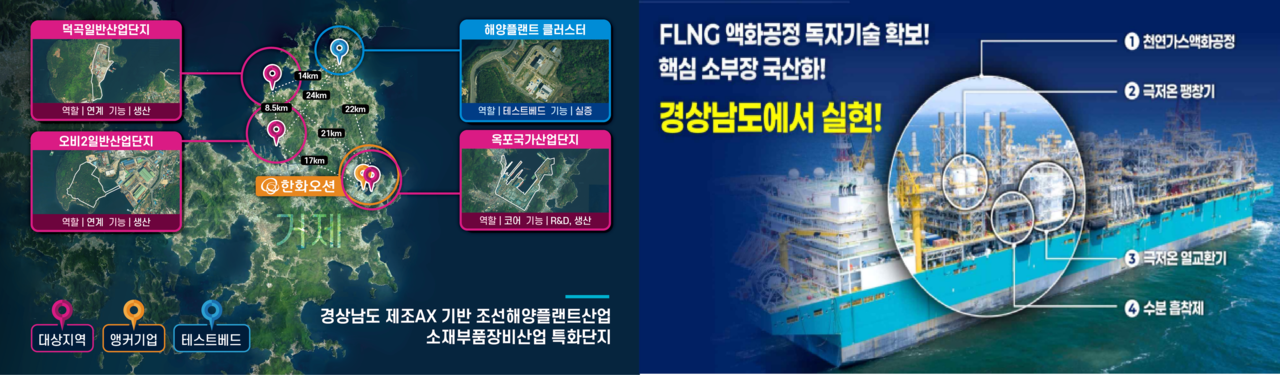
A hub for floating liquefied natural gas technology — often called a "factory on the sea" — is set to be built in Geoje, South Gyeongsang Province. Riding the current shipbuilding boom, the project aims to achieve technological self-reliance in eco-friendly, high-value-added offshore plant technology and drive a new leap forward for the regional economy.
South Gyeongsang Province said Wednesday that the Ministry of Trade, Industry and Energy had selected the Geoje shipbuilding and offshore plant complex in its national competition for specialized materials, parts and equipment complexes. The designation marks the start of a concerted push to localize the core FLNG source technology and key components that have long been locked behind foreign licenses — and to pull decisively ahead of China's fast-closing challenge in Korean shipbuilding.
The selection was the result of collaboration among South Gyeongsang Province, Geoje City, anchor company Hanwha Ocean and the South Gyeongsang Technopark. The government plans to concentrate support on the complex through a package that includes demonstration infrastructure, research and development, talent development and regulatory exemptions, treating advanced shipbuilding and shipping as a core growth engine for the southeastern region.
FLNG, or floating liquefied natural gas liquefaction processing, is a cutting-edge integrated facility that floats above an offshore gas field, refines natural gas drawn from the seabed, rapidly cools and liquefies it to minus 162 degrees Celsius, stores it in onboard tanks and then transfers it directly to LNG carriers. Typically built on a hull three to four times the length of a soccer field, the structure is essentially a massive onshore chemical plant compressed and mounted at sea. Each unit costs more than 4 trillion won ($2.94 billion) to build, making it one of the most high-value projects in the industry.
Onshore plants face significant obstacles in securing sites — resident complaints, environmental regulations, and the risks of gas leaks and explosions. FLNG, by contrast, travels directly to deepwater gas fields far from shore, freeing it from location constraints and regulatory barriers. It has drawn particular attention as a strategic asset for national energy security amid growing global maritime logistics instability — including the crisis at the Strait of Hormuz stemming from Middle East conflicts — and a surge in power demand driven by the spread of the AI industry.
Manufacturing an FLNG unit is extraordinarily demanding. Unlike onshore plants, it must withstand the extreme conditions of a hull that pitches and rolls constantly in heavy seas and wind. Tens of thousands of precision chemical pipelines must circulate cryogenic gas safely without cracking even under violent motion, making advanced composite engineering design and rigorous safety standards essential.
South Korea's shipbuilding industry has effectively monopolized global FLNG orders on the strength of its overwhelming construction capabilities. But behind that track record lies a structural weakness: the source technology for the core natural gas liquefaction process design is monopolized by a handful of foreign engineering firms, including France's Technip.
As a result, domestic shipbuilders have had to pay royalties of 80 billion to 120 billion won per unit — equivalent to 2 to 3 percent of the contract value — to foreign firms even after winning FLNG orders worth around 4 trillion won each. The bigger problem is vendor lock-in. Foreign licensors have used their proprietary designs to force shipbuilders to use only parts from designated overseas suppliers, shutting out domestic materials, parts and equipment companies despite their strong technological capabilities.
South Gyeongsang Province plans to use the complex designation as a springboard to localize four key items currently 100 percent dependent on foreign sources. The priorities are achieving self-reliance in liquefaction process design technology, along with localizing moisture adsorbents that remove impurities from gas, turboexpanders that expand the cooling gas, and cryogenic heat exchangers that withstand ultra-low temperatures. Anchor company Hanwha Ocean will secure a liquefaction process license, while government and local authority research and development support will enable locally produced small and medium-sized enterprise components to be incorporated into actual designs and ordered — creating a virtuous cycle of cooperation.
Public and private investment in the project will approach 1.6 trillion won ($1.18 billion) through 2031. Hanwha Ocean will invest 1.52 trillion won in building large offshore plant construction facilities, smart manufacturing automation and safety management infrastructure.
An additional 74.5 billion won in national and local government funds and private matching investment will support core technology self-reliance, demonstration infrastructure and specialist workforce development. The complex also aims to build a stable domestic supply chain for key components, helping South Korea respond to shifts in the global energy market and strengthen national energy security.
The complex will be organized by function across multiple sites. A demonstration testbed for precision performance verification of developed components will be established on the grounds of the Korea Research Institute of Ships and Ocean Engineering in Jangmok-myeon, Geoje. Partner materials, parts and equipment and component companies wishing to invest in Geoje will be concentrated in the Geoje Obi 2 General Industrial Complex and the Deokgok Industrial Complex to form a robust industrial value chain.
The economic ripple effects from the complex are expected to reach 4.2 trillion won in production output and create more than 19,000 jobs. The project is seen as delivering a clear trickle-down benefit to the broader regional shipbuilding industry, which has only recently emerged from a prolonged downturn.
Having already dominated conventional commercial vessels and LNG carriers, and having recently delivered its first FLNG unit, South Korea now stands at a turning point in its effort to leave China's fast-closing pursuit behind. The strategy is to internalize the core materials, parts and equipment supply chain to fend off aggressive low-price competition and cement Korean shipbuilding's global technological lead behind an insurmountable barrier.
"The shipbuilding and offshore plant materials, parts and equipment specialized complex is an important turning point that will elevate the competitiveness of South Korea's shipbuilding industry — not just South Gyeongsang Province," said Choi Man-rim, the province's vice governor for economic affairs. "We will pursue this project with a strong sense of responsibility to realize Korean shipbuilding's decisive competitive edge through FLNG core technology self-reliance and the localization of materials, parts and equipment."
ook967@heraldcorp.com