10-year cumulative returns: high of 506%, low of -32%
Monthly contributions and accumulated funds require different strategies
Set equity allocation first, with at least 50% in overseas funds
Frequent fund switches hurt returns even in volatile markets
Hold 10 years for tax exemption — and watch contribution limits
South Koreans pay an average of about 5.15 million won in insurance premiums per year (2025, Korea Insurance Development Institute). This series is about making every won count.
![Lee Su-jin (pseudonym, 45), an office worker, had not checked her variable life insurance fund once since signing up years ago. When markets turned volatile recently, she opened her insurer's app for the first time — wondering where the 500,000 won she pays each month was actually being invested. [Created using ChatGPT]](https://wimg.heraldcorp.com/news/cms/2026/09/24/news-p.v1.20260923.b470d7c4c0454765a19419786eb36abd_P1.png)
Lee Su-jin (pseudonym, 45), who works at a mid-sized company in Seoul, signed up for a variable life insurance policy a few years ago at the suggestion of an acquaintance who worked as an insurance agent. She thought it would help fund her retirement. She left the funds exactly as the agent had chosen them and never looked at them again.
The premiums came out automatically each month, so there was nothing to worry about — until a colleague's offhand remark at lunch recently stopped her cold.
"With the Kospi swinging like this, have you switched your variable insurance funds?" Lee had no idea the funds could even be changed. When she finally opened the app, she found nothing but unfamiliar fund names and numbers. Should she switch funds now, or leave them alone? She decided to find a specialist who could help manage her variable insurance portfolio.
Retirement savings need to work for anywhere from 10 to more than 30 years. They must outpace inflation and, when equity markets perform well, deliver a reasonable investment return.
When people think about retirement savings, pension savings funds and individual retirement pension (IRP) accounts usually come to mind first, largely because of their tax benefits. Variable life insurance is another option worth considering. It is a product that combines insurance and investment: a portion of the premiums paid goes into funds invested in equities, bonds and other assets, and the eventual payout depends on how those funds perform. It provides both investment exposure and risk coverage, and policies held for 10 years or more qualify for a tax exemption on investment gains.
Even within variable life insurance, the choice of fund makes an enormous difference. According to disclosures by the Korea Life Insurance Association, the 10-year cumulative returns of variable insurance funds with more than a decade of operating history ranged from a low of -32% to a high of 506% as of Aug. 5. Some funds lost roughly a third of their value over 10 years while others grew more than sixfold. These figures reflect the funds' own returns and differ from the net returns policyholders actually receive. They illustrate why active fund management is essential for anyone using variable life insurance to build retirement savings.
Q. Pension savings and IRP already exist for retirement — is variable life insurance also necessary?
A. It is better to think of personal pension accounts (pension savings funds and IRP) and variable life insurance not as alternatives but as complementary tools. Both offer tax advantages, but the timing and form of those benefits differ.
Personal pension accounts offer an immediate benefit through a tax credit that reduces your current tax bill. The combined tax-credit limit for pension savings and IRP contributions is up to 9 million won per year. The trade-off is that when the account grows through strong investment returns, withdrawals in retirement are subject to a pension income tax of 5.5%.
Variable life insurance offers no significant upfront tax benefit, but its key advantage is that gains accumulated over a policy held for 10 years or more are entirely tax-exempt — no matter how large those gains become. To qualify, however, two conditions must be met: (1) monthly premiums must not exceed 1.5 million won ($1,100), or a lump-sum premium must not exceed 100 million won, and (2) the policy must be maintained for at least 10 years from the date of the first premium payment. Since the tax exemption only matters if there are gains to exempt, investment performance is ultimately the more important factor in deciding whether variable insurance makes sense.
In short, variable life insurance becomes more attractive the better the long-term returns and fund management. If returns are modest, IRP tends to have the edge. Rather than declaring one universally superior, both pension savings accounts and variable life insurance can serve as solid retirement-planning tools — and using them together is a reasonable approach.
Q. If I pay 500,000 won a month into variable life insurance, does all of it go toward investment?
A. No. Variable life insurance is an insurance product before it is an investment product, so deductions are made from your premium before any money reaches the funds. These include the risk premium — the cost of covering risks such as death — and operating expenses covering contract administration and distribution. Only what remains after those deductions is invested in the funds. The exact amounts vary by product and insurer, so no single figure applies across the board.
One feature worth paying close attention to is additional contributions. This refers to putting in extra money on top of the fixed monthly base premium. At most insurers, additional contributions are invested without a separate deduction for operating expenses — meaning more of your money actually goes to work in the funds compared with the same amount paid as a base premium.
Q. If I'm contributing 500,000 won a month, how should I invest it?
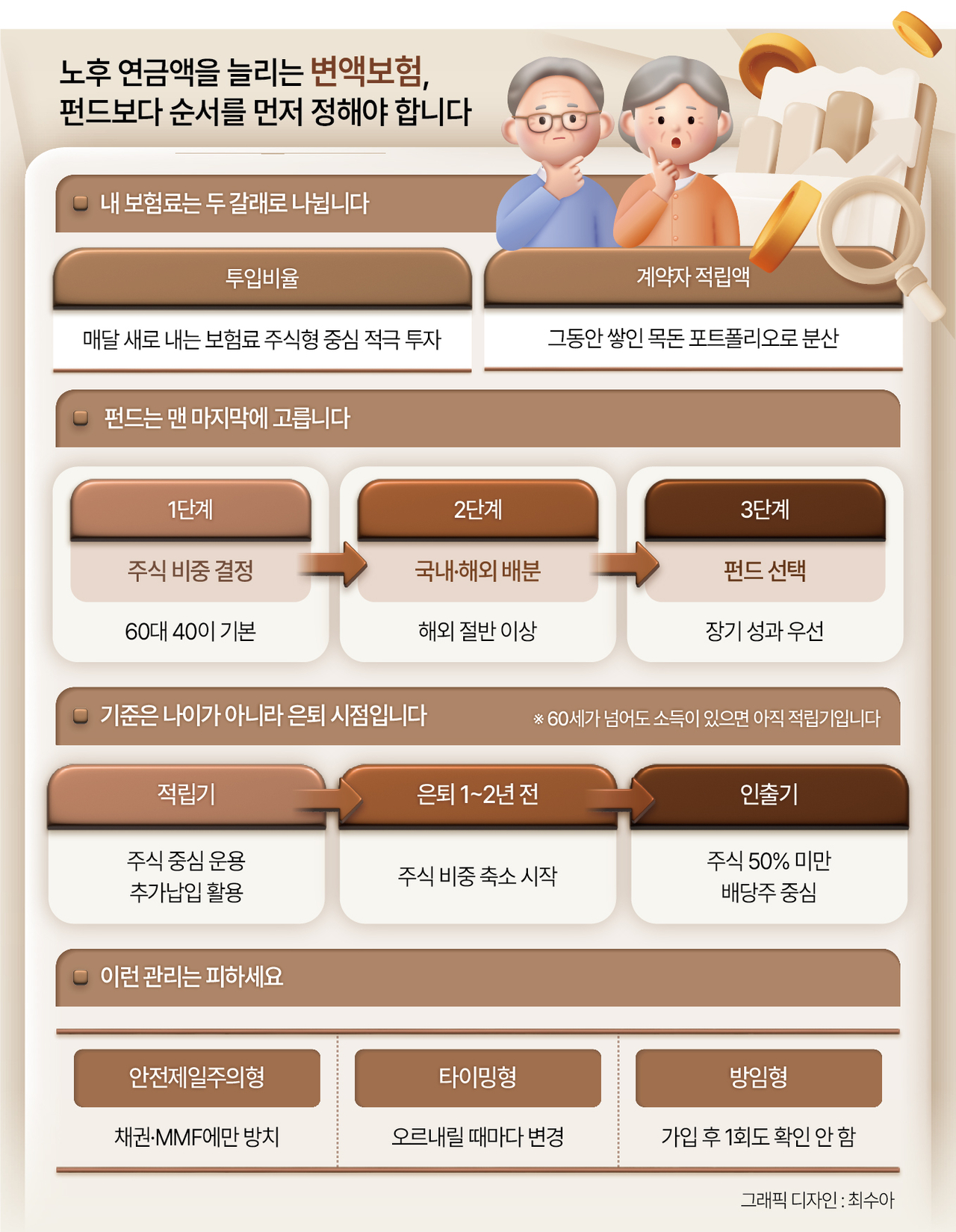
A. You first need to distinguish between two things: the "contribution allocation ratio" and the "policyholder reserve." Simply put, the contribution allocation ratio is the proportion of each premium payment that actually goes into the funds. The policyholder reserve is the total amount you have accumulated so far. In variable life insurance, you can set the fund mix and allocation for each of these two pools separately. Changing only the contribution allocation ratio leaves the money already accumulated in its existing funds untouched.
For the money coming in each month, investing aggressively through equity-focused funds is advisable. Putting in the same amount every month means you buy more units when prices are low and fewer when prices are high, lowering your average cost over time. The longer the investment horizon, the more this effect reduces risk.
The accumulated reserve, on the other hand, is directly exposed to market swings. A portfolio approach that blends equities with bonds is therefore more appropriate for that pool.
For someone like Lee at 45, the monthly contributions are best directed aggressively into equity funds. For the accumulated reserve, holding some bonds makes sense, but given that retirement is still more than 10 years away, keeping equities at a higher weight than bonds is the better call.
More important than any of this, though, is determining what percentage of your total accumulated funds should be in equities — based on your risk tolerance and age. In practice, many policyholders hold multiple funds yet end up with 100% in equities despite a conservative profile, or the opposite: far too little in equities. Either extreme leads to losses that are hard to absorb, or returns that fall short of expectations, causing people to give up midway.
The right sequence is: ① decide on your equity allocation, ② divide that between domestic and overseas markets, and ③ only then select the most suitable individual funds.
Q. How do I figure out the right equity allocation for me?
A. The most widely used benchmark is the "60/40 portfolio." It allocates 60% to equities and 40% to bonds — equities for growth, bonds for stability. It is the standard model used by pension funds and institutional investors alike.
JP Morgan analyzed a 60/40 portfolio of US equities and bonds from 1950 to 2025 and found an average annual return of 9.4%. Over any holding period of five years or more, the portfolio never produced a loss of principal even in the worst-case scenario. The National Pension Service follows a similar approach: as of April, it had 61% in equities and 39% in bonds and alternative investments, according to data from the NPS Fund Management Committee.
Using 60/40 as a baseline, investors who want a more aggressive stance can raise the equity share to 70/30 or 80/20, while those who prefer stability can reduce it.
If you are unsure of your own risk tolerance, try the "100 minus your age" rule: allocate to equities the percentage equal to 100 minus your current age. That works out to 70% for a 30-year-old and 55% for a 45-year-old. The formula naturally shifts the portfolio toward equities when young and toward stability as you age, making it easy for beginners to apply. As life expectancy rises, some now use "110 minus age" or "120 minus age" instead. Treat it as a flexible starting point to be adjusted for your risk profile, asset size and investment horizon — not a rigid rule.
Because variable life insurance is a long-term product, however, even the most conservative investor is advised to keep at least 40% in equities. Keeping more than half of the equity portion in overseas stocks is also recommended. The Korean won is not a reserve currency with the global reach of the US dollar. Holding overseas equities denominated in dollars alongside domestic holdings provides greater stability than concentrating entirely in Korean stocks.
More important than age, though, is your retirement date. Someone who retires early at 40 and immediately needs living expenses is in the "drawdown phase" — spending down accumulated savings. Conversely, someone still earning income past 60 remains in the "accumulation phase" and should continue investing for growth.
Q. I've never checked my policy since signing up — what should I look at right now?
A. Work through four checks in order.
First, confirm whether the funds you are in invest in equities or bonds.
Second, assess whether your current equity allocation matches your risk tolerance.
Third, for any equity funds you hold, check whether they invest in domestic or overseas stocks — and make sure you are not overly concentrated in Korea.
Fourth, review the long-term performance of your equity funds over at least five years.
Q. How should I choose equity funds?
A. Variable insurance funds are generally divided by investment region into domestic and overseas funds, with overseas funds further broken down into global, regional and country-specific options. More recently, funds focused on high-growth industries have also emerged, broadening the range of choices.
When selecting funds, prioritize long-term performance over short-term returns. Even among funds with strong long-term records, one that delivers consistent results year after year is a better choice than one whose annual performance swings wildly.
Anyone can check variable insurance fund returns through the Korea Life Insurance Association's variable insurance disclosure portal. Unlike regular funds, where investors must sift through countless asset managers and products on their own, variable insurance funds are pre-screened and managed by the insurer's fund management team — reducing the burden on policyholders.
Q. What should I do when markets are as volatile as they are now?
A. If sharp swings concern you, keeping a fixed portion of your reserve in cash-equivalent assets is one option. Moving part of your variable insurance reserve into a money market fund (MMF) does the job. MMFs invest in short-term bonds and similar instruments, operating with near-cash stability. They limit losses when markets fall and preserve dry powder to buy in at lower prices. Because markets can turn volatile at any time, maintaining a steady MMF allocation as a matter of course — rather than reacting to each downturn — is the point.
In consultations, when the Kospi was surging past 8,000, many clients said they wanted to pull everything out of their other funds and pour it all into a Kospi index fund. Then, when the Kospi recently dropped sharply, the same clients asked whether they should get out of the index fund. That is buying high and selling low. Because no one can predict share prices, the principle of diversification must never be forgotten.
Q. Isn't it still better to switch funds quickly when markets move?
A. Timely fund management is certainly important. Variable life insurance allows up to 12 fund switches per year — separately for the contribution allocation and the accumulated reserve — with no switching fees. But switching frequently does not guarantee better results.
When comparing clients who switched extremely often with those who made no changes over more than 10 years, the hands-off clients sometimes came out ahead. Rising markets breed greed and push investors toward more aggressive positions; falling markets breed fear and push them toward caution. The result is a tendency to increase equity exposure near peaks and reduce it near troughs.
Equity returns also tend to be concentrated in a small number of brief periods across the full investment horizon. Missing those sharp rallies by switching funds too often can significantly damage overall performance.
Of course, investing for more than 10 years does not guarantee strong returns. Some markets have delivered poor results even over decade-long horizons. The recommendation, therefore, is to take a long-term approach while spreading investments globally rather than concentrating in any single country.
Q. I'm not confident managing funds myself — are there other options?
A. Setting your equity allocation to match your risk profile and retirement timeline, and spreading that allocation across domestic and overseas markets, is something you must do yourself. For everything after that, the management services your insurer provides are worth using.
The most common is automatic fund rebalancing. It automatically restores your original fund allocation at set intervals. If you started with a 60/40 equity-to-bond split and strong equity performance pushes it to 70/30, the system trims equities and adds bonds to bring it back to 60/40. By systematically selling what has risen and buying what has lagged, it effectively automates the discipline of selling high and buying low. It suits investors who want stable, downside-conscious management rather than maximum returns. Rebalancing intervals are typically three, six or 12 months; for retail investors, once or twice a year — every six or 12 months — is a sensible choice.
A 'fund doctor' service is also available, where a specialist reviews your specific fund holdings and provides tailored advice. More recently, AI-driven fund recommendation and management services have emerged, as have target-date funds (TDFs) that automatically reduce equity exposure as your retirement date approaches.
These services carry no additional charge. The fund doctor service is operated by most insurers in line with financial regulatory guidance. Automatic rebalancing is offered by a significant number of insurers as well, though AI-based fund management remains available only at select companies. When choosing a variable life insurance policy, it is worth checking which of these management services are on offer.
Q. Is there anything anyone saving for retirement absolutely needs to know?
A. Retirement planning calls for different strategies at different stages.
During the accumulation phase — when you are building up savings — invest aggressively through equity-focused funds to maximize growth. Start with a high equity allocation and gradually reduce it as retirement approaches. The "100 minus age" rule mentioned earlier is a useful guide. Making full use of additional contributions and minimizing mid-term withdrawals will help grow your retirement nest egg and compound returns over time.
The drawdown phase — when you begin spending down what you have saved — calls for a different approach. The priority shifts to making the money last. Keep equities below 50% of the portfolio and favor relatively stable equity funds such as dividend-focused funds. Starting to trim equity exposure one to two years before retirement helps protect against a sharp drop in savings right when you need them most.
Certain investment principles hold regardless of how markets move. Determine the right mix of domestic and overseas assets, and of equities and bonds, based on your risk profile and retirement date — then stay the course. The longer you invest, the more you benefit from the power of compounding.

won@heraldcorp.com