Ulsan Mayor Kim Sang-uk, visiting Gwangju on Monday, pledged to deliver tangible results for residents by the same time next year, saying he would ensure that concrete policy, economic and cultural exchange initiatives between the two cities are up and running.
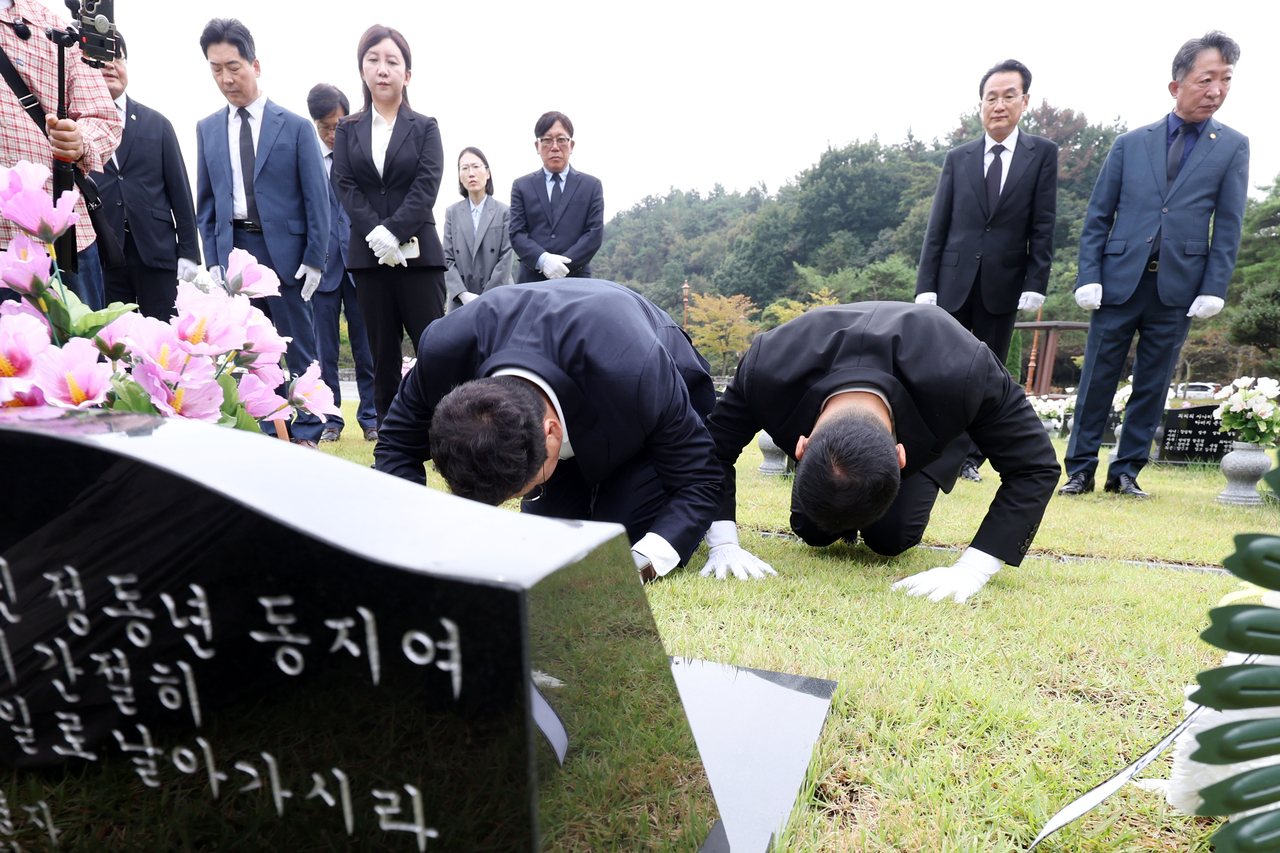
Kim paid his respects at the National May 18 Democratic Cemetery in Unjeong-dong, Buk-gu, Gwangju. It was the first time a sitting Ulsan mayor had visited the cemetery.
Kim identified autonomous driving vehicle demonstration projects, humanoid robots, AI, petrochemicals and cultural exchange as priority areas for cooperation between the two cities.
"Combining Gwangju's foundational AI capabilities with Ulsan's industry-focused AI transformation will allow us to build a new model of cooperation in the automotive and manufacturing sectors," he said. "We also need to find ways to jointly upgrade the petrochemical industries of Ulsan and Yeosu."
He added that Ulsan would share experiences and explore cooperation with Suncheon ahead of the 2028 Ulsan International Garden Expo, and said he planned to propose a cultural exchange program that would allow performing arts groups from both regions to tour each other's cities.
"Thanks to Gwangju, we have been able to jointly pursue a 100 billion won ($74 million) autonomous driving vehicle demonstration project and a 58 billion won humanoid robot project," he said.
After the cemetery visit, Kim called on Chonnam National University and Gwangju City Hall that afternoon.
At City Hall, Kim met with Gwangju Mayor Min Hyeong-bae and signed a friendship agreement on future co-development between the two cities.
Under the agreement, the two cities will cooperate on building AI-based factories and advancing AI transformation, building on their joint "Ulsan-Gwangju Humanoid-Based Automotive Industry Manufacturing AI Transformation Support Project."
Specifically, the two cities will combine the industrial strengths of Ulsan, home to Hyundai Motor, and Gwangju, home to Kia, to jointly develop the future automotive industry — including the establishment of AI-based factories and autonomous driving technology.
The cities will also work together to develop hydrogen and secondary battery energy industries in response to surging power demand driven by the government's mega-project initiatives.
Cooperation in culture, tourism and sports will also be expanded.
The two cities will strengthen exchanges of performing arts and sporting events, and will leverage their shared distinction as two of only two cities in the country with a national garden — linking the 2028 Ulsan International Garden Expo with Suncheon Bay National Garden to promote tourism.
A separate MOU was also signed to advance AI transformation cooperation among major universities in both regions.
The two city governments, along with four universities — the University of Ulsan, Ulsan College of Science, Gwangju Institute of Science and Technology and Chonnam National University — agreed to establish a cooperative framework for research into core AI transformation technologies and the training of specialized talent.
"We will continue to strengthen substantive cooperation with Gwangju," Kim said, adding that he would keep identifying joint projects with other local governments — including LNG cooperation with Incheon and hydrogen energy cooperation with Gyeonggi Province — to expand Ulsan's role as a hub connecting multiple metropolitan regions.
sij@heraldcorp.com