Regional employment promotion subsidy budget to rise 214.8%, from 610 million won to 1.92 billion won
Advanced and digital skills training frozen at 20 billion won despite two consecutive cut ratings
Share of increased or frozen budgets hits highest level since 2022
![A job seeker looks at employment listings at the Seoul Western Employment and Welfare Plus Center in Mapo-gu, Seoul. [Yonhap]](https://wimg.heraldcorp.com/news/cms/2026/10/01/rcv.YNA.20250214.PYH2025021405770001300_P1.jpg)
Half of the government-funded job programs that received a "budget cut" rating in this year's performance review are set to see their budgets increased or frozen at current levels in next year's spending plan — the highest such share since 2022.
According to data submitted to People Power Party lawmaker Lee Jong-wook by the Ministry of Employment and Labor on Thursday, five of the 18 programs that received a cut rating in this year's review will see their budgets increased in the 2027 government spending plan. Four others were allocated the same funding as this year. Six programs had their budgets reduced, while the remaining three were terminated or merged into other programs.
Fiscally supported job programs are designed to strengthen the employment safety net for vulnerable workers and to develop the workforce needed to meet industrial change. The government evaluates programs implemented in the previous year and is required to reflect the results in the following year's budget. This year's review covered programs carried out last year.
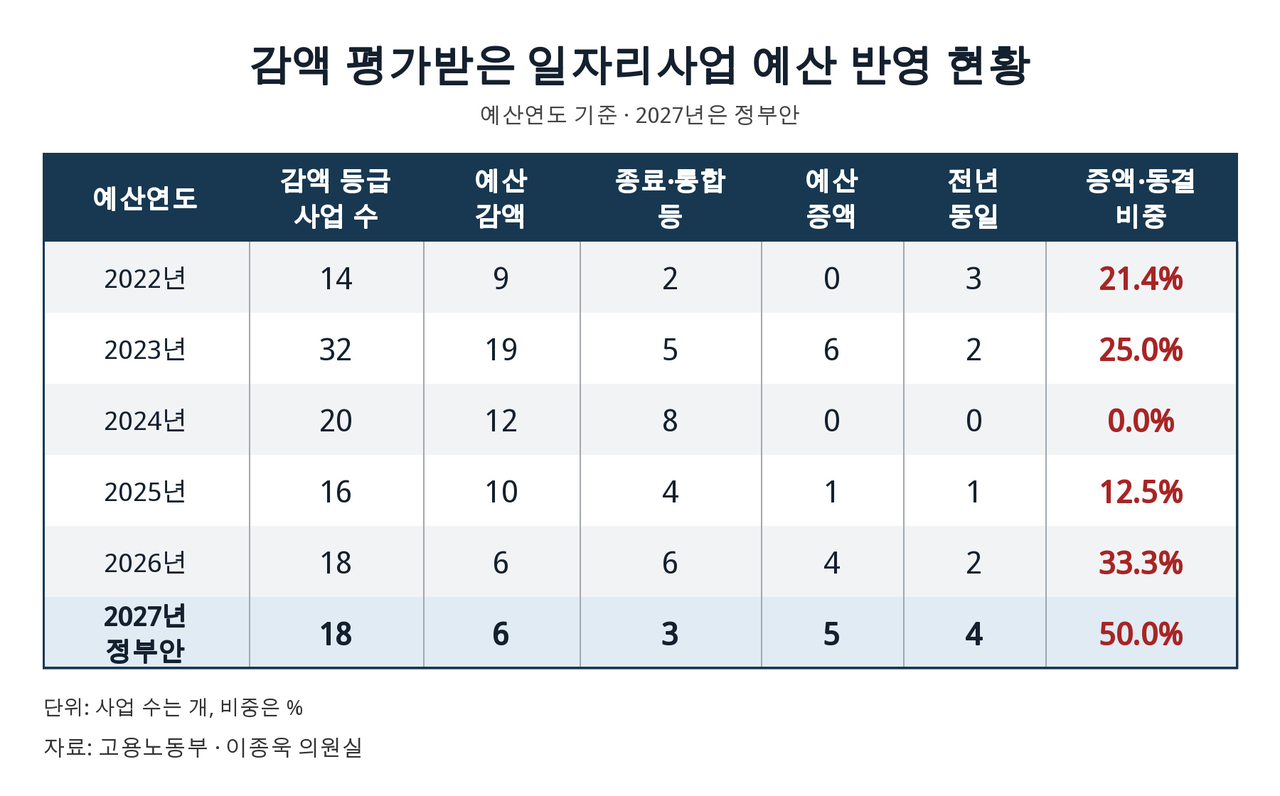
The share of cut-rated programs that nonetheless received budget increases or freezes stood at 21.4 percent for the 2022 budget year and 25.0 percent for 2023. In 2024, all 20 programs that received cut ratings either had their budgets reduced or were terminated and merged, leaving no programs with increases or freezes.
That share then rebounded to 12.5 percent for the 2025 budget and 33.3 percent for 2026. In next year's government plan, nine of the 18 cut-rated programs will see their budgets increased or maintained, pushing the share to 50.0 percent.
A prominent example is the Ministry of Employment and Labor's regional employment promotion subsidy. The program received a cut rating this year because budget execution was extremely low and quantitative indicators — including the employment retention rate — were poor even accounting for the special circumstances of designated employment-crisis regions. Despite this, next year's government plan allocates 1.92 billion won ($1.41 million) for the program, a 214.8 percent increase from this year's 610 million won.
The advanced industry and digital basic skills training component of the Tomorrow Learning Card program received a cut rating for the second consecutive year, with evaluators finding that quantitative outcomes such as employment and retention rates fell below the average for similar programs. Even so, next year's budget was set at 20 billion won, the same as this year.
By contrast, the overseas employment support program was cut by 21.1 percent, the high school employment-linked subsidy by 32.7 percent, and the smart farm youth startup incubation center operating budget by 15.0 percent — cases where evaluation results did translate into reduced funding.
"When a program rated for cuts still has its budget maintained or expanded, the rationale must be clearly stated during the budget formulation process," Lee said. "Programs that repeatedly underperform should lead to real improvements and budget adjustments."
fact0514@heraldcorp.com