Oil prices contributed 0.49 percentage points to the change in consumer price inflation in the first half, versus 0.12 percentage points from demand factors; analysts urge caution on further rate hikes given burden on vulnerable borrowers
![Fuel prices are displayed at a gas station in Seoul on Sept. 10, as rising geopolitical tensions between the United States and Iran push international oil prices above $100 per barrel. [Yonhap]](https://wimg.heraldcorp.com/news/cms/2026/10/01/rcv.YNA.20260910.PYH2026091004540001300_P1.jpg)
International oil prices had roughly four times the impact of demand factors on changes in consumer price inflation during the first half of this year, according to an analysis by the National Assembly Budget Office. The finding comes as the Bank of Korea has raised its benchmark interest rate twice in response to the possibility of growing price pressures from economic recovery — prompting calls for policymakers to also weigh supply-side cost pressures and the interest burden on vulnerable borrowers before any further hike.
The analysis, commissioned by Democratic Party of Korea lawmaker Kim Young-hwan of the National Assembly's Finance and Economy Planning Committee and released Thursday, estimated that oil prices contributed 0.49 percentage points to the change in the consumer price inflation rate in the first half of this year compared with last year — about 4.1 times the 0.12 percentage point contribution from demand factors. Even in core inflation, oil prices accounted for an estimated 0.16 percentage points of the change, about 2.3 times the 0.07 percentage point contribution from demand.
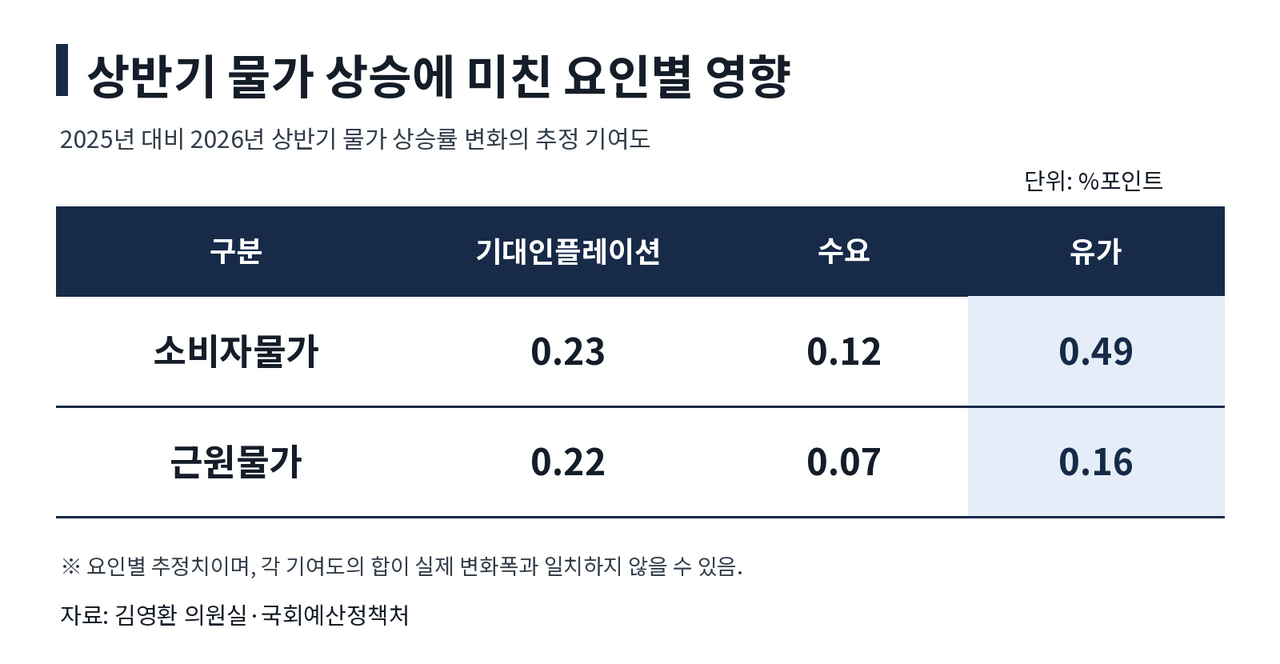
A breakdown by product category also highlighted the outsized role of petroleum products. Their contribution to consumer price inflation averaged 0.12 percentage points for all of last year but rose to an average of 0.67 percentage points in the January–July period this year — an increase of 0.55 percentage points that exceeded the 0.43 percentage point rise in the overall consumer price inflation rate over the same period. The expansion in petroleum products' contribution, in other words, was larger than the overall increase in the inflation rate itself.
The budget office found that a sharp rise in international oil prices in March and a weaker won from May through July contributed significantly to recent inflation. Fluctuations in the exchange rate and oil prices fed through import prices and producer prices into consumer prices, amplifying cost pressures.
By contrast, the pass-through from income growth to consumer spending remained limited. Data from Kim's office showed that real gross domestic income rose 12 to 16 percent this year on improved terms of trade, yet private consumption growth stayed at around 2.5 percent over the same period. Kim said income gains driven by the semiconductor industry's boom were concentrated among certain companies and workers and could not be taken as a broad improvement in households' spending capacity.
The Bank of Korea, however, has placed greater weight on the risk that demand-side price pressures will intensify. The central bank raised its benchmark interest rate twice — in July and August — lifting it from 2.5 percent to 3.0 percent annually, citing expectations that inflation would persist for a considerable period and that demand-side pressures could grow as the economy recovers.
In its August report, the Bank of Korea said that if rising wages and asset prices improve households' real purchasing power, increased consumption could push up core inflation. It also noted that when demand recovers quickly, companies find it easier to pass accumulated cost increases on to consumers. The bank added that if strong semiconductor exports and improved terms of trade translate into broader income gains and higher spending, price pressures could intensify further.
Kim said that before any additional rate increase, policymakers should assess the effects of the existing hikes on prices and financial stability, as well as the repayment burden on low-income and low-credit borrowers. He expressed concern that higher interest rates could increase the debt-servicing costs of vulnerable households, erode their capacity to consume and build assets, and widen inequality.
"The possibility of demand-driven inflation that the Bank of Korea has raised must be examined carefully," Kim said. "But any decision on a further rate hike should come only after also assessing the repayment burden on low-income and low-credit borrowers, the risk of a consumption slowdown, and the potential widening of inequality."
fact0514@heraldcorp.com