91 violations tied to explosions, fires and hazardous-material leaks
189 cases referred for criminal prosecution; 284 others to draw fines totaling 505.1 million won
Output and hiring rose, but safety staffing failed to keep pace
![An ambulance enters the main gate of Hanwha Aerospace's Daejeon plant in Oesamdong, Yuseong-gu, Daejeon, as the area in front of the gate remains cordoned off following an explosion Thursday morning. [Yonhap]](https://wimg.heraldcorp.com/news/cms/2026/10/01/news-p.v1.20260601.1ea2de4cd203499bbc7090f2baafa819_P1.jpg)
A special government inspection of Hanwha Aerospace's Daejeon plant — the site of three explosions and fires that have killed 13 workers — has uncovered a sweeping array of basic safety violations, including failures to prevent the very types of blasts that caused those deaths.
Inspectors found the company using electrical and mechanical equipment without explosion-proof certification in areas at risk of dust and blast hazards, and failing to install leak-detection and alarm systems where acutely toxic substances were handled. Despite rising output and new hires, safety and health management staffing was not increased to match.
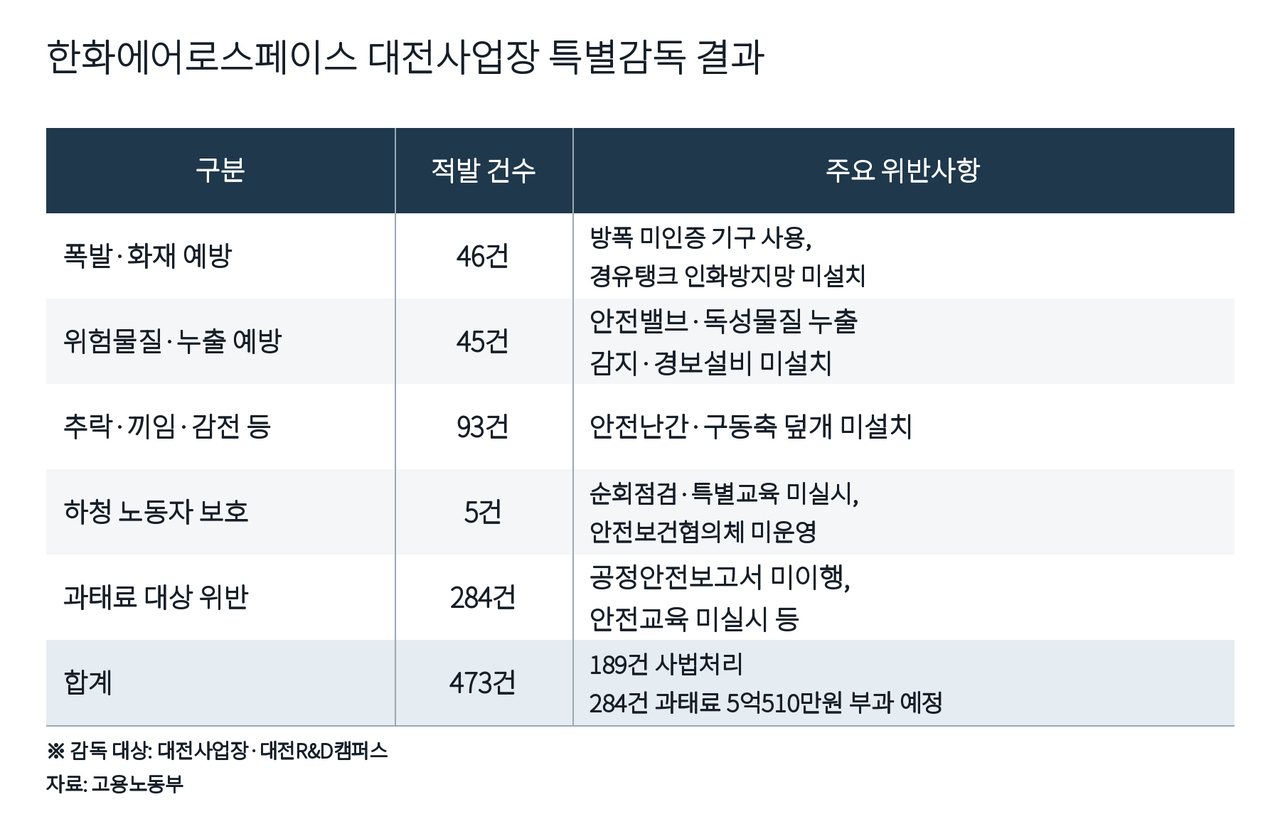
The Ministry of Employment and Labor said Thursday it had detected a total of 473 legal violations at the Daejeon plant following a special inspection triggered by a June 1 explosion that killed five workers and injured two. Of those violations, 189 have been referred immediately for criminal prosecution, while fines totaling 505.1 million won ($373,000) are set to be imposed for the remaining 284.
The inspection, which also covered the Daejeon R&D Campus, ran from June 29 to Sept. 18. Inspectors focused on explosion and fire prevention — the cause of the fatal accidents — as well as hazardous-material leak controls, management of harmful substances and compliance with process safety reports specific to the industry.
Violations of occupational safety and health regulations totaled 184. Of those, 46 were related to explosions and fires, and 45 to hazardous-material leaks — together accounting for 91 violations. The remaining 93 involved falls, entrapment, electric shock and similar hazards.
Basic equipment to guard against explosion and fire risks was found to be inadequate. The company used electrical and mechanical devices without explosion-proof certification in areas at risk of dust and blast hazards, and failed to install flame-arrester screens on the diesel tank of an emergency generator. Inspectors also found pressure vessels with no maximum operating pressure markings, and buildings housing chemical equipment where sandwich panels — rather than non-combustible materials — had been used in construction.
Measures to prevent hazardous-material leaks were also deficient. Safety valves were missing from equipment where thermal expansion could cause overpressure, and facilities handling acutely toxic substances lacked leak-detection and alarm systems. The company also failed to install local exhaust ventilation where silicon oxide — a regulated hazardous substance — was being handled.
Additional violations included the absence of emergency exits opening in the direction of evacuation at hazardous-material handling areas, and missing safety railings at the edges of work platforms. Anti-entrapment measures were also lacking, including missing covers on motor drive shafts. Five violations related to the protection of subcontracted workers were identified, covering failures to conduct workplace safety patrols, provide special training on hazardous materials and operate joint safety and health consultative bodies.
Measures to inform workers of risks and protect their health were also found wanting. Inspectors cited 56 violations involving the failure to post safety data sheets or conduct related training, 27 violations for not carrying out safety and health education, and four for failing to conduct special health examinations. The latter included cases where workers exposed to hazardous agents such as indium and iron oxide had not received the required medical screenings.
Non-compliance with process safety reports — documents required to prevent accidents involving hazardous and dangerous equipment — accounted for 102 violations. These included failures to observe alarm threshold settings for gas-leak detectors and interlock set-point standards based on equipment temperature.
The ministry said that despite recent increases in output and new hiring, safety and health management staffing had not been expanded accordingly, leaving the industrial safety foundation insufficiently secured. It plans to verify that violations are corrected and improvements made, and to guide the company in reinforcing its safety and health management personnel and systems.
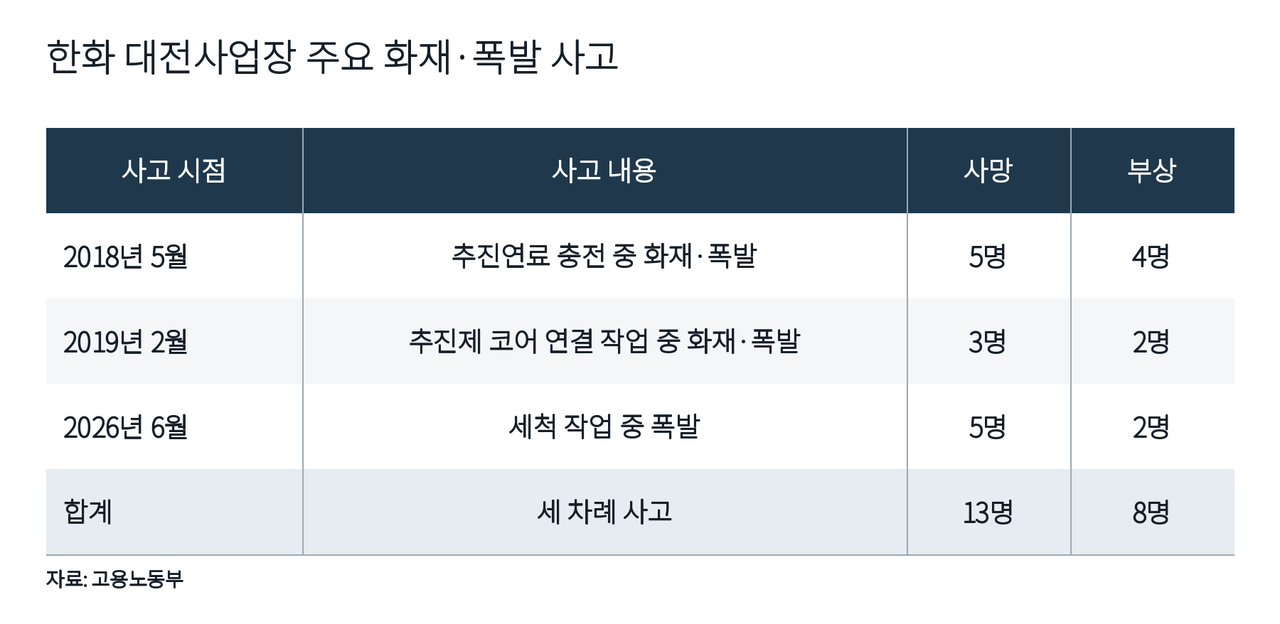
The Daejeon plant has been the site of three deadly accidents. In May 2018, a fire and explosion during propellant fueling killed five workers and injured four. In February 2019, a fire and explosion during propellant core connection work killed three and injured two. This past June, an explosion during a cleaning operation killed five and injured two — bringing the total death toll from the three incidents to 13.
Minister of Employment and Labor Kim Young-hoon said the inspections had confirmed violations not only of fire and explosion safety rules but also of basic safety measures at one of the defense industry's leading large companies — a sector where an especially high standard of safety management is required. "The fact that the same type of fire and explosion accident has recurred after those of 2018 and 2019 is a problem that cannot be taken lightly," he said.
Kim added that the company must use the inspection results as a basis for reviewing all risk factors — including fire and explosion hazards — and draw up improvement measures to fundamentally overhaul its safety and health management system.
fact0514@heraldcorp.com