Interview: Cha Myung-hun, CEO of Coinone
'Our goal is to tear down the wall between stocks and digital assets'
Coinone targets Korea Investment & Securities VIP clients
Combining Coinone technology, KIS brokerage expertise and OKX's global experience
'When the tokenized asset market opens, we'll move fast'
A coding CEO focused on making investing easy
AI service collaborations with Treasurer and Com2uS also in the works
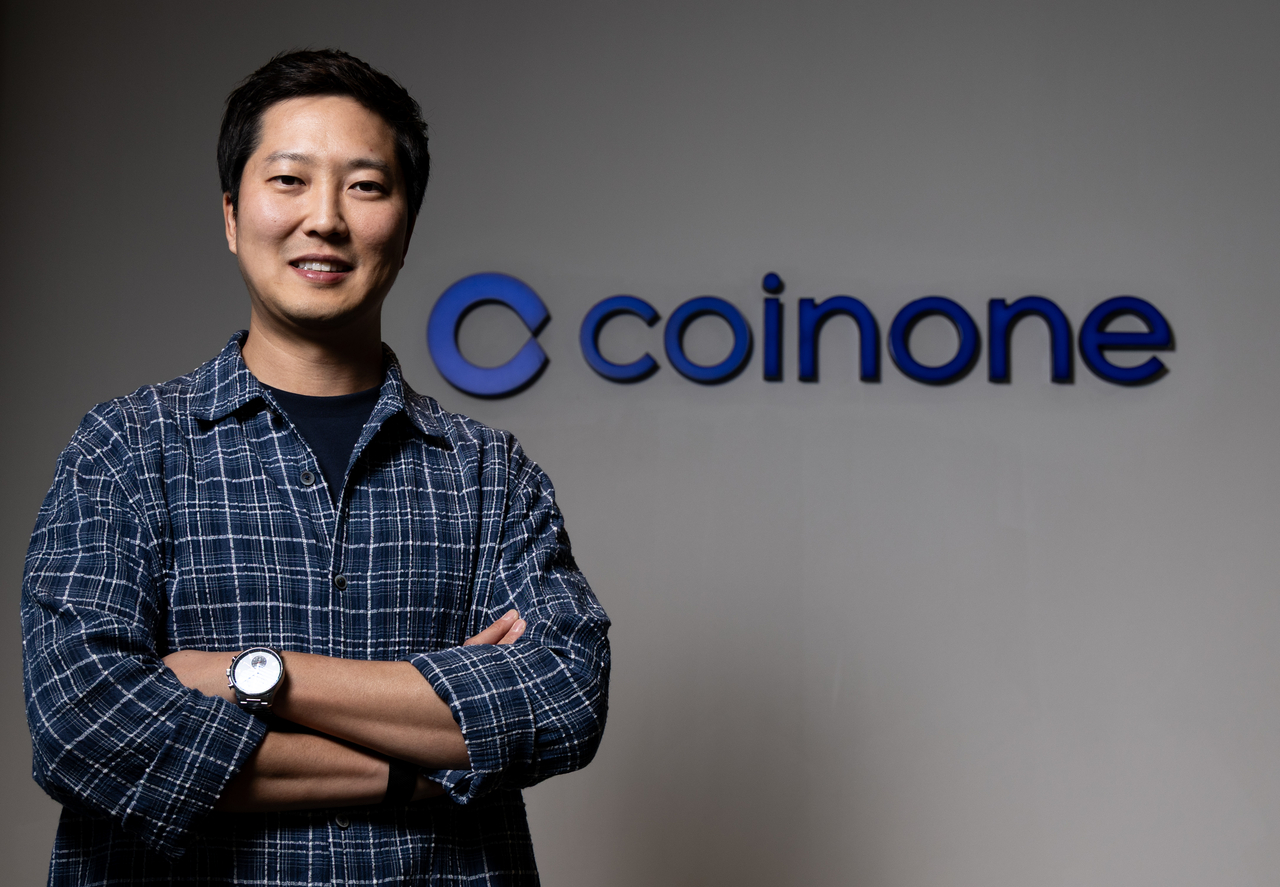
"In the past, when a bear market hit, people panicked and asked whether the Bitcoin market was going to disappear. Now the attitude has shifted — people say, 'It's cheap, so let's buy.' In line with the trend of adding digital assets to investment portfolios, we are working on joint marketing with Korea Investment & Securities targeting VIP clients."
Cha Myung-hun, CEO of Coinone, laid out his strategy for transforming the exchange into a comprehensive financial platform in a recent interview at the company's headquarters in Yeouido, Seoul. The joint marketing effort starts with high-net-worth clients, he said, reflecting growing demand from wealthy investors who want to hold digital assets such as Bitcoin alongside other holdings — much as they might keep a portion of their assets in dollars.
Coinone this year secured investment from Korea Investment & Securities and OKX Ventures, the investment arm of global virtual asset exchange OKX, as it pursues its ambition to become a full-service financial platform. On the industry-wide push to launch AI-powered customer services, Cha said the company plans to collaborate with Treasurer, an AI-based hyper-personalized investment platform, and is in talks with Com2uS on related initiatives.
Cha identified breaking down the barrier between stock and digital asset investing as the core goal of the partnership with Korea Investment & Securities, or KIS. "We are putting all our efforts into a shareholder synergy strategy — helping investors recognize digital assets as one pillar of their portfolio and guiding potential customers who have yet to invest into the market, at a time when demand for wealth accumulation through equities is growing," he said.
The first experiments have been market price integration and web trading system, or WTS, connectivity. Following the launch of a "Stock Investment Shortcut" feature inside the Coinone app in July, the two companies introduced a virtual asset price-check service within the KIS app. "We started from the perspective of doing what we can as quickly as possible," Cha said. "The WTS and price services launched within just a month or two of each other, which showed the strength of the partnership."
The collaboration, which began with price integration, is now advancing to the stage of jointly targeting high-net-worth clients. The two companies have identified demand among affluent investors in their 50s and 60s who have the financial means to invest but have been hesitant because they are unfamiliar with exchanges. While so-called "Samjeonniksu" — a shorthand for Samsung Electronics and SK Hynix shares — fell nearly 40 percent over three months, Bitcoin climbed more than 40 percent to reclaim the $80,000 level, drawing attention as an asset allocation option.
"In line with market demand from investors who want to hold digital assets such as Bitcoin in their portfolios — just as they might keep some assets in dollars — we are preparing joint marketing with KIS targeting VIP high-net-worth clients," Cha said. "We will lower the threshold for adding digital assets to a portfolio by connecting customers through the familiar touchpoint of a brokerage they already know."
The longer-term target is the tokenized asset distribution market — a system in which rights to stocks, bonds, real estate and other assets are converted into blockchain-based tokens and traded. The model allows investors to buy and sell fractional rights to, for example, rental income from a building or principal and interest payments on government bonds, in small denominations.
The vision is to combine KIS's brokerage expertise with Coinone's blockchain technology and domestic operating experience, and OKX's global technology and track record. Technical exchanges have already begun: Coinone held a technology workshop with OKX in Singapore in early August.
"OKX is already running related businesses in global markets, so if needed we can receive technology transfers and move quickly," Cha said. "The reason we built this alliance structure is precisely so that when the market opens up through regulatory reform, we can commercialize faster than anyone else."
The shareholder synergy extends beyond customer-facing services. Coinone and KIS hold weekly meetings to discuss collaboration priorities and share know-how on internal controls and compliance. "Both companies are also tracking whether KIS customers who sign up for Coinone go on to make actual trades," Cha said. "We are deepening our understanding of each other's businesses."
Some observers have suggested that Coinone's recent zero-fee policy and large-scale marketing push could signal plans for additional fundraising, but Cha drew a line. "Our marketing and investment activities are controlled and managed within a range that maintains financial soundness," he said. "Having established a stable four-party governance structure through our investment rounds, we are not currently considering any additional paid-in capital increases or external fundraising."
Coinone has also moved quickly to expand digital assets into the realm of personal finance. A prime example is staking — a deposit-style reward product it introduced first in South Korea — which lets investors earn rewards by locking up their coins without selling them. Coinone simplified the process, which previously required setting up a personal wallet and transferring assets, so that ordinary investors can use it with ease.
At the center of that effort is Cha, a former white-hat hacker who founded Coinone and still writes code himself using AI tools and stays hands-on with service development. "Attracting customers is important, but so is making sure the customers who come can use the service easily," he said. "Our focus in service development is on asking whether anyone can use it and solving the difficult steps on their behalf."
Smart Trading — an AI grid product launched last year — grew from the same thinking. It is an algorithmic trading service that automatically buys low and sells high within a set price range around the clock. A community where users share investment information and returns, and a service that relays comments from key market figures, are also attempts to make investment information accessible to customers who say they do not really understand Bitcoin.
Developing AI agents to help customers make investment decisions is another area Cha is focused on. Overseas exchanges have also been pouring resources into AI agent-powered investment services. The concept is that when a customer asks a question, the agent analyzes market news and indicators to explain the reasons behind price movements and help the customer examine investment strategies.
What Cha is particularly interested in is how skilled traders read the news — which stories they check in the morning and what reasoning they use to forecast the market. He wants to capture that thought process in a service. "If we replicate the mindset of people who trade well, ordinary customers can also access high-quality information," he said. "We will be able to answer the kinds of questions customers have — like why Bitcoin rose on Wednesday and why it rose on Thursday."
The key, he said, lies in data quality and the way it is interpreted. "Just because you feed in all the information and expect AI to give you an answer doesn't mean you'll get a good one," Cha said. "What matters is what thought process you use to extract insights from a diverse range of reliable data."
Coinone's community platform supports this vision. Users publicly share their returns and investment information, which other customers can reference when trading, and they can follow specific investors to exchange ideas. The information accumulated through that process can then be fed into an AI service and delivered back to customers.
"The information is already there, and I think we can weave it together into a service," Cha said, adding that security remains a constant concern even as everyone talks about AI. "We will manage sensitive information so it does not leave our systems, and in customer-facing services we will focus on preventing personal data leaks," he said.
Cha also expressed confidence in hitting the company's year-end target of 1 million monthly active users. "Monthly active users in August grew 8.4 percent from the previous month, and our market share last month nearly doubled from August's 3.62 percent," he said. "I see it positively that we are consistently trending upward rather than spiking sharply in a short period."
Cha said he hopes discussions around a basic digital assets act will go beyond ownership restrictions to address the broader potential for business expansion. "Beyond debates over major shareholder stake limits, it is important to look at the expandability of the business — what ancillary activities such as payments can be permitted, and whether STOs can be distributed," he said.
While agreeing on the need for virtual asset taxation, Cha said clear standards must come first. "To reduce market confusion and improve tax compliance, ambiguities such as how acquisition costs are calculated and how to obtain transaction information from overseas exchanges need to be addressed," he said. "Detailed guidelines need to be established before taxation is implemented."
forest@heraldcorp.com
kyoung@heraldcorp.com