
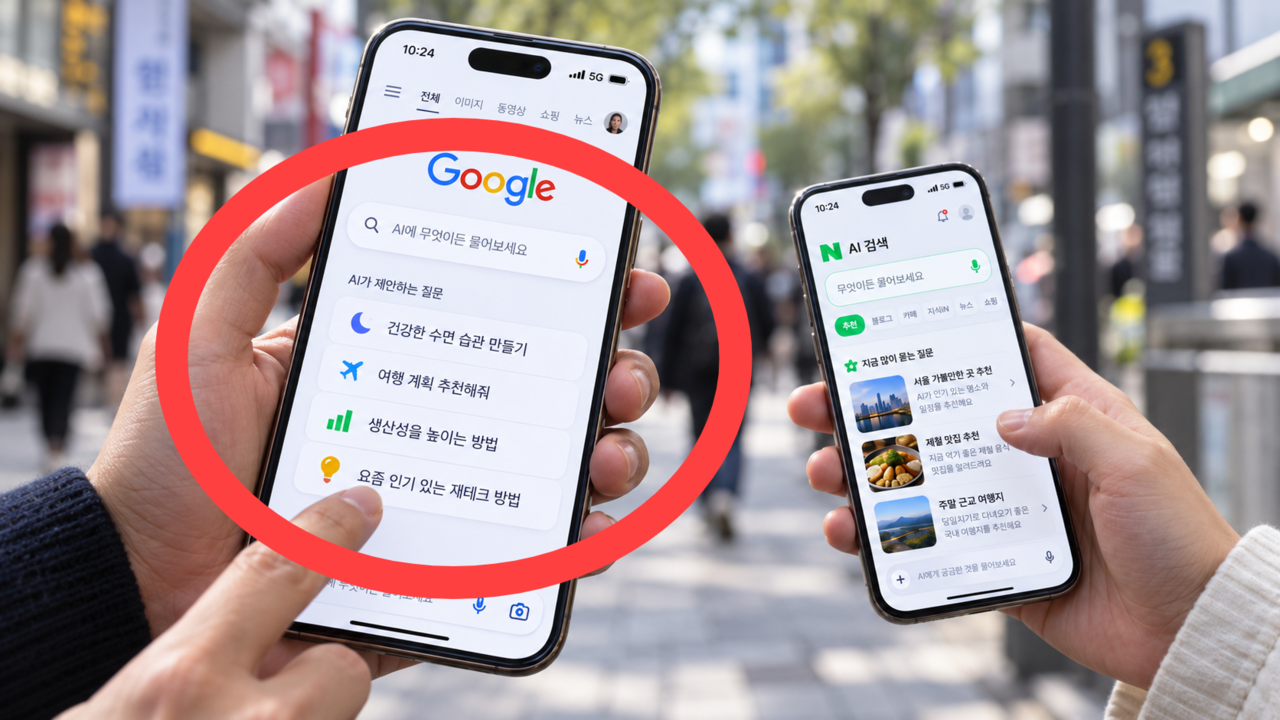
Google Chrome has overtaken Naver for five consecutive months in South Korea's search and browser app market by total usage time, as the rollout of generative AI in search services reshapes the competitive landscape.
Industry insiders agree that the ability to secure data has emerged as the key variable in the AI search race — and that domestic companies are at a structural disadvantage compared with global tech giants that hold data from users around the world.
According to app analytics firm WiseApp·Retail, Chrome logged the longest total usage time among search and browser apps on South Korean smartphones in September, at 260 million hours. That put it 20 million hours ahead of second-place Naver, which recorded 240 million hours.
Samsung Browser ranked third at 130 million hours, followed by the Google app at 87 million hours, Brave at 38 million hours and Daum at 23 million hours.
The industry is paying close attention to the fact that Chrome has held the top spot over Naver for nearly half a year. Chrome first surpassed Naver in May and has maintained its lead for five consecutive months since.
Industry observers point to generative AI search as the driving force behind the shift. Both companies introduced generative AI search features around the same time the rankings flipped.
![Google logo [Reuters]](https://wimg.heraldcorp.com/news/cms/2026/10/14/news-p.v1.20260617.ed770a89842c4f98b81ce20258170867_P1.jpg)
Earlier this year, Google introduced "Gemini in Chrome" to its South Korean browser on April 20, embedding the Gemini AI assistant directly into Chrome to analyze web page content and answer user questions. If a user is browsing multiple online stores, for instance, the AI can simultaneously compare prices, product specifications and pros and cons across different pages. It can also summarize lengthy documents and retrieve content from previously visited web pages.
Google has also deepened integration with its own services — summarizing YouTube videos within Chrome, drafting emails in Gmail and adding events to Google Calendar.
Naver also expanded its AI search service starting in April, launching a conversational AI search feature called "AI Tab" in beta on April 27. AI Tab analyzes the intent behind a user's query and presents comprehensive results in response. In June, Naver extended AI Tab to all users.
Industry observers broadly agree that Naver's AI search offering lags behind Google's. As data holdings emerge as the defining measure of AI search competitiveness, they say domestic companies cannot match the scale of Big Tech firms with global user bases.
Google is layering AI services on top of a search infrastructure built across websites worldwide, while Naver's strengths lie in content produced by domestic users — blogs, community forums and its Q&A platform — along with shopping and local information.
As the AI search competition increasingly centers on data dominance, companies are moving to erect barriers around their proprietary data.
![Naver [Yonhap]](https://wimg.heraldcorp.com/news/cms/2026/10/14/news-p.v1.20260926.7ff77519b5cc45d6b6a9988604cb6db3_P1.jpg)
Naver currently restricts external AI search crawlers from accessing its key services. A September analysis by search data firm DataFreePrep of crawler access policies across 14 South Korean online platforms found that four Naver services — its blog, community forum, Q&A platform and influencer channel — blocked all three major AI search crawlers. Naver's community forum went further, barring even Google's standard search crawler.
Google also restricts unauthorized scraping of some of its content. YouTube is the most prominent example, with the platform limiting the scope of third-party data collection and use through its terms of service and developer policies.
As both companies increasingly treat their proprietary data as a competitive asset in AI search, they are tightening restrictions on unauthorized access by outside operators.
chami@heraldcorp.com





