
Corporate tax up 28.2 trillion won, income tax up 14.4 trillion won; consolidated balance swings to 5 trillion won surplus
Central government debt tops 1,372.1 trillion won, up 104 trillion won from end of last year
![A sign at the Ministry of Planning and Budget [The Herald Business DB]](https://wimg.heraldcorp.com/news/cms/2026/10/15/news-p.v1.20260322.2809375417dc4f83b75426dd2f7e6906_P1.jpg)
National tax revenue rose more than 69.1 trillion won ($51.5 billion) from a year earlier, cutting South Korea's fiscal deficit for the first eight months of this year to less than half the level recorded in the same period last year. The improvement was driven by a sharp increase in corporate tax receipts on the back of better corporate earnings, along with gains in income tax and stock market-related revenue. Central government debt, however, climbed past 1,372.1 trillion won, rising 104 trillion won from the end of last year.
According to the Ministry of Planning and Budget's monthly fiscal trends report for October, released Thursday, the managed fiscal balance — the broadest measure of the government's underlying fiscal position — posted a deficit of 43 trillion won for the January–August period. That compares with a deficit of 88.3 trillion won in the same period last year, a reduction of 45.3 trillion won, or 51.3 percent.
The managed fiscal balance is derived by subtracting the surpluses of four major social security funds, including the national pension, from the consolidated fiscal balance, and is considered the most accurate gauge of the government's actual financial health. The consolidated fiscal balance swung to a surplus of 5 trillion won for the first eight months of the year, reversing a deficit of 53.7 trillion won in the same period last year.
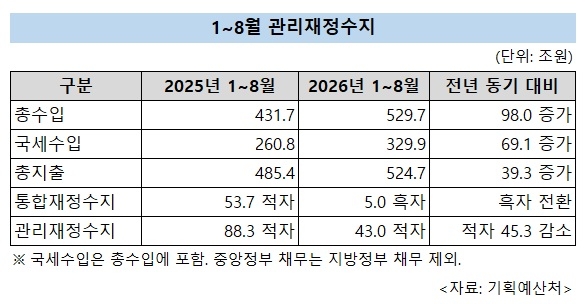
The improvement in the fiscal balance was driven primarily by higher tax revenue. National tax receipts for January through August totaled 329.9 trillion won, up 69.1 trillion won from the same period a year earlier. The collection rate against the supplementary budget target stood at 79.4 percent, 9.3 percentage points higher than in the same period last year.
Among individual tax categories, corporate tax posted the most notable gain. Receipts reached 91.6 trillion won, up 28.2 trillion won year on year, buoyed by improved corporate earnings. The collection rate against the annual budget target reached 90.4 percent.
Income tax came in at 101.1 trillion won, an increase of 14.4 trillion won, driven by higher wage and salary tax receipts on the back of rising performance bonuses and an increase in capital gains tax tied to a pickup in real estate transactions. Value-added tax rose 7.4 trillion won to 65.1 trillion won, reflecting higher imports and stronger private consumption.
Securities transaction tax receipts climbed 7 trillion won to 9.2 trillion won, boosted by higher share trading volumes and a rate adjustment. The special rural development tax also rose 9.5 trillion won, largely on increased Kospi trading volume.
Total revenue — combining national taxes, non-tax revenue and fund revenue — reached 529.7 trillion won, up 98 trillion won from a year earlier. Non-tax revenue rose 9.2 trillion won to 32 trillion won, while fund revenue increased 19.8 trillion won to 167.8 trillion won. The overall revenue collection rate stood at 75.6 percent.
Total expenditure for the same period was 524.7 trillion won, up 39.3 trillion won. The execution rate against the supplementary budget stood at 69.7 percent. The fiscal balance improved because the increase in total revenue outpaced the increase in total expenditure. For August alone, the consolidated fiscal balance recorded a surplus of 25.1 trillion won and the managed fiscal balance a surplus of 21.8 trillion won.
Despite the narrowing deficit, government debt continued to grow. Central government debt at the end of August stood at 1,372.1 trillion won, up 17.9 trillion won from the previous month and up 104 trillion won from 1,268.1 trillion won at the end of last year. The monthly figures do not include local government debt, which is calculated only once a year.
Compared with the end of last year, the outstanding balance of Treasury bonds rose 102.1 trillion won and the balance of foreign exchange stabilization bonds increased 4.7 trillion won. The outstanding balance of national housing bonds fell 2.8 trillion won.
Meanwhile, government bond issuance in September totaled 17.4 trillion won. Cumulative issuance from January through September, excluding bonds for individual investors, reached 179.7 trillion won, accounting for 80.4 percent of the annual issuance limit. The average funding rate in September was 4.25 percent, up 0.15 percentage points from 4.10 percent the previous month. Foreign holdings of Treasury bonds fell 3.7 trillion won from the prior month to 319.6 trillion won.
fact0514@heraldcorp.com





