
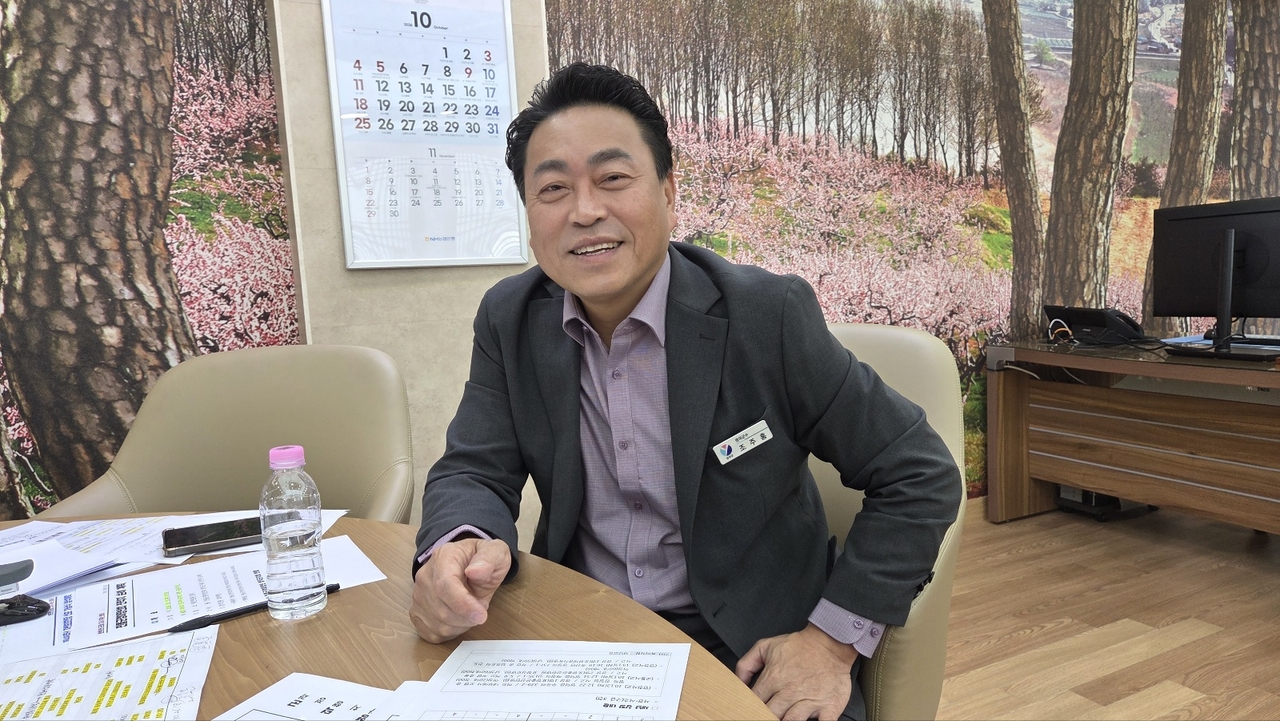
"My biggest goal is to make my hometown of Yeongdeok a place where people can live well. I will listen to residents, work hard to secure the necessary budgets and projects, and steadily map out Yeongdeok's future."
Yeongdeok-gun Chief Jo Ju-hong sat down for an interview at his office Wednesday morning, marking 100 days since taking office under the ninth directly elected administration. "I will build on results one step at a time so that residents can feel the change for themselves," he said.
Jo identified economic recovery, livelihood stability and the securing of future growth engines as his core priorities, expressing a firm determination to deliver tangible change that residents can feel — not merely declarations.
Yeongdeok faces no shortage of pressing challenges: damage from a major wildfire, a shrinking population, a sluggish local economy and fiscal strain. Jo plans to address these by listening closely to residents, resolving difficulties on the ground, attracting outside funding and nurturing emerging industries to build a new foundation for regional growth.
The following is an edited transcript of the interview.
— What has been your top priority over the first 100 days?
Above all else, people's livelihoods. I believe that listening to residents in the field — hearing firsthand what difficulties they are facing — is the starting point of local governance. With the local economy struggling and population decline compounding the problem, the administration cannot afford to sit at a desk and draw up plans. We must reflect residents' voices in policy and personally go out to find solutions for the projects that matter. The reason I set "principled governance, Yeongdeok on the move again" as the guiding motto of the ninth administration is precisely that: run the administration by the book, and take an active role in everything that drives regional development.
— You have emphasized communication with residents. What are your specific plans?
The 100-day community forum held Oct. 8 was held in that same spirit. We brought together about 100 residents from a wide range of fields — farmers, fishers, forestry workers, merchants and welfare facility staff — to discuss local issues and the direction of future development. It should not be a one-way briefing on achievements; it should be a place where we listen to residents. We heard a wide range of views, from everyday inconveniences to jobs, tourism and population issues, and we will review each one through the relevant departments, conduct on-site checks and report back on the outcome. I want to build a style of governance where communication does not stop at listening but leads to action.
— You have set a target of 1 trillion won ($747 million) in total budget and investment. How do you plan to get there?
Yeongdeok's own fiscal resources alone are not enough to resolve every local challenge and push forward future projects. The plan is to add roughly 400 billion won in central government direct projects, public institution projects and private investment on top of the county's current budget of around 600 billion won, opening a new era of 1 trillion won in total regional investment. I am personally visiting the National Assembly, central ministries and North Gyeongsang Province to make the case for these projects and secure national and provincial funding. We are also identifying and preparing projects for 2028 in advance. I intend to manage existing debt in a stable manner, minimize any additional local bond issuance and maximize the external funding we bring in.
— You have highlighted the energy industry as a future growth engine for Yeongdeok. Can you elaborate?
Developing Yeongdeok into an energy industry city by linking nuclear power and wind power is a key task. Rather than treating the plan to build two new large nuclear reactors and the local wind power projects as separate matters, we need to connect them as a large-scale carbon-free power production base and attract companies that need that kind of energy. We must build a structure where energy production leads not just to generation but to business attraction, local job creation and higher incomes for residents. I also plan to prepare strategic projects in advance so that nuclear power support funds strengthen Yeongdeok's long-term competitiveness — in industrial infrastructure, residential development, education, healthcare and tourism — rather than being spent on one-off projects.
— How will you tackle wildfire recovery and population decline?
Simply restoring damaged areas to their previous state is not enough. Reconstruction must go in a direction that restores residential and livelihood foundations while also reviving farming, forestry, fisheries, tourism and local jobs together. For wildfire-affected areas such as Nomul-ri that have been excluded from the nuclear power plant zone, I will listen carefully to residents' opinions and consult with the relevant agencies. On education and population, I plan to create conditions for young people to settle in the region through measures including free high school dinner support, operation of a future talent development center, recruitment of agriculture-fisheries convergence programs, and support for newlyweds and households moving into the area. Ultimately, a region can only come back to life if people can stay and work here.
— Finally, what would you like to say to residents?
The results of local governance cannot be measured by budget size or the number of projects alone. There must be real change — more people finding jobs in Yeongdeok, businesses moving in, young people choosing to stay. To make that happen, I will listen to residents and go wherever I am needed. I approach this work with the conviction that I will make my hometown of Yeongdeok a place where people can live well. I will build on results one step at a time so that residents can feel the change for themselves.
kbj7653@heraldcorp.com





