Fruit Fly Trader (5): The secret behind that 1,484% return was simply luck
Since the complete wiring diagram of the fruit fly brain was made public, researchers abroad have been racing to build "virtual fruit flies" inside computers — running games and simulations on them in what has become something of a trend. The Herald Business is publishing a series documenting its own experiment in which a reporter used a virtual brain modeled on the published fruit fly connectome to trade cryptocurrency. All trades were conducted as simulated transactions, and this series is not intended as investment advice. [Editor's note]
![[AI-generated image]](https://wimg.heraldcorp.com/news/cms/2026/10/15/news-p.v1.20261015.21240384e2b945ae8a97a697b90a666a_P1.png)
When a virtual brain built from the fruit fly connectome was taught to trade bitcoin — with profits fed back as rewards and losses as penalties — it generated a return of 1,484% on the charts used for training.
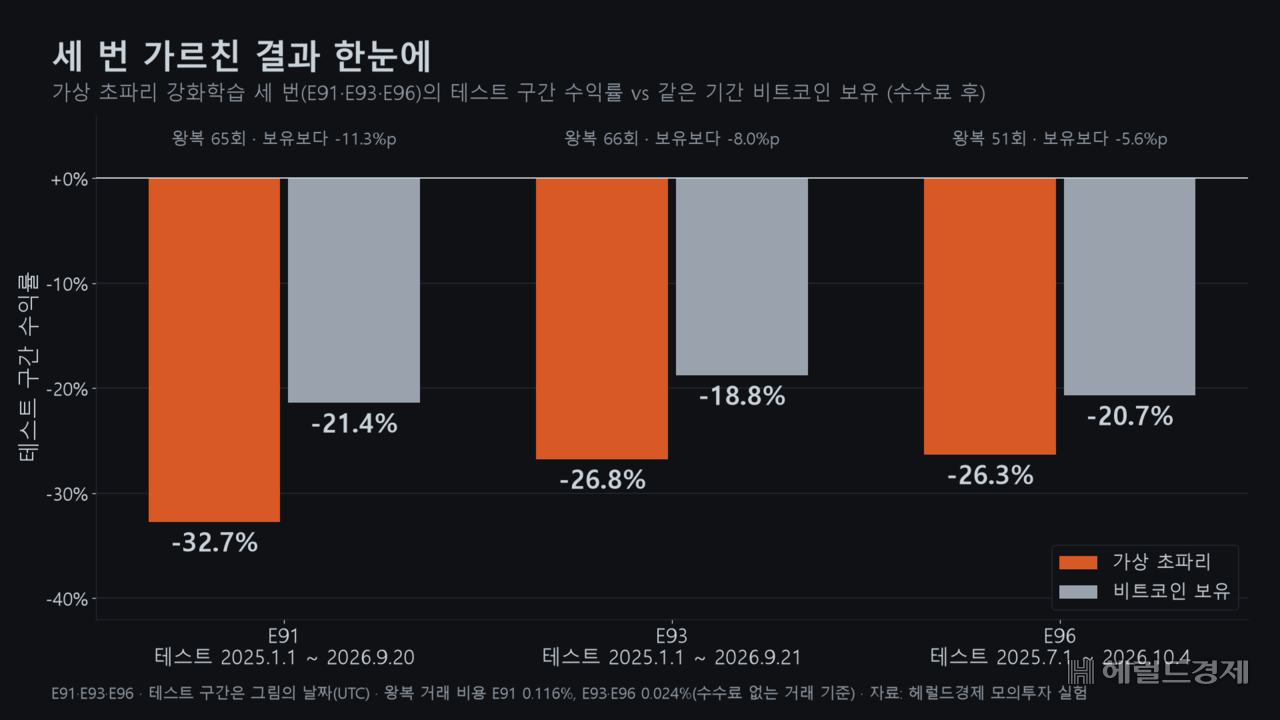
But when tested on charts from January 2025 to September 2026 that it had never seen before, the result flipped to a loss of 32.7%. That was worse than simply buying bitcoin and holding it over the same period, which would have lost 21.4%.
The Herald Business has been running a simulated bitcoin trading experiment using a virtual fruit fly brain operating on a PC. Based on the fruit fly connectome completed by scientists in 2024, chart data is converted into odor signals the virtual brain can process; when the virtual brain moves toward a scent, that is read as a buy order, and when it moves away, a sell.
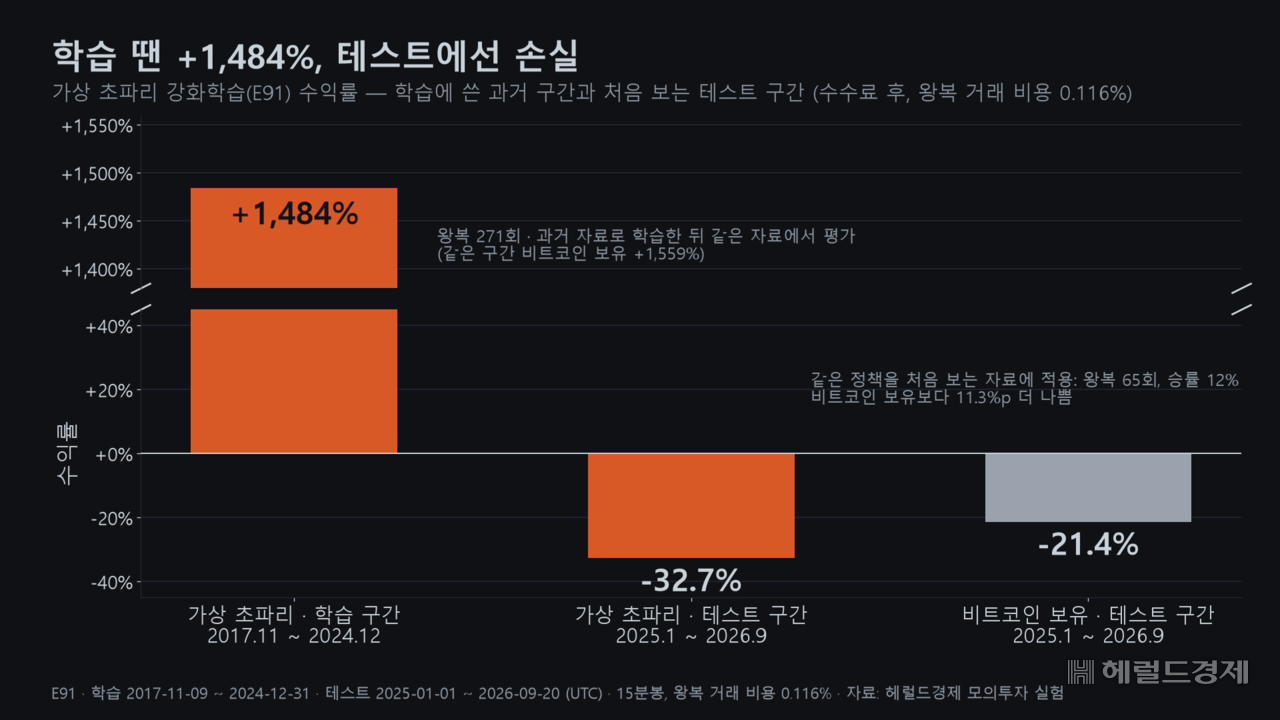
The 1,484% return turned out to be nothing more than an unconditional buy strategy. What the virtual brain had learned was a simple rule: always hold bitcoin and sell whenever it drops 2%, regardless of what the chart showed. Because the training charts covered a period when bitcoin was rising, merely holding the coin was enough to generate large gains.
Reinforcement learning tried on the fruit fly — but it failed
The method used to train the virtual fruit fly brain was reinforcement learning — a technique in which the model is rewarded for good trading outcomes and penalized for bad ones, nudging it to change its own behavior toward earning more rewards. It resembles learning through trial and error, in that no one tells the model the right answer — only the result.
In the first round of training, rewards and penalties were based solely on money gained or lost. The virtual fruit fly responded by making no trades at all. The reason: the expected profit from a single trade was 0.06%, while the combined cost of fees and the bid-ask spread came to 0.11%. The fly had learned, above all else, that not trading meant not losing money.
This time, a penalty was added for not trading, and the virtual fruit fly began executing hundreds of transactions. On the training charts, it bought and sold 271 times and earned 1,484% — but its trading behavior was identical to the simple rule of always holding bitcoin and selling whenever it fell 2%.
Running the same training on a fake virtual brain built from randomly shuffled fruit fly wiring, and on a standard AI neural network unrelated to fruit flies, produced results identical down to the decimal place. On charts from January 2025 to September 2026 that had not been used in training, this approach was profitable in only 12 percent of all transactions.
New constraints were then introduced: the virtual fly had to outperform a simple buy-and-hold strategy, and it could not hold bitcoin for more than 90 percent of the total period.
Despite repeated attempts, the fruit fly always ended up defaulting to holding bitcoin at all times.
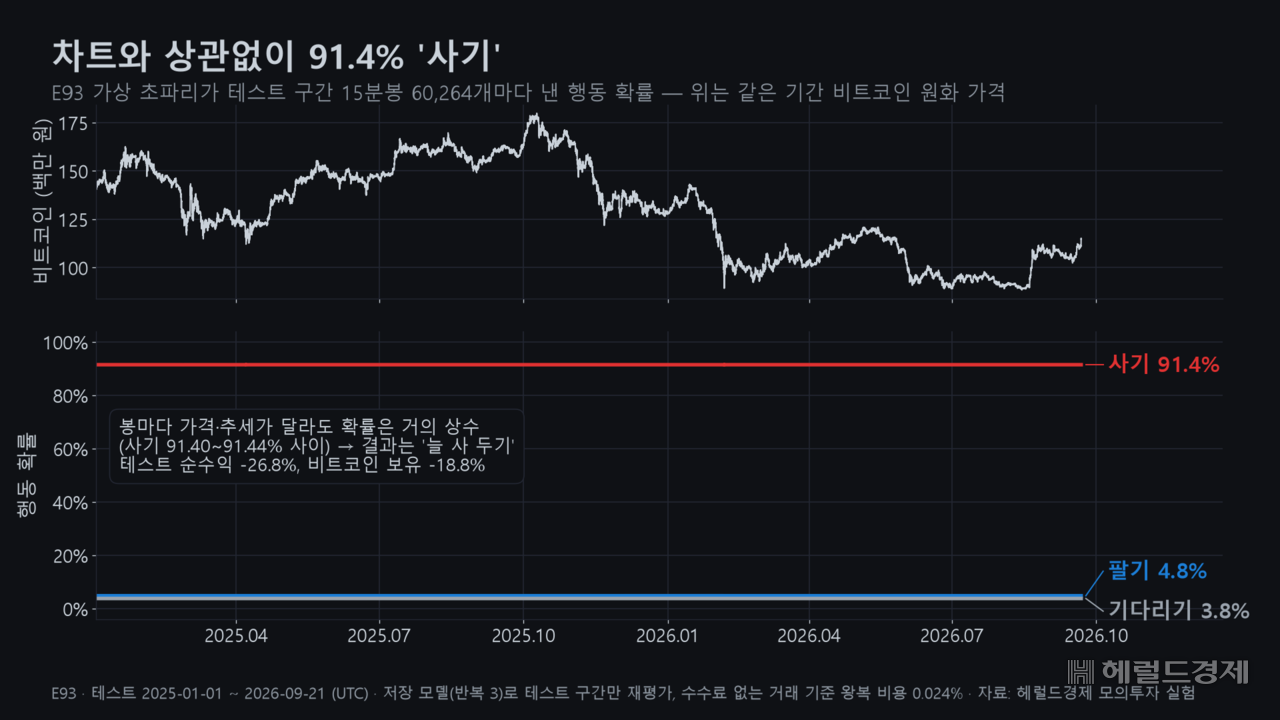
At each moment, the virtual fruit fly sets its action — buy, wait, or sell — probabilistically. Yet even under the new constraints, the probability that it would choose to buy remained fixed at 91.4 percent, whether the chart was rising or falling. In other words, it chose to buy bitcoin almost every single time, regardless of market conditions.
Under the same conditions, the AI executed 453 trades and distributed its actions — buying, selling, and waiting — according to the situation. The virtual fruit fly, by contrast, held bitcoin without selling for 99.9 percent of the entire chart period.
Virtual fruit fly's memory lasts about 0.1 seconds
One reason the virtual brain failed to learn chart patterns is memory. Reading a chart requires holding the previous data point in memory and comparing it with the current one. A separate test was conducted to see how long the virtual brain could retain a signal it had just received.
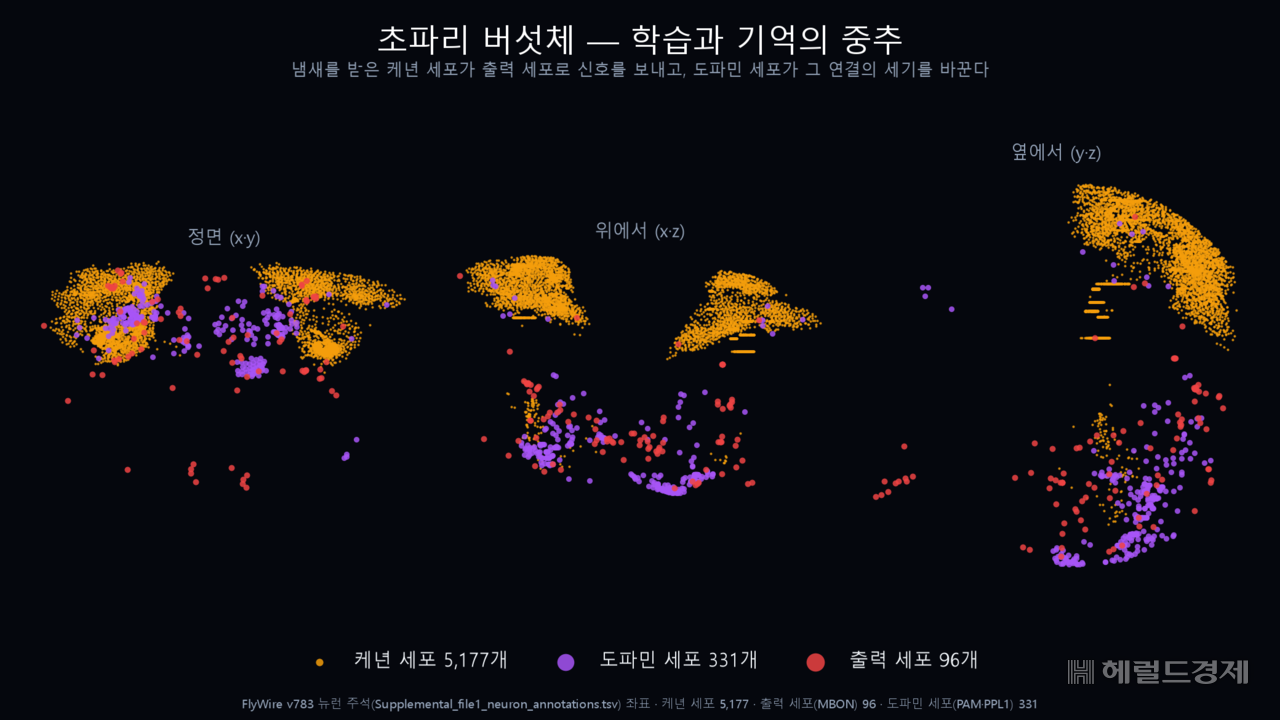
The test focused on the mushroom body circuit — the learning and memory center of the fruit fly brain. The name comes from its mushroom-like shape; in the virtual brain, it is made up of 8,572 neurons.
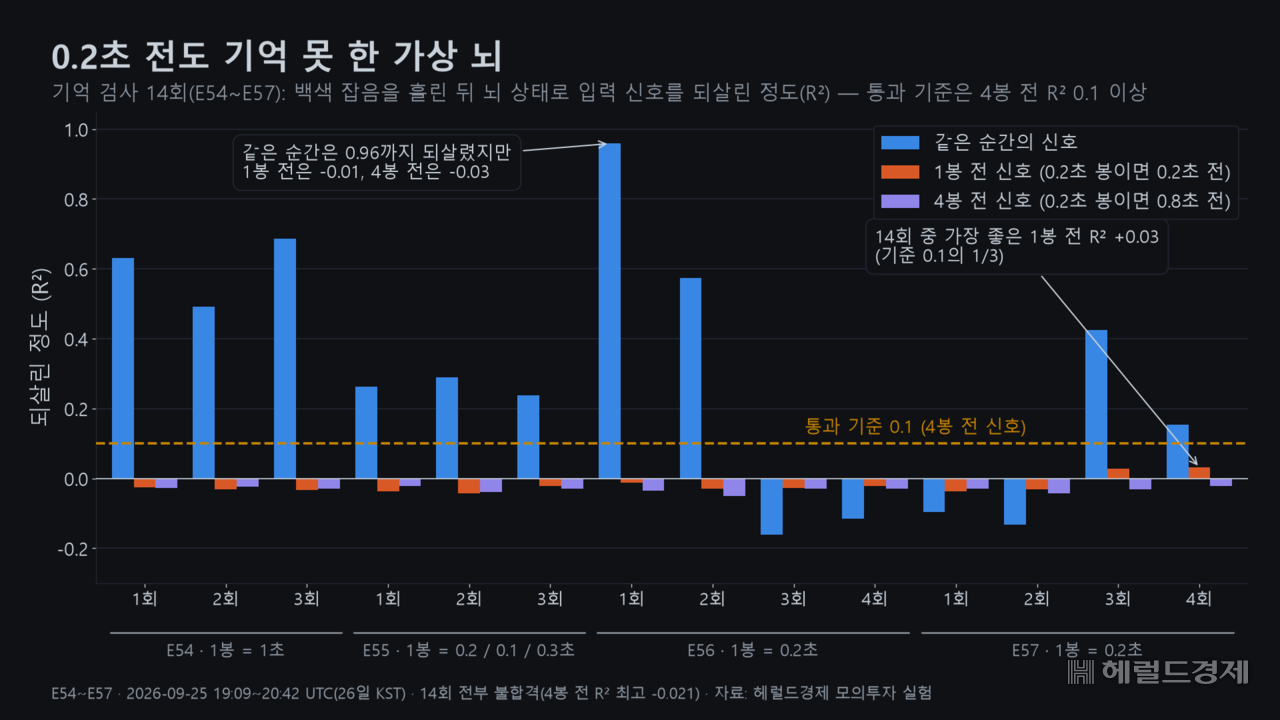
Random signals were fed continuously into the mushroom body circuit of the virtual fruit fly brain, and 14 checks were run to see whether the brain could reconstruct a signal it had received moments earlier, based on its current state alone.
In all 14 tests, the virtual fruit fly could barely recall even a signal it had received just 0.2 seconds earlier. Its state returned to baseline after roughly 0.1 to 0.15 seconds. Charts move on the scale of minutes and hours, yet the virtual fruit fly's memory lasted only about 0.1 seconds.
This is a limitation of the simulation model used in the experiment. The model replicates only the basic operation of neurons — accumulating a signal and firing it, then immediately resetting to their baseline state.
It does not include the chemical signals that in a real brain modulate neuronal activity slowly, allowing signals to be held for longer. The results therefore cannot be taken as a measure of a real fruit fly's memory.
Fruit fly that earned 3% turns to a loss ten days later
A separate virtual fruit fly — one that trades according to a pre-built lookup table rather than through reinforcement learning — has also swung into the red.
This fly was built by feeding past charts one by one into the virtual brain as odor signals, recording how it reacted to each, and compiling those reactions into a table. When new chart data arrives, the fly compares it against the table and trades accordingly.
That fly began live simulated trading on Sept. 21 and, through Tuesday, had completed three trades for a gain of 3.16% — outperforming a simple bitcoin hold over the same period by 2.2 percentage points.
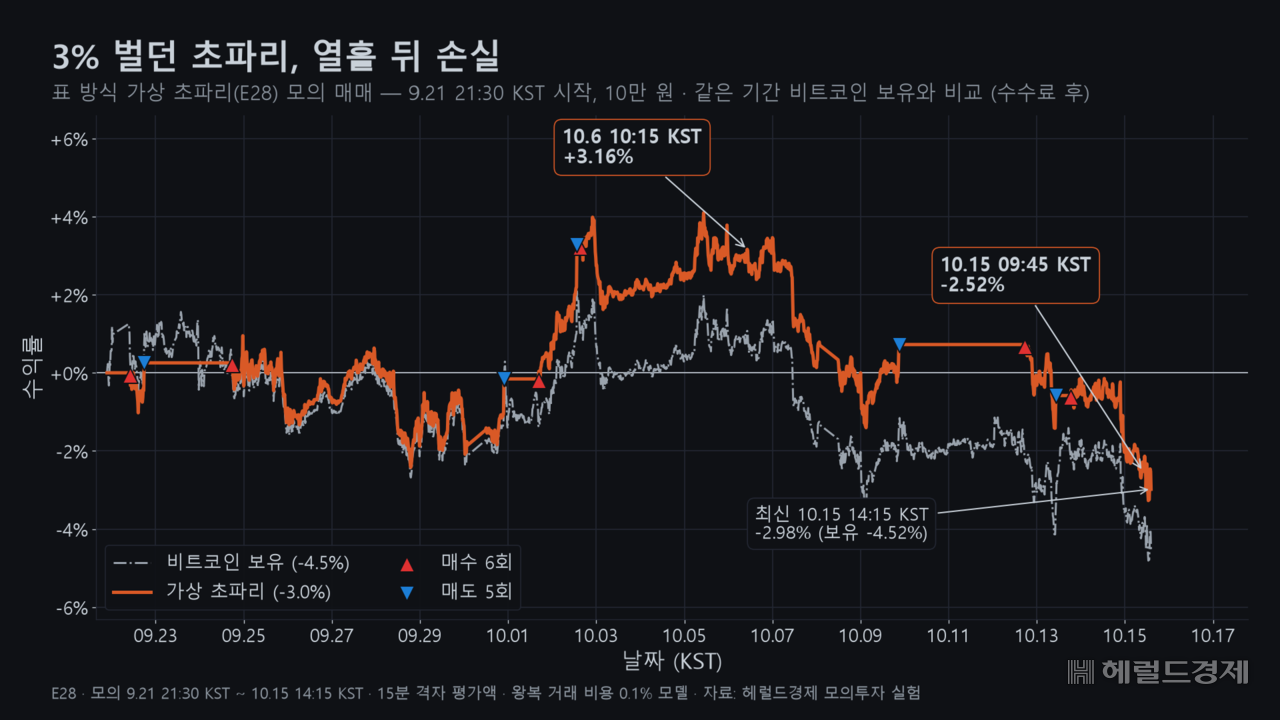
Ten days later, on Thursday, the scorecard showed five trades and a loss of 2.52%. The main drag was a drop in bitcoin's price while the fly held a position it had bought on Tuesday. Still, it lost less than a simple buy-and-hold over the same period, which would have returned -4.17%.
After three trades, it was hard to tell skill from luck — and two more trades later, the result had turned negative. All trading was conducted as simulated transactions, not with real money.
Meanwhile, a separate group of 30 virtual fruit flies — modeled not on the brain's wiring but on the behavioral rules fruit flies use to follow scent trails toward food — continued to post gains through 12 days of simulated trading. Those results, however, assume a zero-fee exchange. The next step is to rerun the experiment with actual exchange fees factored in.
A four-week Saturday-and-Sunday series documenting an experiment in which a virtual fruit fly, built from the published fruit fly connectome, was put in charge of trading cryptocurrency.
dbsdn1110@heraldcorp.com