
Investigators up 19.7% while pending cases rise 59.5%
82.7% of unfair dismissal reviews at NLRC take more than 151 days
Lee calls for more investigators, separate tracking of long-delayed cases
![The National Labor Relations Commission [Photo by Kim Yong-hun]](https://wimg.heraldcorp.com/news/cms/2026/10/16/news-p.v1.20260804.8950e2dd72504278a8e5cc70db22b49f_P1.jpg)
The number of unresolved cases at labor commissions nationwide has jumped nearly 60% in just eight months this year, with the average processing time for unfair dismissal appeals rising to 165 days — 50 days longer than last year. Critics say the pace of hiring investigators has failed to keep up with the growing caseload, delaying relief for both workers and employers.
According to data that People Power Party lawmaker Lee Heon-seung of the National Assembly's Climate, Energy, Environment and Labor Committee obtained from the National Labor Relations Commission, pending cases at labor commissions nationwide rose from 4,094 at the end of last year to 6,528 at the end of August — an increase of 2,434 cases, or 59.5%.
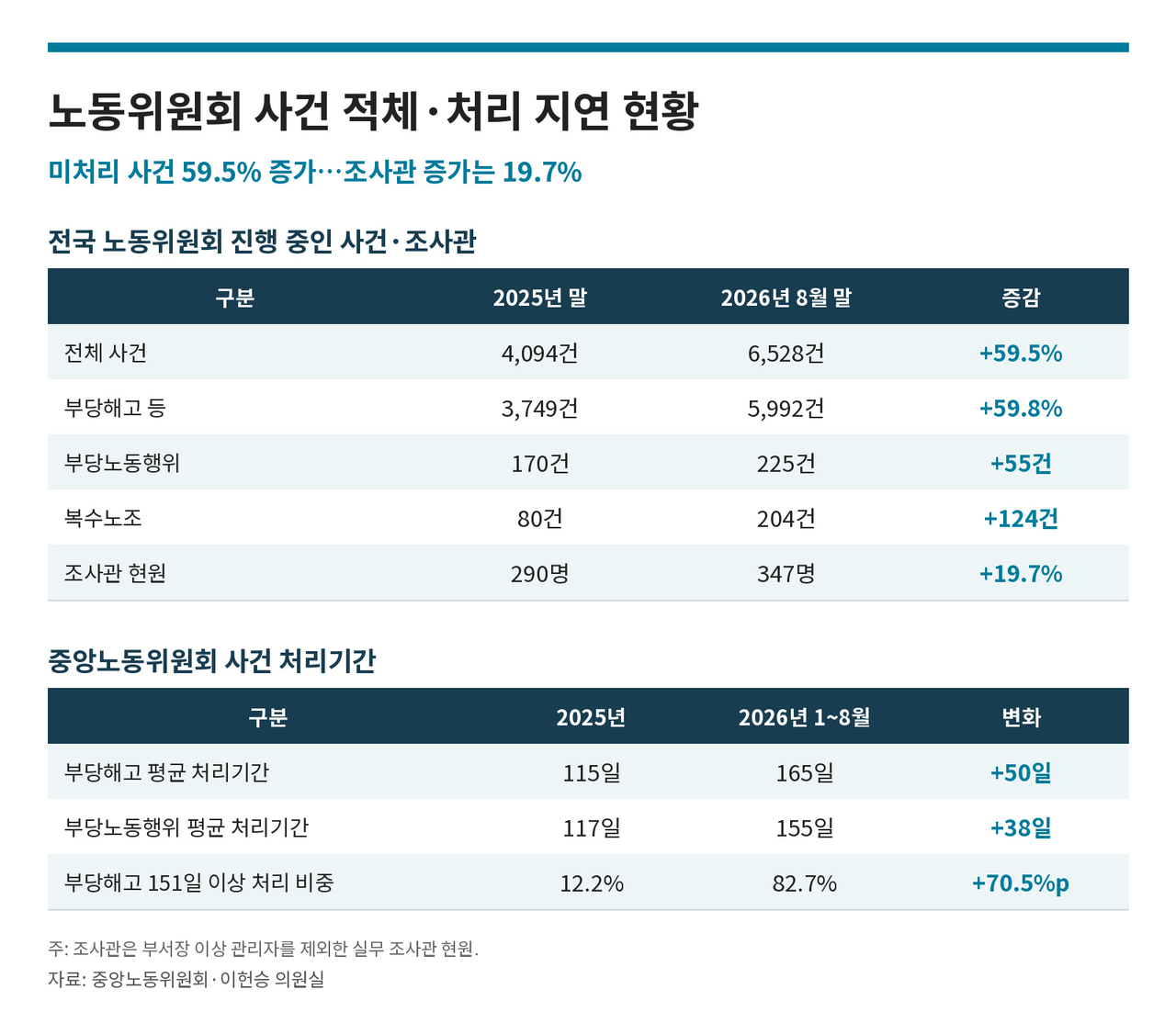
The vast majority of pending cases involved relief claims such as unfair dismissal, which rose from 3,749 at the end of last year to 5,992 at the end of August — a gain of 2,243 cases, or 59.8%. Such cases accounted for 92.2% of the total increase of 2,434 pending cases over the same period.
Other categories also grew. Unfair labor practice cases rose from 170 to 225, and multiple-union cases climbed from 80 to 204. Mediation cases increased from 46 to 52, while discrimination-correction cases edged up from 49 to 55.
Processing times have lengthened alongside the backlog. The average time to handle unfair dismissal cases at the National Labor Relations Commission, which oversees appeals, stretched from 115 days last year to 165 days as of August — a 50-day increase. Unfair labor practice cases took 38 days longer, rising from 117 days to 155 days.
Particularly striking, 1,219 of the 1,474 unfair dismissal cases the commission processed through August — 82.7% — took more than 151 days. Last year, only 237 of 1,937 cases, or 12.2%, exceeded that threshold, meaning the share has risen by 70.5 percentage points.
The same trend held for unfair labor practice cases. Of the 82 cases the commission handled through August, 63 took more than 151 days, compared with 27 out of 174 cases last year.
Regional labor commissions handling first-instance cases also slowed. The average processing time for unfair dismissal cases rose from 45 days last year to 55 days as of August, while unfair labor practice cases grew from 61 days to 65 days.
Investigator staffing, meanwhile, has not kept pace. The number of working-level investigators at labor commissions nationwide — excluding managers at the department-head level and above — grew from 290 at the end of last year to 347 at the end of August, an increase of 57 people, or 19.7%. That is far below the 59.5% rise in pending cases over the same period.
Requests to expand investigator headcount have gone largely unmet. The commission sought 40 additional investigators for adjudication cases in 2022 and 42 more in 2024, but neither request was approved. Last year, it asked for 55 positions — including adjudication investigators — through the regular staffing review and received only six. A separate request for 102 positions to handle changes to the Trade Union Act was cut to 50.
A request this year for 11 additional investigators at the Gyeonggi Province Regional Labor Commission was also rejected. For next year, the commission has asked for 100 more adjudication investigators, but a proposal for 47 positions is currently under budget review in the National Assembly.
Labor commissions serve as the primary body for resolving labor disputes — including unfair dismissal and unfair labor practice claims — and for providing legal relief to the parties involved. The longer cases take to resolve, the longer disputants must wait for an outcome, undermining the system's core purpose of delivering timely relief.
"Cases at labor commissions are surging, but investigator numbers are not keeping up, making delays worse," Lee said. "We need to work with related ministries to push through investigator increases without delay, and to manage long-pending cases separately so that both workers and employers can receive timely relief."
fact0514@heraldcorp.com





