Kospi manages 2% bounce after 7-session losing streak
Philadelphia Semiconductor Index posts longest losing run since 2008
Premarket signals further losses as top-cap stocks slide 5–6%
Analysts warn of prolonged volatility; big tech earnings in focus
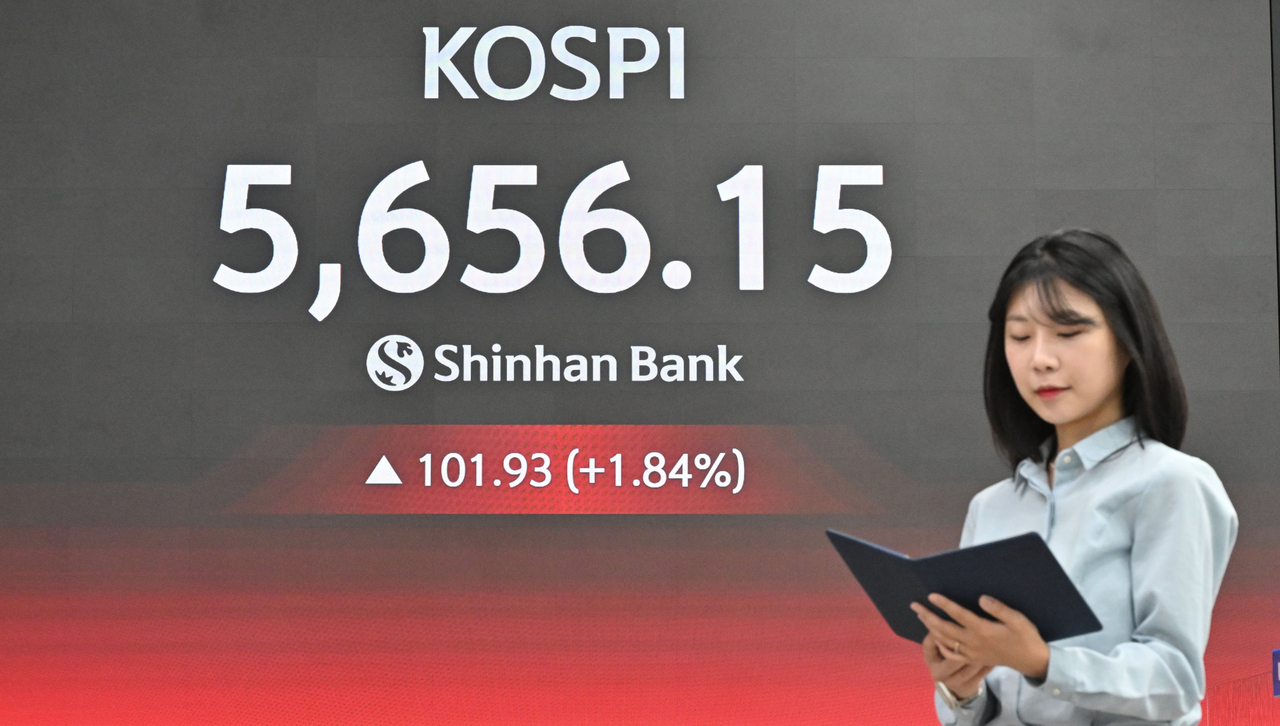
The Kospi, which tumbled 14.5% last week, faces fresh fears of another sharp decline Monday as a deep freeze in the US semiconductor sector delivers a direct blow to Korean markets. Renewed concerns over the profitability of AI investment have driven the Philadelphia Semiconductor Index to its longest losing streak since 2008, and premarket trading shows top-capitalization stocks — led by chipmakers — all in the red.
The Kospi managed to shake off its freefall on Friday, closing up 113.83 points, or 2.05%, at 5,668.05.
The index opened with gains of around 2% and briefly surged as high as 5,809.94, up 4.60%, before lingering doubts about AI investment trimmed the advance.
The benchmark had fallen for seven consecutive sessions from Oct. 6 through Thursday, shedding a total of 1,449.52 points, or 20.70%. Over last week alone — from Monday through Friday — it lost 14.5%. On Thursday, both the Kospi and Kosdaq plunged more than 7% each, triggering circuit breakers on both markets for the first time in roughly two and a half months.
The selloff has been driven by a string of negative AI-related developments. AI cloud provider CoreWeave saw its corporate bond values tumble into distressed territory, while Anthropic, a leading frontier AI model developer, reported that its third-quarter sales growth slowed sharply quarter-on-quarter.
However, bargain hunters stepped in amid the sustained declines, with foreign investors turning net buyers on the KOSPI for the first time in eight sessions, snapping up 343 billion won ($254 million) by the close of regular trading. Individuals and institutions, by contrast, were net sellers of 484.7 billion won and 683.4 billion won, respectively.
The two dominant chipmakers also rebounded after their recent slide. Samsung Electronics closed up 2.62% at 215,500 won, while SK hynix rose 0.79% to finish at 1,272,000 won.
The Kosdaq surged 33.96 points, or 4.46%, to close at 794.78. The index opened at 772.17, up 11.35 points, or 1.49%, and climbed as high as 807.54, a gain of 6.14%, briefly reclaiming the 800 level. The sharp rally triggered a buy-side sidecar on the Kosdaq market.
Yet Wall Street cast a shadow over domestic markets on Friday, with all three major US indexes closing lower.
The Dow Jones Industrial Average fell 0.34%, while the S&P 500 and the tech-heavy NASDAQ Composite dropped 1.09% and 2.15%, respectively.
CoreWeave tumbled 11.91% as its credit risk resurfaced, dragging other major neo-cloud providers into double-digit losses. Micron fell 5.63%, Broadcom dropped 4.52%, SK hynix's American depositary receipts slid 6.58%, and AMD lost 5.95%.
The Philadelphia Semiconductor Index plunged 3.83%, extending its losing streak to eight consecutive sessions — the longest since the 2008 global financial crisis. Major big tech names also retreated, with Meta falling 3.72%, Alphabet down 2.47%, and Microsoft off 1.93%.
The MSCI Korea ETF, a gauge of foreign investor sentiment toward Korean equities, tumbled 3.70%. The KOSPI 200 overnight futures index also fell 3.5%.
Domestic markets are expected to face downward pressure from weakness in US technology stocks and rising global oil prices. A key question is whether foreign investors, who turned net buyers on Friday for the first time in nine sessions, will revert to net selling.
As of 8:34 a.m. Monday, Samsung Electronics was trading in the premarket at 204,000 won, down 11,500 won, or 5.3%, from the previous close, while SK hynix was down 80,000 won, or 6.2%, at 1,192,000 won.
Other large-cap stocks were also all lower: SK Square fell 6.8%, LG Energy Solution dropped 2.8%, Samsung Electro-Mechanics slid 8.5%, Hyundai Motor lost 3.5%, and Samsung Biologics declined 0.8%.
Analysts at brokerages acknowledged that the Kospi has entered oversold territory after its steep decline, but cautioned that anxiety over the AI sector would likely prevent a swift snapback, pointing instead to a period of elevated volatility.
Han Ji-young, a researcher at Kiwoom Securities, said the Kospi would face a volatile week as markets navigate key events including credit spread movements and share price swings in US AI stocks, as well as earnings from big tech names such as Meta, Tesla and Lam Research. She set a weekly trading range of 5,200 to 5,900 for the Kospi.
"What could shift the negative mood is the earnings from big tech companies like Meta, Lam Research and Tesla," she added. "The key question is whether those results can restore market confidence in AI."

yuni@heraldcorp.com