At a press briefing for the Ministry of Interior and Safety beat, Park warns that firefighting budgets are shrinking under personnel cost burdens, leaving no funds to replace aging fire trucks
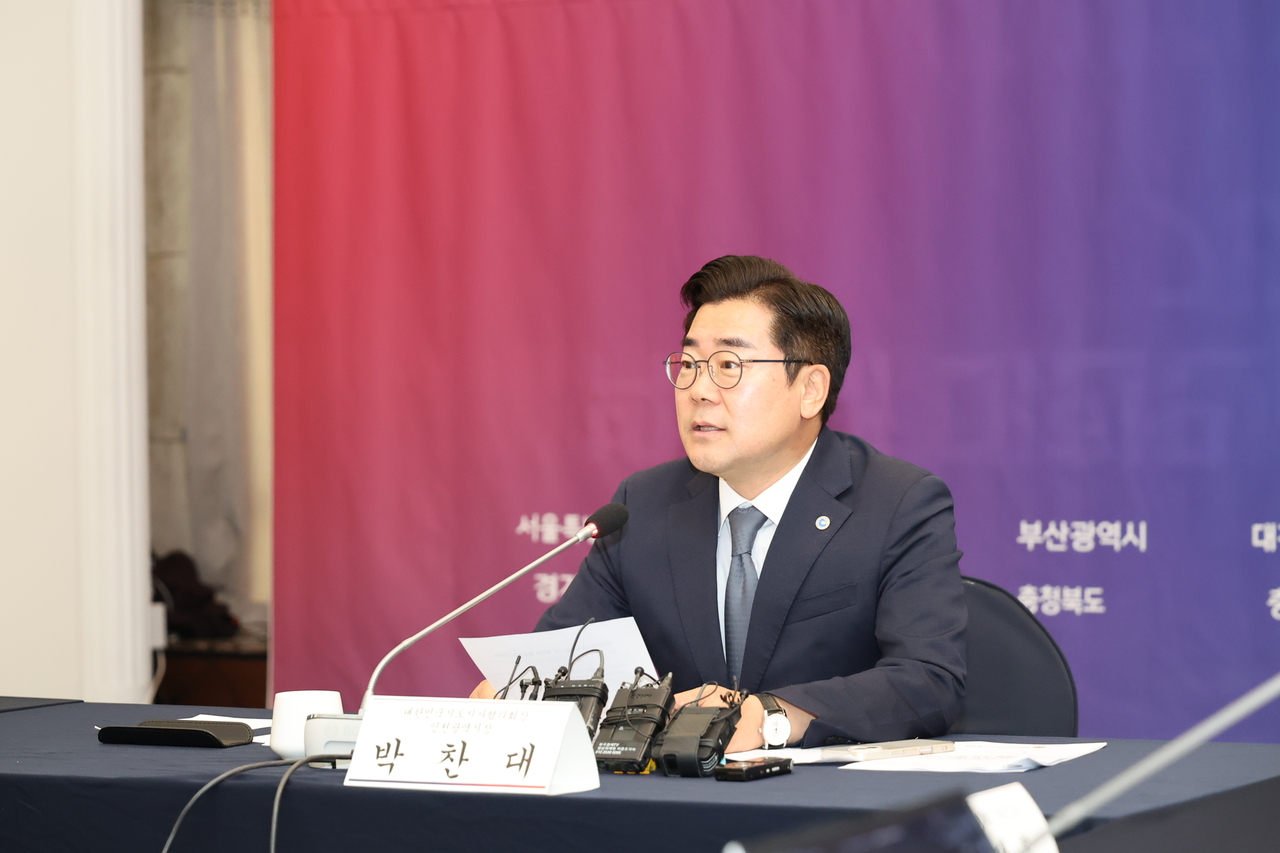
Park Chan-dae, chairman of the Council of Metropolitan and Provincial Governors and mayor of Incheon, said Monday he would push to place the deterioration of local finances on the agenda of the 11th Central-Local Cooperation Council.
Speaking at a press briefing at the Press Center in Jung-gu, Seoul, Park said local governments had deep concerns about the fiscal damage that could result from the central government's push to establish a 162 trillion won ($121 billion) future response fund.
"If the surplus tax revenue that goes into the fund is excluded from the domestic tax base, the local allocation tax that gets distributed will ultimately shrink," Park said. He stressed that local governments must have a say in how the roughly 31 trillion won in local allocation tax — which would otherwise be distributed if the fund's revenue were included in the domestic tax base — is allocated.
Asked whether directing part of the future response fund to local grants would still allow the money to be used for long-term investment as the fund intends, Park said it would not be feasible. "We have not secured any budget at all to carry out our campaign pledges," he said.
Earlier, the council convened a governors' meeting in Jeju on Friday and adopted a joint petition calling for institutional reforms to prevent the proposed future response fund from worsening local finances and to secure fiscal stability for local governments.
The heads of 16 metropolitan and provincial governments urged in the petition that the current local allocation tax calculation method be maintained, that a pan-government fiscal decentralization TF be reactivated, and that concrete measures be drawn up to expand local finances — including raising the local allocation tax rate, increasing the share of local taxes and boosting the central government's share of funding for national projects.
According to the council, the scale of nationally subsidized projects grew more than elevenfold — from 7.2 trillion won in 2000 to 83.8 trillion won in 2024 — and local governments will need to shoulder more than 3 trillion won in additional costs next year just to carry out 11 major nationally subsidized projects.
The council is also pushing to place the local fiscal deterioration caused by the introduction of the future response fund on the agenda of the 11th Central-Local Cooperation Council, which is chaired by the president.
"There has long been a demand that the ratio of local to national taxes should reach roughly 7 to 3," Park said. "I understand that several bills have been introduced to amend the relevant law to raise the local allocation tax rate from the current 19.24 percent to as high as 40 percent."
He added that the future response fund was a separate matter — a question of what to do with surplus tax revenue generated by an exceptional surge in domestic taxes driven by a semiconductor boom. "This is something the central government, the National Assembly and local governments need to put their heads together to resolve," he said.
Turning to firefighting finances — a topic that has come to the fore following the recent death of a firefighter after the service was transferred to national employment status — Park expressed deep gratitude for firefighters who "risk their lives and throw themselves into protecting the lives and property of the people." He noted, however, that when firefighting was nationalized in 2020, fiscal responsibility remained with local governments.
"This year, local government firefighting budgets total 8.6 trillion won, of which the central government contributes only about 900 billion won — just over 10 percent," Park said.
Park said the central government had led a drive to add about 20,000 frontline rescue personnel but was contributing only about 500 billion won toward the cost while local governments were absorbing an additional 760 billion won. "Because of the personnel cost burden, essential spending such as replacing aging fire trucks is shrinking every year," he said.
He added that there had been a proposal to redirect the local education tax on tobacco consumption — set to expire this year — into firefighting revenue, but no consensus was reached. "Separately from that, we are continuing to work with the central government and the National Assembly to secure firefighting funding," he said.
thlee@heraldcorp.com