'Military sovereignty is minimum requirement for a state,' president says
Lee pushes back on framing of US-Korea tensions as abnormal
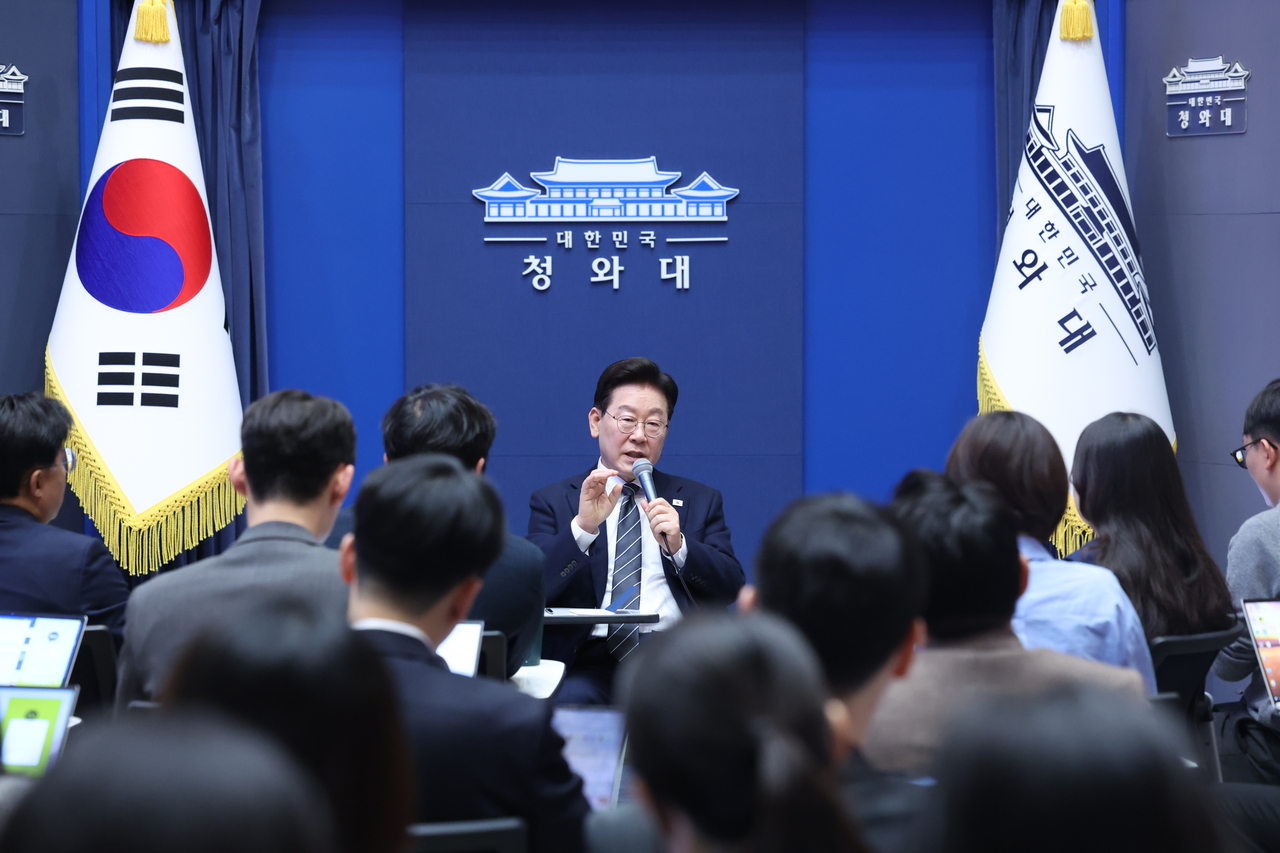
President Lee Jae Myung said Monday that South Korea must swiftly reclaim wartime operational control from the United States, arguing the country should stop using the word "transfer" and instead speak of "reclamation" or "reversion."
"Military sovereignty is likely one of the most essential components of (national) sovereignty," Lee said at a press meeting with reporters at Chunchugwan inside Cheong Wa Dae. "South Korea must get it back quickly to meet the minimum requirements of being a state."
Lee said he believed the country was fully capable of handling its own defense. "Can we manage our own defense? My view is that we absolutely should, and that we are fully capable of doing so," he said. "If there are shortfalls, we must fill them."
"To put it directly, we must reclaim it early, we are fully capable of doing so, and consultations between South Korea and the United States are basically proceeding in the direction of returning it," Lee said. "However, the process will not be easy."
Lee acknowledged the goodwill behind the existing arrangement but said South Korea needed to take ownership. "The goodwill is appreciated, in a way," he said. "But I think this is something we must do ourselves. It will work out."
On the state of the South Korea-US relationship, Lee pushed back against the notion that friction between allies is cause for alarm. "If there are never any problems between countries and everything is always calm, that is not normal," he said. "Each country pursues its own national interest. It is natural to have differing views."
Lee said the key question was whether disagreements remained manageable. "The issue is whether it stays within a manageable range," he said. "I think we need to work through conflicts and differences of opinion to secure the greatest possible national interest."
He also cautioned against domestic critics who treat any sign of friction with Washington as a problem in itself. "We should not make too much of the mere existence of conflict," Lee said. "When there are disputes between countries, you should stand by your own government. If you attack your own government and treat the existence of disagreement as inherently problematic, you will ultimately have no choice but to follow the other country's lead in negotiations."
Lee said he found such behavior genuinely puzzling. "I really do not understand it," he said. "Wherever you look in the world, it is rare to see people attack their own government over differing political positions in the area of diplomacy and security."
sunpine@heraldcorp.com