Korean-Japanese companies that have long supported the entry of South Korean agricultural and food products into the Japanese market have stepped up to help victims of flooding in Nepal. Member companies of the Korean Agricultural and Food Products Association in Japan — an organization that bridges Korean producers and Japanese consumers — rallied together to aid the home countries of foreign employees who work alongside them.
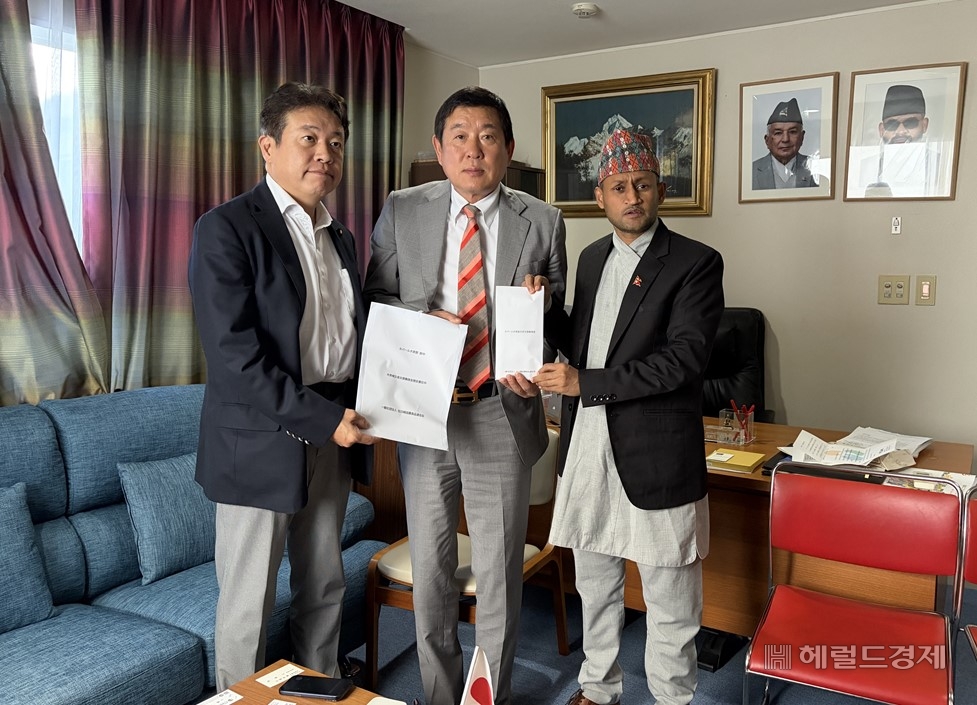
Yuk Jong-moon, chairman of the association, visited the Nepalese Embassy in Meguro-ku, Tokyo, on Thursday to deliver 1 million yen ($6,310) in flood relief donations pooled by member companies. Tsuruhо Yosuke, a member of Japan's House of Councillors from the Liberal Democratic Party, accompanied Yuk, and the funds were presented to Harihar Kant Paudel, Nepal's acting ambassador to Japan.
The initiative grew out of the bonds formed with Nepalese employees working at member companies. A significant number of those companies employ Nepalese staff in imports, retail distribution and sales of Korean food products. When disaster struck their colleagues' homeland, the member companies came together to raise the donation.
"Nepalese employees play a major role at our member companies' stores and logistics sites," Yuk said. "We could not simply stand by while the families and neighbors of our colleagues were suffering."
The association was founded on Nov. 29, 2005, as the Korean Food Products Association in Japan, before adopting its current name in 2008 and converting to a general incorporated association in 2009. It marks its 21st anniversary this November. The organization was established to ensure the safety of Korean agricultural and marine food products distributed in Japan and to build a sound distribution framework.
What began as information-sharing among member companies has grown into efforts to expand the market for Korean agricultural and food products and to promote economic exchange between South Korea and Japan. The association relays Japanese consumer needs to Korean producers and processors, and serves as a bridge connecting Korean local governments and exporters with Japanese distributors.
Last year, to mark the 60th anniversary of the normalization of South Korea-Japan diplomatic relations, the association partnered with Korean restaurants in Japan on a "K-Food Day" promotional campaign. It also participated in food fairs and export consultations while using local Korean restaurants to introduce Japanese consumers to Korean agricultural products. The association has also been active in contributing to Japanese society, taking part in earthquake relief efforts and providing scholarships to 21 students in 2023.
Yuk, who is originally from Daegu, settled in Japan in 1987 and has worked in trade and distribution. He served as the 11th chairman of the Korean Association of Tokyo and as chairman of the Japan Eastern Council of the National Unification Advisory Council. During his tenure as head of the Korean association, he focused on strengthening the organization's operations, expanding exchanges with Korean communities across Japan and encouraging greater participation from younger generations.
In a phone interview, Yuk said opportunities for women and youth to take on leading roles must be expanded. He cited women-led Korean cultural promotion activities and youth peace-and-unification workshops as priorities, and outlined plans to increase exchanges and projects across Tokyo and other areas under the association's jurisdiction.
"Alongside promoting Korean agricultural and food products in Japan, we will consistently give back to Japanese society in proportion to what we have received," he said.
ahnbc@heraldcorp.com