Card company leverages 260 million combined customer touchpoints across partners
Shifting focus from member recruitment to broad-based business collaboration
AI platform to deepen data cooperation with partner companies
Hyundai Card is expanding its private-label credit card (PLCC) business beyond card issuance and member acquisition, pivoting toward AI-driven data analysis and deeper collaboration on partners' core operations. The company calls this its "PLCC 2.0" strategy — aimed at boosting partners' actual sales and business competitiveness, not just growing their cardholder base. Hyundai Card plans to renew its entire PLCC product lineup by the first half of next year and strengthen exclusive cultural benefits for members.
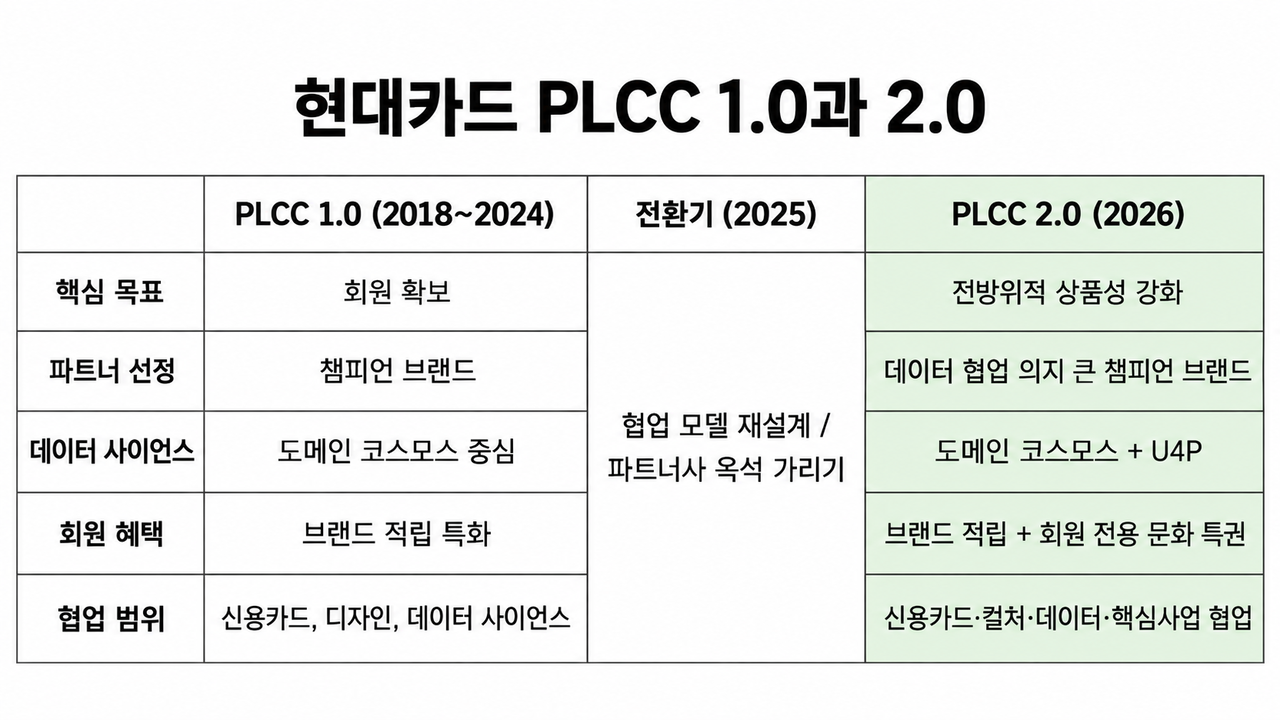
Financial industry sources say Hyundai Card has been pushing the PLCC 2.0 strategy in earnest since September. The shift moves away from PLCC 1.0 — which ran from 2018 to 2024 and focused on member acquisition and expanding card benefits — toward simultaneously broadening and deepening the scope of cooperation with partners. Last year served as a transitional period during which the company redesigned its collaboration model and reorganized its partner lineup.
A PLCC is a co-branded credit card issued by a card company in partnership with a specific firm, offering benefits tailored to that brand. Hyundai Card has led the domestic market since launching the country's first PLCC — the E-mart e-Card — with E-mart in 2015, subsequently expanding partnerships with major companies including Korean Air, Naver and Costco.
As of the end of June 2025, Hyundai Card accounted for about 78 percent of the 13.97 million PLCC cards cumulatively issued by nine domestic card companies, with 10.92 million cards of its own. As of this month, the company has 15 major partners. According to Ryu Su-jin, head of Hyundai Card's PLCC division, the PLCC business now accounts for roughly half of the company's overall business volume.
Building on that track record, Hyundai Card is shifting the center of gravity of its PLCC business — from expanding membership numbers to driving tangible business growth for its partners. "A card is just one tool," Ryu said. "What matters more than simply issuing a lot of cards is making customers use them more often and contributing to partners' sales growth."
The criteria for selecting partners have also changed. Where the previous approach focused on partnering with leading companies in each industry, PLCC 2.0 places greater weight on companies with a strong willingness to collaborate on data. The vision goes beyond card issuance and joint marketing to growing partners' core businesses together.
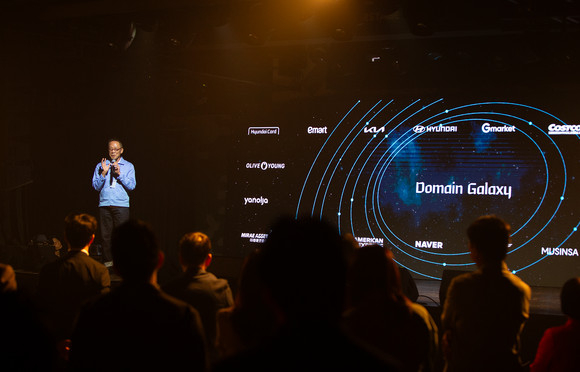
The key enabler is Hyundai Card's data analytics capability. The company has built a data alliance called "Domain Cosmos" that allows partners to conduct joint marketing without directly exchanging customer data. Combined customer touchpoints across all partner members reach about 260 million, and the company has carried out more than 5,000 data-collaboration marketing initiatives to date.
PLCC 2.0 layers AI technology on top of that foundation. Hyundai Card will deploy "Universe for Partners" (U4P), a version of its proprietary AI platform "Universe" reconfigured exclusively for partners. Previously, Hyundai Card analyzed partners' customer data and provided marketing support on their behalf; going forward, partners will be able to conduct AI-driven customer analysis, recommendations and predictions themselves.
Hyundai Card has invested more than 1 trillion won ($755 million) in data science and AI over the past decade or so, with about 500 billion won of that going toward data structuring. In 2024, it exported its proprietary AI platform to Japanese major card company SMCC in a deal worth tens of billions of won. Genesis, which launched a new card in September, is also moving to adopt U4P.
The data collaboration is extending beyond card-related business. Hyundai Card worked with E-mart to identify popular restaurants using payment data and develop them into ready-meal products, and partnered with Korean Air to introduce Starlink-based high-speed in-flight Wi-Fi service.
Consumer-facing card benefits are also being enhanced. Hyundai Card plans to renew its entire PLCC product lineup by the first half of next year, restructuring benefits so customers receive greater rewards the more frequently they use their cards and the more their spending patterns align with the card's focus. The company is also expanding its premium product range; in September it unveiled two Genesis Hyundai Card products with annual fees of 200,000 won and 800,000 won, respectively.
"The most important thing in PLCC is not the size of a one-time payment benefit but frequency of use," Ryu said. "The business model is one where the more you use it, the better the benefits — and loyal customers enjoy the privileges that come with that status."
Hyundai Card's accumulated cultural marketing capabilities will also be woven into PLCC 2.0. The company is adding exclusive cultural experiences for members on top of existing rewards — a prime example being "THE SIX," a women's tennis tournament it will co-host with Naver in December. Ticket purchase opportunities will be available only to Naver Plus membership holders and Hyundai Card members, with Naver Hyundai Card members also receiving a 10 percent discount.
Hyundai Card says it will continue combining AI technology, card products and cultural content to deepen business collaboration with partners. "We need to make customers reach for their Hyundai Card first among all the cards they carry," Ryu said.
snsd@heraldcorp.com