Only 22% of salary remains after 10 days
Workers in their 20s see sharpest drop; those in their 60s still hold 76% after a month

The familiar workplace lament that "a paycheck just passes through" has been confirmed in hard numbers. An analysis of salary account holders at NH NongHyup Bank found that only 22 percent of a monthly paycheck remains in the account 10 days after it is deposited.
According to the bank's NH Trend+ salary account analysis released Tuesday, tracking account balances from payday — set at 100 percent — showed that 57 percent remained the following day. That figure fell to 35 percent after five days and to 22 percent after 10 days. The balance continued to shrink to 16 percent at the 15-day mark, 10 percent after 20 days, 6 percent after 25 days, and just 3 percent by the end of the month.
Applied to the median monthly salary of 3.03 million won ($2,290) for workers in their 20s, that translates to roughly 1.73 million won remaining the day after payday, about 1.06 million won after five days, and about 670,000 won after 10 days.
The overall median monthly salary across all salary account holders came to 3.71 million won. By age group, workers in their 20s earned the least at 3.03 million won, followed by those in their 30s at 3.64 million won, their 40s at 4.46 million won, and their 50s at 4.69 million won. The figure dipped back to 3.08 million won for those aged 60 and older.
The pace at which balances declined after payday also varied by generation. Taking the total checking account balance on payday as 100, workers in their 20s saw it fall to 75 percent the next day, 62 percent after five days, and 57 percent after 10 days. A month after payday, only 48 percent of the payday balance remained.
By contrast, account holders aged 60 and older still held 90 percent of their balance the day after payday, 82 percent after 10 days, and 76 percent a full month later. Younger workers tend to see money leave their accounts at a noticeably faster pace after each paycheck arrives.
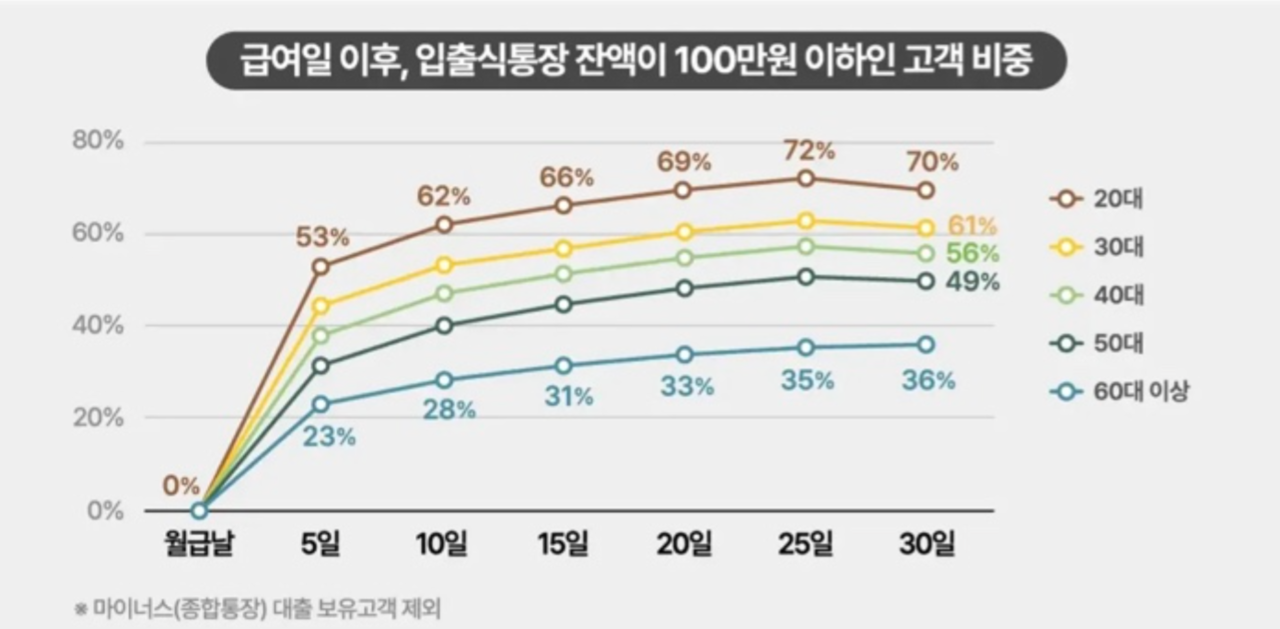
Generational differences were equally pronounced in the amounts workers typically keep in their checking accounts. The median balance stood at 750,000 won for those in their 20s, 1.18 million won for those in their 30s, 1.56 million won for those in their 40s, and 2.16 million won for those in their 50s — rising steadily with age. Workers aged 60 and older held a median of 3.56 million won, roughly 4.7 times the figure for those in their 20s.
More than half of workers in their 20s — 57.4 percent — had checking account balances below 1 million won. At the other end of the spectrum, 25.4 percent of those aged 60 and older held 10 million won or more.
Among workers in their 50s, who earn the highest salaries overall, the income gap was particularly stark. Some 30.2 percent of workers in their 50s earned 6 million won or more per month — the highest share of any age group — yet 26.3 percent earned 2 million won or less, meaning both high and low earners are heavily represented within the same generation.
Workers in their 20s were more tightly clustered: 40.3 percent earned between 2 million and 2.99 million won per month, and 35.4 percent earned between 3 million and 3.99 million won, meaning more than three-quarters of the age group fell within those two salary bands.
The 25th of each month was the most common payday, with 42.1 percent of all salary account holders receiving their wages then. The 10th came second at 13.3 percent, followed by the 21st at 13.2 percent.
Meanwhile, a separate NH Trend+ analysis of NH NongHyup Card medical payment data found that healthcare spending in 2025 rose 16.9 percent from 2023, while the number of transactions increased 6.8 percent. Hospital visits were also concentrated among older age groups, with those aged 50 and older accounting for about 68 percent of all medical use — underscoring the trend that healthcare consumption rises sharply with age.
rim@heraldcorp.com