111 pesticide residue limits secured across 19 crops
20 Taiwan grape customs violations resolved
Pesticide safe-use guidelines expanded to 86 varieties in 13 countries
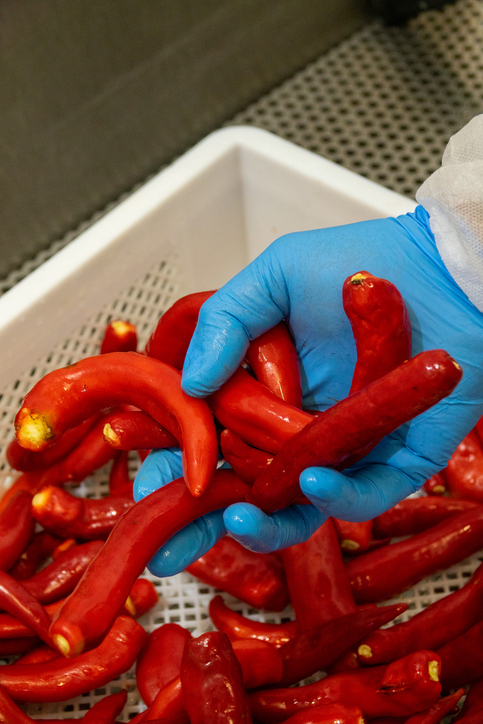
The customs clearance time for South Korean peppers exported to Japan has been cut from more than a week to one to two days, after Japan established new pesticide maximum residue limits that eased inspection requirements. Grapes shipped to Taiwan have also cleared a hurdle, with customs violations caused by a specific pesticide ingredient now eliminated. Stronger pesticide safety management tailored to each importing country's regulations is proving effective at lowering non-tariff barriers for South Korean agricultural exports.
The Rural Development Administration said Wednesday it has established 111 pesticide maximum residue limits across 19 crops in importing countries as part of a strengthened pesticide safety management system for export produce. The agency has also expanded its pesticide safe-use guidelines from 32 varieties covering 12 crops in 6 countries in 2003 to 86 varieties covering 30 crops in 13 countries this year.
Key achievements in pesticide safety management for export produce (Rural Development Administration)
Category | Previous | Improvement/Achievement Pesticide safe-use guidelines | 2003: 6 countries, 12 crops, 32 varieties | 2026: 13 countries, 30 crops, 86 varieties Pesticide residue limits in importing countries | Some items lacked country-specific standards | Standards established for 19 crops, 111 cases Customs clearance time for peppers exported to Japan | More than 1 week | 1–2 days Export volume of peppers to Japan | 694 metric tons in 2023 | 928 metric tons (up 33%) Customs violations for grapes exported to Taiwan | 20 cases from 2023 to early 2025 | No additional violations since standard established in March 2025 Value of grape shipments in violation (Taiwan) | Approx. $919,000 | No further violations involving the ingredient since standard established Pesticide safety management education | — | 17 in-person sessions, 64 online sessions AI information service | Database of approx. 36,000 pesticide-related records built | Development of conversational safe-use guidance service underway
Exporters of agricultural produce must comply with the pesticide maximum residue limits set by each importing country. Even pesticides approved for use in South Korea can result in shipments being rejected, destroyed or returned if the importing country has no established standard for them. This constitutes a form of non-tariff barrier — restricting exports through regulation rather than tariffs.
In the case of peppers exported to Japan, customs inspections were eased after residue limits were established for the pesticide ingredients tebufenpyrad and hexaconazole — in March and September 2024, respectively. Clearance times that had previously exceeded a week were cut to one to two days. Export volumes also rose 33 percent, from 694 metric tons in 2023 to 928 metric tons.
A similar improvement was seen for grapes exported to Taiwan. Customs violations involving the pesticide ingredient tetraniliprole totaled 20 cases — 4 in 2023, 14 in 2024, and 2 in January and February 2025. The volume of affected shipments reached 89,980 kilograms, with an estimated product value of approximately $919,000.
Annual customs violations for South Korean agricultural exports (Rural Development Administration)
Year | Taiwan | Japan | US | Thailand | Total 2021 | 13 | 20 | 0 | 0 | 33 2022 | 12 | 5 | 4 | 0 | 21 2023 | 13 | 2 | 2 | 0 | 17 2024 | 40 | 2 | 4 | 3 | 49 2025 | 10 | 3 | 2 | 1 | 16 Jan.–Sept. 2026 | 2 | 3 | 2 | 2 | 9
However, no additional violations have been recorded since Taiwan established a residue limit for the ingredient in March last year. The Rural Development Administration has applied a pre-registration system for grapes exported to Taiwan and holds annual pesticide safe-use training sessions for farmers and exporters each April and May.
The overall number of customs violations for exported agricultural produce has also been declining. Violations across four countries — Taiwan, Japan, the United States and Thailand — fell from 33 in 2021 to 21 in 2022 and 17 in 2023. The figure temporarily rose to 49 in 2024 before dropping to 16 last year, and stood at 9 through September this year. The agency noted that the current figure covers only nine months and cannot be directly compared with full-year totals.
The Rural Development Administration is developing pesticide safe-use guidelines in step with regulatory changes in importing countries. This year, new guidelines were drawn up for persimmons exported to China, oriental melons exported to Australia, and lettuce exported to Taiwan. When an importing country's residue limits are stricter than South Korea's, farmers are advised to adjust the number of pesticide applications or the timing of use.
For pesticides with no established residue limit in an importing country, the agency applies for new standards based on domestic test data. A total of 151 applications have been filed for 20 crops to date, of which 111 covering 19 crops have been approved. The remaining 40 are still under review. Establishing a new standard typically takes three to four years.
On-site education and consulting have also been strengthened. The Rural Development Administration has conducted 81 pesticide safety management training sessions in total — 17 in person and 64 online. It also provided root-cause analysis and recurrence-prevention consulting to 18 companies that had committed customs violations.
To make pesticide use information more accessible, the agency has distributed QR code information boards that farmers can scan with a smartphone. About 15,000 copies were distributed this year to export organizations, companies and rural development institutions.
The agency also plans to develop an AI-powered consulting service. It intends to upgrade its agricultural technology information platform, "Nongsaro," by drawing on a database of approximately 36,000 records to allow farmers to look up pesticide use information through a conversational interface. The service will be rolled out after accuracy verification and field testing.
Seong Je-hun, director of the National Institute of Agricultural Sciences under the Rural Development Administration, said pesticide safety management for export produce "is a precise undertaking that must be thoroughly prepared from the production stage." He added that the agency would "spare no effort in providing field support so that our agricultural products can reliably break through non-tariff barriers in global markets and raise the profile of K-agricultural produce."
adastra@heraldcorp.com