Analysis of Jinhaksa score-disclosure service users
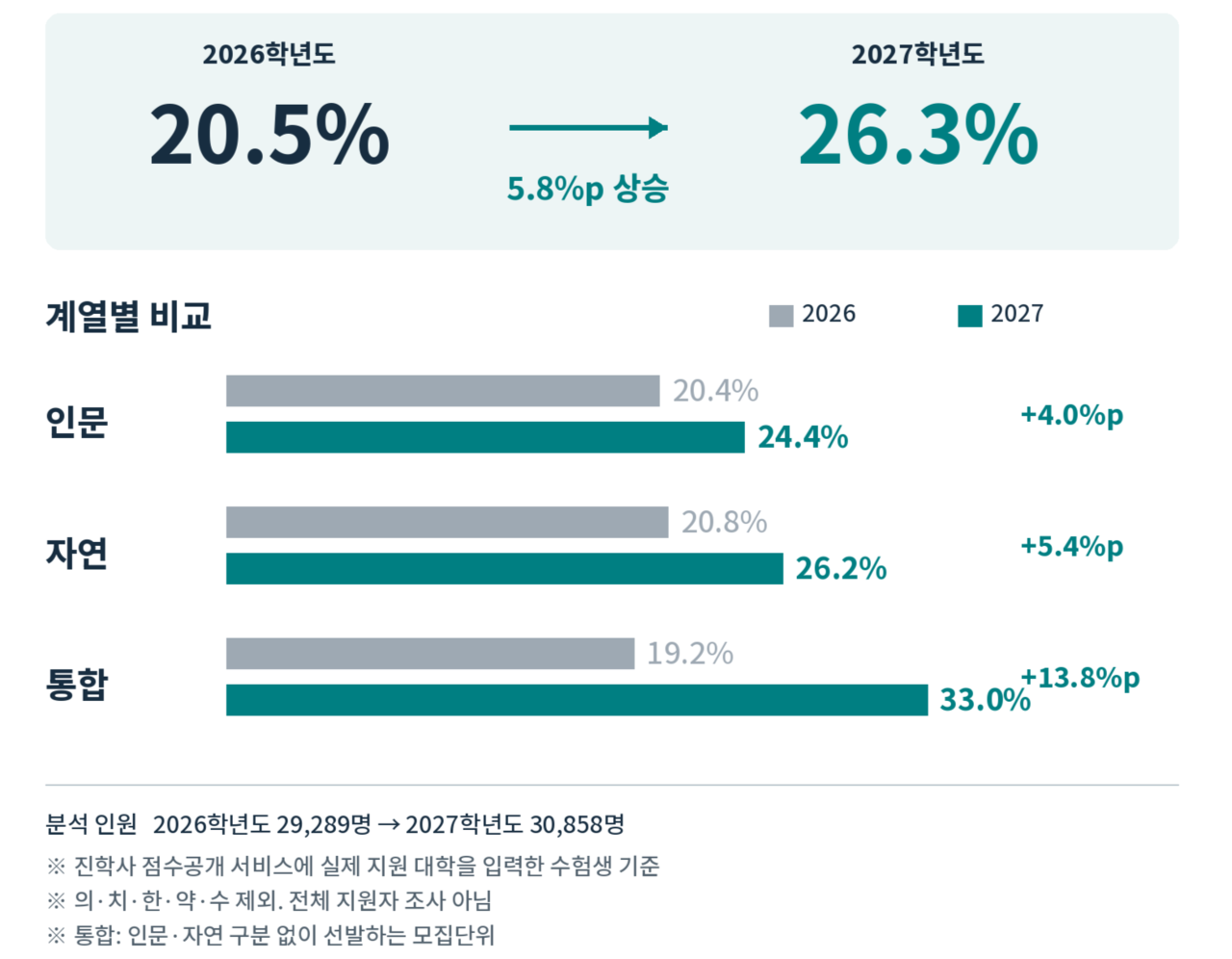
Share of top-grade applicants rises from 20.5% to 26.3%
Eight of nine universities see higher scores in both humanities and sciences
Tuition burden and employment outlook among factors cited

Students applying to regional hub national universities through the school record-based admissions track for the 2027 academic year posted stronger high school grades than those who applied last year, according to new data. Analysts say applicants are increasingly turning to regional hub national universities as they weigh tuition costs, living expenses and employment prospects.
An analysis released Wednesday by college admissions consultancy Jinhaksa found that the share of applicants with first- or second-grade high school transcripts among those applying to nine regional hub national universities through the school record-based track rose 5.8 percentage points — from 20.5 percent last year to 26.3 percent this year.
The analysis covered students who entered their actual university choices into Jinhaksa's score-disclosure service. The sample included 29,289 students for the 2026 academic year and 30,858 for 2027. Applicants to medical, dental, traditional Korean medicine, pharmacy and veterinary programs were excluded.
The increase in top-grade applicants was sharpest in integrated-track programs that admit students regardless of academic stream. The share of first- and second-grade applicants in the integrated track rose from 19.2 percent last year to 33.0 percent this year, a gain of 13.8 percentage points. The humanities track rose from 20.4 percent to 24.4 percent, and the sciences track from 20.8 percent to 26.2 percent.
Average high school grades also improved. Based on the combined average of Korean, English, mathematics, social studies and science scores, humanities applicants improved from grade 3.78 last year to 3.61 this year. Sciences applicants moved from 3.83 to 3.68, and integrated-track applicants from 3.88 to 3.55. In the Korean grading system, a lower number indicates a higher academic standing.
Breaking down the results by institution, average scores rose in both the humanities and sciences tracks at eight of the nine universities, with Jeju National University as the sole exception. Pusan National University recorded the largest gains in both streams — up 0.29 grade points in humanities and 0.28 in sciences. Jeju National University saw humanities scores improve by 0.05 grade points, while sciences scores slipped 0.04.
All seven universities for which integrated-track comparisons were available posted higher average scores, with Chonnam National University recording the largest gain at 0.78 grade points. Universities and tracks with fewer than 100 applicants in the sample were excluded from the comparison.
Jinhaksa said the cost of attending university and employment prospects may have influenced applicants' decisions. Government efforts to strengthen regional universities, tuition support policies and expectations surrounding the administration's "10 Seoul National Universities" initiative — which aims to elevate regional institutions to a comparable standard — were also cited as contributing factors.
In a separate survey conducted earlier, 41.8 percent of applicants to regional national universities said tuition support policy had influenced their choice of university.
When asked in a multiple-choice question why they applied, 60.5 percent cited their likelihood of admission. Relief from tuition and living costs came second at 49.6 percent, followed by favorable employment and career prospects at 34.9 percent. Some 19.2 percent cited expectations for the "10 Seoul National Universities" policy.
However, whether the rise in applicant grades will translate into higher final cutoff scores remains to be seen. Some students may fail to meet the College Scholastic Ability Test minimum score requirements, while others may withdraw after gaining admission to a different university.
"The simultaneous rise in average high school grades and the share of top-grade applicants in the school record-based track at regional hub national universities is a meaningful shift," said Woo Yeon-cheol, head of the admissions strategy research institute at Jinhaksa. "However, actual cutoff scores may vary depending on how many applicants meet the CSAT minimums and the outcome of the waitlist process."
brunch@heraldcorp.com